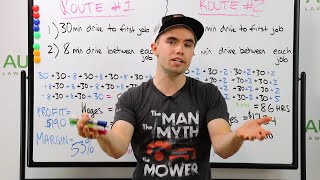
Mike Andes (founder of Augusta Lawn Care) explains why route density is critical for mowing/lawn-care businesses and demonstrates, with two worked numeric examples, how reducing drive time between jobs increases the number of daily jobs, revenue, gross profit, and margin. He assumes 30 minutes per cut and a $60/hour charge ($30 per cut) with a $20/hour employee wage. Route 1 (sparser): 30 min to first job, 8 min between jobs → 12 jobs, $360 revenue, ~$169.20 wages, ~$190 profit (≈53% margin). Route 2 (denser): 5 min to first job, 2 min between jobs → 16 jobs, $480 revenue, $173.40 wages, ~$306.60 profit (≈64% margin). He recommends relocating the shop, marketing to neighbors, or raising prices (example: $35 per cut) to address low route density.
Questions this video answers
Mike Andes, founder of Augusta Lawn Care.
30 minutes per job.
$60 per hour (i.e., $30 per cut).
$20 per hour.
30 minutes to first job, 8 minutes between jobs → 12 jobs per day.
Chapters
Hey everyone. Today I'm going to be talking about and showing the math behind why route density is the most important thing in your lawn care and mowing business. I'm Mike Andes, I'm the founder of Augusta Lawn Care. We have over 50 locations around North America and today I'm sharing the most important number. If you do mowing of lawns or any sort of routinized work so you have a route, you will go from place to place. And in my opinion it's route density that is I don't have to go drive 30, 40 minutes to the houses. And furthermore, the houses that I do mow, the properties do mo are closer together. So I'm going to show you today in a very simplistic manner because we talk about it all the time. You probably hear a lot of other people talk about how important it is to have your truck park one time and do three or four lawns, or do a whole bunch of the same houses in the same neighborhood, all really, really close together and getting a lot more profit that way. Today I'm going to show you the numbers behind that to just show you how small differences in your route density make a massive impact on the business and in your profit. Alright, so what we're going to do is we're going to have two different routes. Route number one, route number two, route number one, we're going to have a 30 minute drive time to the first job. So it takes us 30 minutes to drive to a nearby city and start doing work. We're going to have eight minutes drive between each job and then obviously at the end of the day we're going to also have to drive back 30 minutes. Okay, so the town nearby, 30 minutes away, maybe it's 15, 20 miles. You drive over there and you do your lawn. They're all a little bit spread out, eight minutes of a drive in between. You could also say this is just getting in and out of the truck if you're talking about efficiencies. But more importantly, we're talking about drive time. So these ones are pretty a little bit spaced apart. The second route over here though, we are really close. All of these jobs are close to where we park the trucks at night and we get started in the morning with our truck. So five minutes drive to the first job and then only two minutes drive between each job. And this is of course an average. But today I'm gonna show you the numbers behind what this really does to your business. So route number one, we got 30 minute drive. That's the blue here, 30 minutes is on the job. Okay. And what we're going to assume on both examples is that we're gonna have 30 minutes per job. So the average lawn's gonna take 30 minutes. And we're gonna also assume that we are charging the customer our rate for mowing. Our target rate for mowing is $60 per hour. So we're keeping the math simple here. And don't get wrapped up too much in the numbers. I'm trying to make a point here. You could move these around as much as you wanted and number would go the more impact this would make on your bottom line. But I want to keep the numbers simple and within reason and pretty conservative, actually, in my mind. So the job's going to take an average. Every single job is going to take 30 minutes, and we're going to charge the customer $60 per man hour. So basically $30 per cut. Again, I know that's a low number, but if you move these numbers higher, it's going to only magnify the impact that I'm going to show today. I want to be a little more conservative by showing it today with these numbers. Okay, so route number one, we drive out to the first property, it takes us 30 minutes. We do the first lawn, that takes another 30 minutes. Then we drive for eight minutes, and then literally do all of these jobs. And in all, we're going to work eight and a half hours for the day. You can do the math. You can check me on this. I rounded slightly, but 8.5 hours for the day. And we're going to get a completed total number of jobs is 12. So if you count these out, 1, 2, 3, 4, 5, there's going to be 12 of these jobs. And let's break down the numbers. If this employee we have paid them $20 per hour. So same employee here making 20 bucks an hour, eight and a half hours. Without the rounding, I'm going to have $169, approximately $170 for wages. The revenue that I'm going to make on this route is going to be 12 times 30, because I have 12 jobs, $30 per job. So the total revenue for this day was $360. So let's determine really quickly what the profit was on this job on or the gross profit, I should say, because we're taking revenue minus the wages. So we have $360 in total revenue on the day. We're gonna take out now the wages of $169.20. So the total profit on this day was $190. So let's put it here. $190. Fantastic. $190.8, that was a profit. So I did this mode for the whole day. And at the end of the day, I had $360 in revenue. $190 of that was profit because I had $20 per hour in wages and I worked eight and a half hours or my employee, however you want to say it. Now, if we take 190.8 and we divide it by our total revenue. So divide it by our revenue is360. That's going to mean that we had a 53% gross margin. 53% gross margin. Okay, so there's the numbers for route number one. Now we switch over to route number two. We have five minutes to the first job, and now only two minutes in between each job because again, we're making sure that we park our truck or that our shop or our house is centralized to where our properties are at and where they're located. Now, same exact employee, same exact efficiency. Everything is exactly the same. But because of our drive time being less at the beginning and end of our day and a few minutes shaved off in between each job because a much more centralized area and our route is much more centralized, we know get 16 jobs done instead of the 12. Now, we work approximately the same amount of time. If we add all these up at 8.6 hours, our wages again at $20 per hour are going to be $173.40. Our revenue, though, is going to be $480. Okay, so let's do the math. We actually get $306.60 in profit on this day and a margin of 64%. Now, when we compare this against route number one, we made over over $115 more in profit doing absolutely the same exact thing. In fact, our profit margin, the margin down here is actually significantly, like, even though it's okay, what, 11, 11% greater here in route number two. The bottom line is the fact is I had to drive probably twice as many miles in this route. So my wear and tear on my truck is more. There's a whole lot more waste involved here. Whereas on this side, I look, I literally made $115 more simply by making sure I had a tight route. So we hear about route density or have a tight route. All of this is to do one thing, and it's make more money. So if you have jobs that are like 10, 15, 20 miles away from you taking 30, 40 minutes just to Drive to your first job and then when you get there, they're all spread out and you got to go into gated communities and you got to drive slow to the back road and you do one property there and you go way over here to another property. There's a reason why with Augusta Lawn Care, our territory sizes are just five mile radius. We want to have a tight route. We want to only have a minute, two minutes between jobs. And this is why your first year, you might not be as profitable. Get started is because you're not going to have the route density. You're going to get a job here and a job here, and you get started, you get cut a job here. But as time goes on, you start to fill in all of the gaps in between your jobs and your route density gets better and better. Your drive time between jobs gets less and less and that's what drives your profits. So what can you do if you have this issue? First and foremost, you might want to move where your shop is. That's the first option. Move your shop. Either your home address or you have a storage facility to get closer to your jobs. That's going to help reduce that 30 minutes at the beginning, 30 minutes at the end of the day. Then start asking yourself, can I do five rounds? Can I get the door hangers on the doorknobs of all of the neighbors of my existing customers so I don't have to drive eight minutes? I can keep my truck in the same exact spot and do two houses right next to each other. So again, increasing route density is like literally, can I stop my truck and do two jobs that is erase one of these? Can I do that anyhow by making.
The neighbors of my customers sign up for my service? Another thing you can do is raise your prices because you might be in an area where you're like, look, I have to drive. It's a very rural area. I'm going to have lots of drive time between my properties. You're going to need to raise your prices. Because if I take all of these jobs and I raised all of these to $35, the math would actually start to equate. They actually start to make the same amount of money. If I made $35 per cut instead of just the 30 so you get your shop closer to reduce the deuce drive time. You've got to advertise the neighbors of your existing customers to improve route density or you need to raise your prices to make sure the math makes sense. Because you cannot afford. You cannot afford to be literally spending. What is it, 60 plus percent of your revenue simply on wages, or almost half? Almost half of your wages, 47% is just spent on wages because you have an inefficient route and you're never gonna make money. You'll never scale your business. You'll never really create more jobs and hire more people. And at the end of the day, you will drive yourself crazy because you'll work harder and harder and harder, and you'll get more and more jobs and you won't make any more money. And you will absolutely get stressed. I hope that was helpful, and I hope it gives some math around why route density is so important. And if at the very least, you thought you didn't get anything out of this math equation, maybe you think this shirt is great. And if that's the case, you should go to lawncaremedia.com and check it out.