By FAR, The Smartest Way to Beat Social Media Algorithms (If You’re an Entrepreneur)
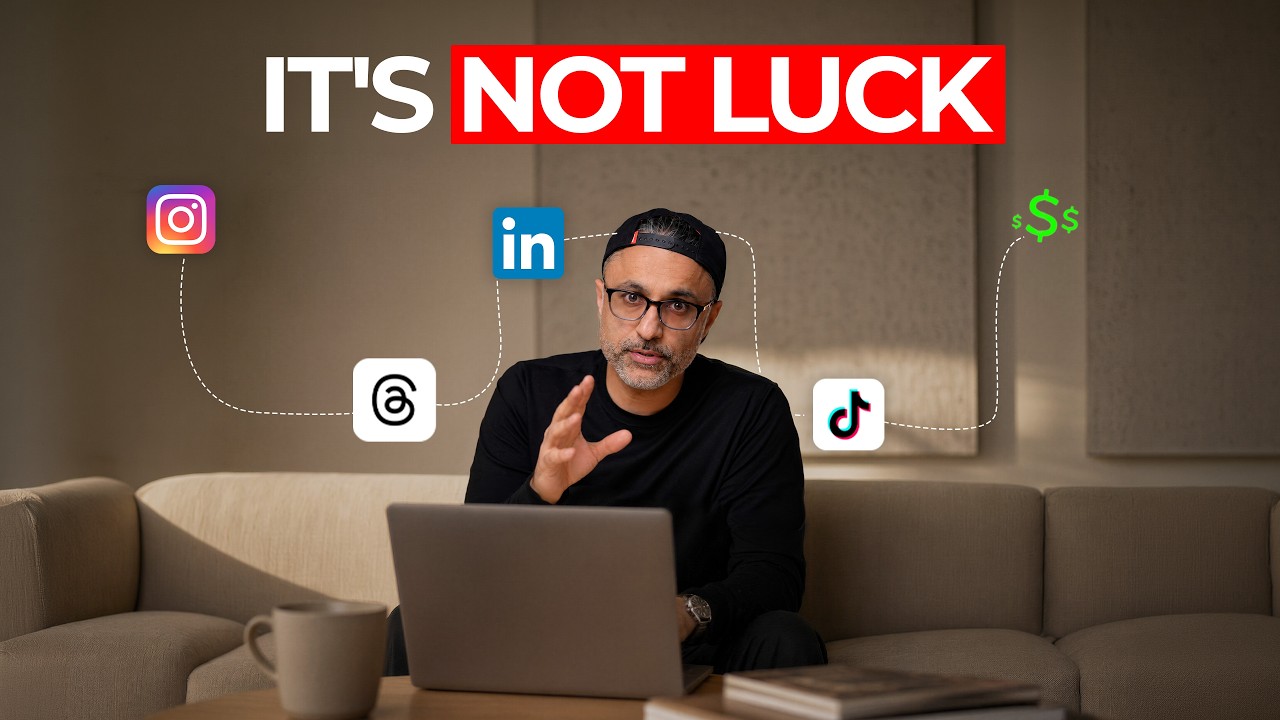
Neel Dhingra argues entrepreneurs waste time chasing viral reach when they should build trust instead. A post with 500,000 views made zero sales, while a 6,000-view post generated client inquiries. His framework: use content to attract attention, nurture relationships, then convert them into paying customers.
Chapters
So if you're an entrepreneur using content to grow your business, but you're not trying to be a full-time influencer, this video's for you. You're probably posting, doing what all the gurus tell you to do, and it's just not turning into actual business. The views aren't becoming clients. See, there are two games being played on social media right now, the influencer game and the entrepreneur game, and you are playing the wrong game. The algorithm is quietly rewarding you for winning the one you actually don't even want to win. Getting out of this comes down to three shifts. Look, I spent the last 5 years using content to build two businesses past multiple seven figures in net income without ever chasing influencer numbers. I've taught thousands of entrepreneurs how to do the same thing, and I've shared stages with some of the biggest names in business and content. I've even collaborated with Alex Hormozi at my own event, and I've watched how these people who are actually winning at this game play completely different than everybody else. So make these 3 shifts and you will start winning the game that actually builds a business. The one that doesn't just get you followers, it gets you paid. Now, the first shift is about the scoreboard you're using. In the influencers game, the scoreboard is reach, followers, views, likes, but in the entrepreneurs game, The scoreboard is trust. And here's the thing that almost nobody tells you. The two scoreboards don't move together. You can win one and completely lose the other. I remember back in 2022 when I hit my first 100,000 followers on Instagram, I was thinking, wow, this is it. This is going to change everything. And yes, some things did happen. My DMs went up, leads went up. I had some more connections. That part was real. And even some of my friends were telling me, look, if a fraction of my audience buys from me, I'm going to be set for life. But the math didn't really work like that. See, I was thinking like an influencer. I thought that a certain number of followers and reach would convert to a set number of buyers, but there was no flat percentage. There's no universal conversion rate on an audience. It's gonna depend on how long you've been creating videos, whether your content actually connects with people, if they actually trust you, whether you've shown them enough proof. 100,000 followers who don't trust you isn't worth anything. I would rather have 1,000 followers who actually trust me and connect with me. And so this is the first shift. You stop chasing reach as a scoreboard and you start measuring trust because you can't deposit your views and likes at the bank. And so here's the new question that replaces how many views did I get? You wanna ask yourself, did my content make the right people trust me more? That is the only number that actually turns this into business. Now, the second shift is what you've actually been optimizing for. This is the one that I see almost everybody get wrong, including honestly me sometimes. I'll be straight with you about this in a minute. In the influencers game, the goal is to go viral, to shoot as wide as possible, reach as many people as you can. But in the entrepreneurs game, the goal is to be valuable, and valuable means something specific. This means that the content does a clear job for your business. It either helps you build your brand or books you clients, meaning your content is going to do a clear job for your business. It's either going to build your brand or book you clients, and you're going to know which one it's doing. I was making the mistake that viral and valuable meant the same thing, but it's the case. Let me show you what I mean. I'm going to walk you through this with my own content. A few months ago, I posted a video that was just relaying the news to the audience. It was considered commodity content because you could have just gone to Google and got the information. Now, I did it my own way and I delivered the message properly with a good hook. And so it did half a million views. But what I realized was I didn't get anything from this. Like, I got a bunch of comments, people, people talking, a few people sharing the video, but it didn't lead to any valuable connections or business opportunity. Now, let me compare this to another video that I posted right around the same time, and it ended up getting 6,000 views. So basically 1/100th of the reach of of the half a million view video. Now directly in the comments of that lower view video, there's actually people asking to do business with me. They're asking for the lead magnet that was offered in there. There's DMs and conversations happening directly because of that video. So this is real business coming from a video that a fraction of my audience saw. And so here's what I finally understood. All of your content isn't doing the same job. Some of this content is used to build your brand and build your credibility at scale, but then some of the content's job is to actually convert the audience into clients. Start conversations, get people to opt in for a lead magnet, and this can turn into business. So that tax video was top of funnel reach content, but the 6,000 view post was trust content. Now both of these are fine, but you have to know which one you're making and why you're posting it. Now here's the part that's gonna sound like a contradiction because you're seeing me say you don't need to go viral. There's different types of content, but then I actually do try to go viral with certain types of content, and I do this every single month on Instagram. The difference is on those specific posts, I'm trying to go viral with perspective content, not commodity content. I actually talked about this in the previous video that I just posted. See, I've had several posts go viral on Instagram, but these were me sharing my unique point of view. Sometimes it's something that differs from what everybody in my industry says, and as a result, some of those posts end up taking off. And sometimes you can make those posts go viral, but they don't really mean anything to the audience. And so it is true that successful creators right now are doing two types of content. They are making content that converts, but then they're also making content that's top of the funnel, meant to bring in more followers and create trust with the audience. Just make sure that you're not doing the same old generic ChatGPT style content and you're trying to do perspective content. And you'll notice that sometimes you might accidentally go viral, and this is good for your overall brand because it's going to create connection and trust with the audience. This actually helps me when I make a conversion piece because more people are already aware of me and they trust me to move forward. And when you look at commodity content, which is the stuff that's the tips, tricks, and hacks, I actually have members in my community who have built their whole audience on this. They got into the drug of like, I posted this type of thing and it went viral. I did a listicle and I got it to take off. I used the text over B-roll with trending audio, and it had all these items that's valuable information, but the people valued the info and not the person. And so what happened with a few of these members is they built 100,000 followers or more, but then when they do a conversion piece, they barely get any results. And so the problem with this is it puts them in a box of the only type of content that works for them is when they make this generic stuff. And so they make more of it, which leads to more of the wrong audience. And remember, being unmistakably you, that's called signature content or perspective content. I talked about this in the last video, and that's what earns you attention in the first place. But this video right now is what you actually do with that attention so it can turn into business and get you paid. Now, one quick thing before we make the third shift. If you're getting value out of this video, I want to tell you about this email that I send out every single week. It's called Forward Focus. Over 30,000 entrepreneurs get this. It's one idea straight to your inbox, no fluff, and it takes you about 60 to 90 seconds to read. There's a link in the description if you want to get it, and I'll send you this week's issue. Now let's get into the third shift, which is one that changes everything in the influencers game. The whole game is content. Make enough good content and you win. And that's actually true if the prize you want is views and attention. But if the prize you want is actually clients and business, then that type of content is only one-third of the real system. The entrepreneurs who win are running two more stages that the influencers skip completely. I call this the three C's: content, connection, conversion. Content gives you the attention, connection builds the relationship with the audience, and conversion turns it into business. Influencers stop at the first C, but the entrepreneurs who are winning are running all three. And I want to show you what the other two actually look like, because this is where all the business you've been missing is actually coming from. So after content comes connection, and I came across this by accident initially. I was looking through all my DMs and I want you to do the same thing. Look at the DMs where somebody started a transaction with you. They asked you something for a lead magnet or a question that led to them booking a call, whatever that conversion piece is for you. And then when I see these messages in the DMs, if you scroll up, I see all these other pieces of reactions and different engagement along the way. So I'll give you my example. There would be people reacting to different stories that I posted, maybe sending a quick DM or two back and forth. Now, what is that content that people were connecting with me on before they got to the conversion piece? Most of it is non-business content. It might be certain things that I want to share about personal values, things I was doing in my personal life, lifestyle, things like this. So this taught me that the connection piece is extremely valuable when you get to conversions because it allows the audience to build trust with you over time. Most people are not yet ready to start a transaction or do business with you, but in the meantime, you can't just keep selling to them. So the glue that keeps them engaged is going to be the other type of content you post in between. For me, I post personal content and I also share my isms. These are my values on business. Personal life, family. And so these are the things that people connect with. And I have conversations with them throughout the year. And then some of these people turn into clients. So once I saw that the conversion piece almost never came cold, I noticed a bridge. This is the bridge between somebody watching your videos and actually trusting you and reaching out. That is the connection piece that people are missing. And I think this is the part that most influencers skip because it doesn't scale. You have to actually be interested in building a community in order to respond to messages. Now, I'm not saying I spend a ton of time on this, but I do block almost an hour every day to just respond to people, react to different things, and build those connections intentionally. Because I'm not just building a community, I'm building a network. And some of these network connections have led to amazing opportunities in my business. Now let's move on to conversion, and I'll tell you about a story that broke my belief on this whole process. Last year, I was invited to speak at an event, and these are people who had actually been in my audience. I noticed when I got there that there were a lot of people who were like, hey, I've been watching your videos. And I was having conversations with people before I even hit the stage. Then I gave my presentation and in this case it led to an offer to do business with me. There was a workshop and this was not cheap. This was going to be kind of a higher ticket, mid-ticket price point. And so normally in this case, I would have some sort of sales team there. Like I would be like, okay, if you're interested in this, go see my team and we could talk about working together. But in this case, I had traveled to this event in Dallas and I was by myself. There was no sales team with me. So I decided to do something different because honestly, I had no choice at the time. I just put up a QR code and told people they could scan this and pay right there to sign up for the workshop. Now, this application was for my Forward business, but this applies to any business. It's just going to be a different conversion step. So I did my whole presentation. I had all the proof in there, and it led to the conversion piece. I gave them a clear next step and put up this QR code, and I was thinking maybe a few people are going to sign up. My expectations were low because, like I said, I didn't have a sales team with me to book the calls or start the process and help me with conversion. So when I got off stage, I looked at the results, I checked my email, and it was shocking because I had filled 2 entire workshops. No sales team, no table, no follow-up calls. Just me, a talk, then a QR code. People scanned it and paid right there. Now, the reason this worked was not my reach. It wasn't because I had the biggest audience in the room. There were bigger influencers on that stage earlier in the day and after me. The reason it worked was because of trust. Trust had been built before I even hit the stage. And then when I was on there, I added to that trust with my presentation. And then I gave people a clear next step. So this is conversion. This is the third C, and it happened with nothing but my personal brand and a clear ask. That event was bottom of the funnel for me because many of the people in the audience were already aware of me. They've been watching my content. Some of them were even on my email list. And so when I gave that talk with proof in it and then I led to a clear next step, they were able to scan a QR code and pay right there from their seat. But in other cases where they're not at the bottom of the funnel, I might offer them a lead magnet. I might offer them to join an email list. And so it's important to know that you can't just go straight for the close like I did there. There's a process to doing this, and this is where you're going to offer these conversion steps online. I think of these as micro-conversions. Like, what's a micro-conversion you could post about today on Instagram? Not going to be for someone to buy your product or service or start the process of working with you. It's going to be for them to sign up for something you offer. This is an easy way to get them down the line of eventually working with you. The whole game changed for me when I stopped selling my product or service and started selling that next step instead. And so when you do this often, there's going to be enough people in the middle with you that when you do offer a bottom of the funnel opportunity, way more people take advantage of this. I've noticed people in our community will complain about, hey, I put out a lead magnet, I put out a clear next step, and not enough people took advantage of it. I was disappointed. Now, one problem could be that that clear next step wasn't valuable enough for the people that were watching. But the bigger problem is more likely you haven't been posting enough content that builds trust and builds connection with people before you made an ask. If you've been making good content and actually doing the connection piece, when you offer something, way more people are going to give you the benefit of the doubt and start the process with you. This is why the 3 C's are so important, because they all work together. Now, that QR code workshop thing was not a one-off. I'll give you another example. Every year I sell out an event called Forward. We sell it through a webinar, live online. Now, this year I sold it out in one single webinar. Normally it takes me 2 to 3 months to do this, and I ended up selling it out in a day. Now, this wasn't because I was viral content creator. It's because the people on that call, there was enough of them who trusted me. They trusted me because they hadn't seen me for the first time that day. They've been watching my content. I looked this up. Many of the people were on my email list before they even joined that webinar. And because of that, when I presented them with an offer, they trusted me that I was going to deliver on the promise, and they ended up taking advantage of it. So my reach got people to sign up for the thing, but trust is what got them to actually purchase. And so that's the system: content, connection, conversion. The influencer runs the first one and wonders why their business never comes, but the entrepreneur, the smart entrepreneur, runs all three. That is the whole game. Now, for those of you who are still watching, there's a decent chance that you've been feeling something this entire video that you never really talk out. Okay? And it's the feeling that everybody else has something figured out that you don't, or this feeling that you're constantly behind. I still deal with this today. I feel overwhelmed and behind when I look at all the people doing all these things online, and I can't help but feel behind. The thing that's actually happening here is you're not behind. You're keeping score on the wrong scoreboard. You've been measuring yourself against influencers, people who are going viral on purpose, people playing a completely different game with different rules and different prizes. They might be looking for brand deals and you're looking for clients. And then you feel like you're a failure because you're not getting the same amount of views as them. But you were never supposed to be playing that game. Your numbers are not supposed to look like these people. The moment you stop measuring your business by the influencer scoreboard, that feeling, the one that says you're not good enough at this, it's all just going to go away because you are not bad at content, especially if you're doing this consistently. You've just been judging yourself by a scoreboard that was never yours to begin with. Once you dial in your messaging and your goals, I would just put like tunnel vision on and stop looking and comparing yourself to all these different creators online. So those are the 3 shifts. Number 1, from reach to trust. You're going to chase the scoreboard that actually pays you. Number 2 is viral to valuable. Know what every single piece of content is for and what its purpose is. And then number 3 is the full content system. You need to run all 3 C's, not just the first one. This is how you stop playing the influencer game and start playing the entrepreneur's game. That is a game that you can actually win. And so that's the goal I want for you guys. It's not always to become an influencer or try and go viral. Yes, you're going to have videos go viral by accident. Yes, you could become an accidental influencer, but your goal should be to build trust with the most amount of people online, and this is what actually is going to lead to business opportunities. This also takes you off of the hamster wheel of constantly relying on your reach numbers. You're trying to build your business with a strong personal brand attached to it. You're not building a personal brand with the hope of one day having a business. It's the other way around. That is the game that is worth playing and that you can stick with for years. In the next video in this whole series, I'm going to walk you through the exact system that I use to make content that all of this. This is going to be the one framework that I'd want you to have if you only watched a single video on my entire YouTube channel. And in the meantime, if you want to learn more about the signature content or perspective content that I'm using to go viral right now, you can check out this video that we just recently posted. I'll see you guys on the next video.
More from Neel





Don’t let people tell you what you can and can’t do. #personalbranding #podcast #entrepreneur

How to use Ai the right way for scripting. #personalbranding #entrepreneur #ai




Your audience already has a story about why it won’t work. #personalbranding #entrepreneur

The new YouTube strategy to hook viewers. #personalbranding #entrepreneur #podcast