How to Grow a Personal Brand Effortlessly (Genius AI Strategy)
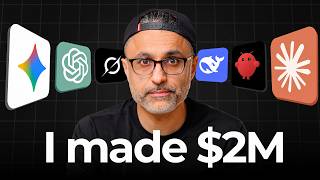
Neel Dhingra and Omar El-Takrori show how to use AI tools like ChatGPT, Claude, and NotebookLM to build income-producing assets: frameworks, newsletters, video clips, and AI clones of yourself. They cover prompting tactics, content repurposing, and using AI as a lever to amplify expertise rather than replace it.
Chapters
Have you ever wondered how all these people are actually using AI to make more money in their business? Whether you're using AI to create content, make better offers, or just strategize in your business, there's a right way and a wrong way. The way I used AI made me an extra $2 million in my business last year, and today I'm gonna give you the exact prompts, strategy, and tools behind all of it.
The reason why you'll be able to make money is because you're using AI to help you create assets. Assets can be exchanged for money.
So let's just jump right into it. How are successful people using AI to make more money? They're using it to create assets. So they're not just getting answers from AI, they're creating assets that can produce income for them and leverage their brand and just amplify everything they're doing in business. And so in today's video, we're going to get through the tools, the AI stack that I'm using, which is going to leverage your time, and I'll show you how to use each one. We're also going to go through prompting strategy and then also the different models and what you should use each one for. And then most importantly, we're going to talk about how to build your AI clone. Which might be the highest leverage thing you do this year. For today's conversation, I brought my good friend Omar El-Takrori on the show. Thank you, bro. So I'm feeling it right now that smart people, people are using this correctly, are getting this huge advantage. They're putting out better stuff, they're amplifying their brand, and they're able to do just way more than they ever could in the past with smaller team, with smaller team. But then the people who don't use it are honestly getting dumber.
Yeah.
So it used to be like people would say AI is closing this gap and it's going to make level the playing field. I feel like the gap is getting bigger. Yeah, between winners and losers.
It's wild. And the reason why I'm on this podcast is because I want to represent the listeners or the viewers who feel like the overwhelm, because I feel a little overwhelmed. And I also am like unsure how to effectively use it. I tell my team to do it, but yeah, the story just came out the other day that the CEO of Square just let go of 40% of his force for 4,000 layoffs.
Jack Dorsey, he laid off 40% of his staff.
And the business is doing amazing.
Yes.
Which is maybe like the first time in history where business is doing amazing is making layoffs, which is something—
Yeah, this is crazy. And so I have this roadmap and we'll put this up on the screen. It's my AI stack for personal brand domination, bro. And so we're going to get into the tools, how to use them correctly, and then hopefully you don't have to lay off 40% of your team after watching this. But you know, sorry, guys. Yeah, sorry. Sorry, team. But no, we— I think there is a right way to do it. And honestly, if you are ever worried, is AI going to take my job? Is it going to replace me? The best way to avoid that is to just replace yourself, to start using AI to increase your output, become an expert on certain tools. And then when you do that, you become irreplaceable. Yeah, I'll tell you right now, the most sought-after people are people who can use these AI tools. Like, we're always looking for people. Hey, could you set up a cloud? Thing? Could you do this? Could you do that? And it's a very small group of elite people who can do this.
Very underrated opportunity to be the AI expert in your circle of friends, in your, in your industry or in your group. Like if you're the person that's just leading the hedge in that, which is just the beginner basic stuff.
But and so this is the biggest shift that people need to make before we get into anything. People think that AI will do the work for you and at a certain level it can once you get into the, to the weeds with this stuff. But it's actually the better use case for a beginner is just to amplify what you already bring to the table. So you have something that's mediocre. Let's use AI to make it amazing, right? Let's use it to make your strategy even better, to see the missing pieces in what you're doing rather than coming to the table with nothing and then asking AI to do the work for you. And then it puts out slop. And so that's the stuff that I think you're seeing a lot of people put out. It's AI-generated slop. What you want is AI-elevated content. Like I wrote something, I made it 10 times better, but it started with some ideas in this, in here, you know, and you can tell the difference immediately. Have you noticed this when you watch people's stuff? Like, oh, this is written by—
Yeah, I mean, like the generic— that's why talking head video is kind of becoming commoditized because simple 3 tips, 3 hacks, like, or just give me 3 things that people are struggling with in this thing and this thing. And instead of AI giving me You tell AI, hey, I'm going to give you something and I'm going to need you to do this. So yeah.
And then the other thing I'm going to share with you guys today is how to use both Omar and myself have used AI to create a clone of ourselves. Okay. So we're going to get into that as well. But I think most people are starting with ChatGPT. That's the beginner's model. And I would tell people that there's so much more than ChatGPT. I think that's just like novice level. It's not the destination with AI tools. It's just where you start. And then most people never leave it. So we're going to get into other tools as well. So what do you think right now in terms of when you're seeing people making offers, structuring events, doing these things like big picture decisions? Are you using AI to process those decisions? Because that's where we're going to start with, like just thinking better as an entrepreneur.
Oh, I mean, 100%. I, Last year I actually used AI to help me unpack my frustrations in my business with my team.
Dang. So like, put together a meeting and it's my fault.
I'm frustrated because there's something I'm missing. And so that's one way I've been able to do it. I've told it it's a business strategist, you know, that specializes in small teams. And as a CEO and here's all that I do, here's what we do. And it was just really, it was really good. It helped me see things and even showed some things I'm not seeing. That's on a relational level. On a content level, did like we use it to edit our podcast. We literally, it auto switches. We don't have a human switch. We have a push a button and it switches our podcast 4K in a minute that and for a 90-minute episode. And then when we release the podcast, we're optimizing for YouTube titles and packaging the description. My coach calls, we send out, you know, uh, overviews, summaries, like, so it really is the timestamps, everything. Yeah, we are using AI to not just save our time, we're using AI to help people save their time.
5 years from now, everyone's going to look back and say, man, I wish I locked in in 2026. It would be like not buying prime real estate 10 years ago. This is exactly why I'm hosting a live virtual event called Escape the Middle. So there's no cost for any of my subscribers, and I'm going to walk you through the 2026 power curve, how to stand out in the sea of sameness, and how to build a personal brand that brings you business while you sleep. There's no fluff, no theory, just a solid game plan. I'm also bringing some special guests, and we're going to be doing a crazy announcement for the 2026 Forward event. There's a link in the description where you can quickly register or scan the QR code that's on this screen. Hope to see you there. And now let's get back to the video. Video. We're going to go through the tools and then we'll go through how to prompt better. So ChatGPT, I'm still using ChatGPT Pro for business decisions, analyzing large groups of data, you know, mapping, offer structuring things. For example, if I have a big picture decision in my business, I will use ChatGPT Pro. And I think you have to pay a little bit more for this, but it will actually turn the pro button on. It takes more time., but it gives you insanely better output. So the problem, problem is if you have ADD, you put it in, you want a quick response. If you have Pro on it, it'll take 5, 10 minutes sometimes, but the output is way better. So for example, you want to dump in as much context about the problem as possible. So here's the people I'm trying to serve. Here's the things they're struggling with. I'm putting together something that would help them with this or go from here to here. I'm struggling with should I do it this way or this way and just start brain dumping all of this. I'm going to skip ahead to one tool that you can use for all of this, and that is Whisper. Flow. I haven't typed since I got Whisper Flow. So Whisper Flow is an AI transcription tool. It can be on your laptop, Mac, PC, desktop. It's also on your phone. You just tap a button and talk. So you should know, if you're typing, you're old, bro, right now. You're old school. And I'm old too, like, but you should be just transcribing everything you say. So, uh, if you're on the walk and you want to transcribe stuff, you ever use, um, the text voice-to-text?
Well, that's like, that's what I'm thinking about. You're—
are you saying it replaces this? It replaces it. Because have you ever used that and it doesn't do it correctly? For sure. Yeah. So this is actually learning the way you speak and doing it correctly. For example, if you laid out a bunch of things, it would actually put it in bullet points, organize it into paragraphs with the right whisper. Yeah, it's Whisper Flow.
And then you're talking into it and then it's sending it to ChatGPT, or you just get—
No, it just— so you put whatever you want to type. So I want to type an email. You should just make a keyboard. Yes, it's a keyboard, but it's a smart keyboard that learns you.
It's like there was keyboard, then there was emojis, and now there's Whisper.
There's Whisper Flow, bro. So Whisper Flow. So for example, going back to ChatGPT Pro, you're dumping in all this context. And then I think this is a big mistake people make is like, you know, before it gives you results, like let it know, let the prompt know that, hey, before you give me anything, what additional questions do you have? Is there anything you need from me in order to give me, you know, a great strategy, for example? And then it will ask you more questions. Which would take a little bit more time. But if you do this, the output you get is insane. Yeah. So this is this exact process that I use to structure when I'm rolling out a new program, when I'm trying to launch a new offer, when I want to put together something for my consumers, like in the business or on the education company for our clients.
Yeah, I think the— because I'm always trying to unpack like your train of thought on why this becomes— because this has become now second nature for you? Like, oh yeah, I'm going to go just like process this with, with, with AI. I think we, a lot of business owners, we internalize our process or then we're processing it with other humans and they're actually limited on their feedback. And I know we've gotten this far by doing that. Yes. And I think there's a place for it and even inviting team into maybe the brain dump. But how did you— how long did it take for you to make this second nature? That like you process everything with AI.
So it was about a couple of years ago where I started using it, but then when I started to go deep on it was right before a big event. Yeah. So I was like, I need to get my thoughts together. And, you know, I'd already talked to like friends in the office like you or, you know, in my network, in my coaching community, even my mentor, past mentors, and they would give me different nuggets. But then I want to take all that and put it into AI. So the biggest benefit for me with AI and anybody you guys might relate. I feel like I have too many things in my head. Yeah, a lot of confusion, a lot of lack of clarity. So I will dump everything into one project and then help me organize this. So say you and I have a conversation. The first thing you should be doing is recording all of your conversations. Like, this is all data for your AI. It's going to be used for your clone, which we're going to get into later. But you can use a Plod device. It's like a little pin that you see people wearing these all the time. For me, I don't wear that. Because I don't— I just haven't put it on before. But what I will do is when I'm about to have a conversation with you, I'll just put the recorder on my phone. If you have an iPhone, the action button on my iPhone is to turn recording on. Yeah. So anytime in a conversation, hit recording, it gives you the transcript, which you can dump later on. The cool thing about Plod and some of these other transcription tools is they actually house it for you. So it's all done automatically. But at a minimum, if you have a phone, just turn the voice transcription tool before you have a meeting. And then anytime I'm meeting with somebody online, it's all done on Zoom. You can also do this on your phone. If you're on a phone call, you can hit record this call. It does notify the other person that you're being recorded. But yeah, you just want to make sure you have a record of all the conversations. So then when I'm doing this brain dump, I could also put in— I've also attached a conversation I had with Omar about this. I've also attached a Zoom transcription of a meeting I had with my business coach on this. I also— here's a random thing I thought of on the way to work today. Help me organize all this because my brain's feeling really mumbled up right now, you know, and it will just refine. It's like pulling one line from that conversation, pulling one line from here. I'll give you an example. I went through the entire thing of how to map out this new program that I was launching. Okay. Then I had a call with Brian Miller, who both of us have had on our podcast. Now, Brian's an expert in communication and how to drive people to take a decision with your con— with your presentation. He's really good at this. So we have a Zoom call. He gives me a few things I wasn't thinking about. And honestly, the AI wasn't thinking about. I get that transcript, that transcription from that Zoom call, and I dump it into that project and I say, I just had a call with my friend Brian Miller. Brian Miller does X, Y, Z, attaches the transcript. Help me incorporate this into what we just did. And it's like, actually, there's 3 things in here that are major factors. We're going to update this now. And it gave me an even better version. Wow. So it's just incredible if you have a lot of data to feed into it. Now, if you have nothing to feed into it, you're going to— yeah, you get kind of both.
Yeah. I think the, the you get so much out of it when you are someone who has the end in mind. Yeah, I think some people, if you're, if you're, if you don't have your goal or the reason why you're doing something and your, your ability to see— John Maxwell says see more and see before— then you're gonna get very little, you know, feedback for it. But something that Brian said about, uh, why you're able to get people to do stuff when you speak is is actually not just how you're saying it. Yeah, it's the order in which you say something. And someone might have a great presentation or a great offer, but it might just be in the wrong order. And by simply asking AI, you know, to put something you already have in the right order so that you can get a better outcome, it can, it can make you a lot of money.
So you just have to think about how you're keeping track of all your thoughts, all your conversations, all your meetings, and then you could dump it in there to organize all this. You could do it in projects to stay organized. Now, I will say that Gemini is another model. And for those who don't understand, when I say a different tool, these are just different language models. They're LLMs, large language models. So there's Gemini, there's Claude, there's ChatGPT, there's other ones. But these are just different AI brains is what I think of. So you run it through ChatGPT Pro. You can also run it in Gemini or Claude and see if you get different output. I think for certain things, certain things are better. So for example, I transitioned to Gemini for learning new skills. And like, for example, if I'm doing something technical like on the internet where I want to learn how to do a Meta ad pixel or something like technical and I want to learn, Gemini is really good at teaching those skills. So if you ever need to learn a technical skill fast, Gemini will help you and like It's like your tutor on steroids. So that's great. You can also use it for some strategy as well. And it's quicker than ChatGPT Pro but gives you similar output. One thing going back is how to make better content with AI and not just asking it for generic output. So the same principle is true when you're trying to make better content. So I just walked through how to create a better offer. What if you want to make an amazing YouTube intro or you want to make better short-form content? The way that most people would do is just say, give it to me. Like, here's some— here, give me some viral videos on X topic, or give me the, the 10 things that people are struggling with and help me write content for these people. And it just gives you generic slop. The better way would be to look at stuff that's already performed, feed that in, and then talk with AI. Why does this work? Why doesn't this work? And then make your own version. So I'll give you an example. Say I have a video, Omar has a video that crushed. You can get the transcript of that from YouTube. Okay. And you can do this in Gemini or any tool online. Gemini is easy. I think you just put the YouTube link in, it gives you the whole transcript. Cool. Now what you do is like say this video did really well for this creator, analyze the entire transcript and let me know why do you think this one hit so hard? Why do you think it did 10x what he normally does? And it'll start analyzing everything, gives you like, well, the intro is really good, the topic thing, these points really did well. Okay, so now you're learning with the AI. It's not just saying like, make me my version. It's like, why did this do well? Okay, cool. Now it's learning. And they say, okay, if I wanted to teach on this, but we wanted to incorporate the successful top things that you just brought up, how could I do that? And then it will give you way better output.
That's so good. I mean, you know what's frustrating about that though? Yeah. As someone who's like obsessed over the platform of YouTube and taught on it, I found that a lot of that is intuition for me. Yes. And I just— I've trained myself to just do what you just said. And I'll just be honest, like, that's why I'm kind of stuck as a creative and an artist. That's how I see myself with AI, because I'm like, when does somebody actually get good?
Yeah, but like for the average or beginner, they don't know. 1 is that, you know, 1000. So intuition comes into it. But you and I guess this is the part where it can make you dumber because you're not getting into why it would actually work. Yeah. And so that's why I would, I would look at why first before you just ask for the output, because if you just go straight to the answer, you don't even know why.
Yeah. I mean, I was at mastermind and some girl was talking about if you want to share something, you can say, use Alex Hormozi's speaking voice to turn my tips into a way he would, you know, and yeah, and it's a very surface-level way of doing something. It's like Alex's voice isn't why he's successful. It's, it's how he looks. It's what he's accomplished. It's, and it's how he's arrived to certain, you know, outcomes and principles and things like that. That's why somebody is successful. So I think there's something to say about when you're trying to unpack the why on why something is working, that in and of itself is a skill.
Yes. Yeah. And then you start to be able to incorporate that into your content. You can even acknowledge now part of the reason why this video does well is because of this person's brand. And that's why I like, like looking at outliers, because when you look at a video that did really well for somebody on their Instagram or on their YouTube, it's going to be a lot of views. And it might be that's just because who they are. Yeah, they could make a piece of content about something random and it blows up, but there's nothing that's an outlier for them. If they have something that did 5x, 10x what they normally do, then there's something special about that piece of content in addition to their look and brand. So that's the part where you want to look at outliers and find out why. So you can kind of start to incorporate those things in and learn. More importantly, the other thing that I switched to from ChatGPT is Claude. Are you using Claude?
I'm not using Claude.
Okay, bro. So you're behind a little bit right now. If you're not on Claude, you're behind. A lot of people this past week switched from ChatGPT to Claude because of political reasons. I don't know. I don't— I'm not up on all the politics, but apparently, you know, for— I've been doing this for the last year. I've been getting way better creative output from Claude versus ChatGPT, and Claude is the best for writing. So if you want to write better emails, you want to write better scripts, newsletters, frameworks, it'll just— it's on another level. Like, I think it's just the output is so much better than ChatGPT.
Well, I just recently used ChatGPT to hire my COO and I think it did a good job. Are you saying keep using ChatGPT or would you say not? I would, I would actually hire—
how do you mean? Like put together the—
put together the job?
Yeah, the KPIs. That's great for business strategy. I would still use ChatGPT.
Business strategy, ChatGPT. Creative marketing, writing, writing, Claude.
Claude. Yeah, that's the difference. So you should— and somebody's like, well, I don't want to pay for all these subscriptions. Well, you wanted to be rich, you know, so you're gonna have to pay. So you got Gemini, you got ChatGPT Pro, you got Claude Pro.
I think way to see it is like you could pay a person or you could pay the subscription.
Yeah. And it's not that much. You know, you can go $20 a month or if you want to go no limit, just, you know, all in, then it's like $200 a month, which is mode stealth mode. That's what I got. I got stealth mode with everybody. But the other thing that Claude has that a lot of people don't or they have different versions, but Claude works the best is they have a desktop app that you can put on your computer. So you could put this on your desktop, your laptop, and this is called Claude Co-Work. And Claude Co-Work doesn't just have, you know, the prompting, it actually will do things for you in a secure environment. So a lot of people are talking about setting up Claude Bot, or there's a new version, a new name for this because they had to change the name. But that's like a bot that can do things on your behalf. It's not really secure and you have to set it up on a separate— people are getting like Mac minis or putting it on a separate machine because it's it could like have its own mind. Yeah. So let me give you an example of how this could go wrong. So somebody in my network and another mastermind installed ClawBot on a separate machine to keep it secure, and then it reported to them in their Slack channel, which Slack is just a messaging tool, right? So it would give them an update every morning on what ads were doing good, which ones are doing bad, what the content was doing, which is not doing, and it would give them a report and then fix anything that wasn't working. So it would give him this report every morning. And then one morning they— and this, they had a name. I think his name was like Bob. And so they came in one morning into the Slack channel and it's like Bob would give the thing and then there's a new thing and it said, hi, I'm John. I fired Bob because he's been lying for the last few weeks. And so I've updated the ads and the data that you received in the past is incorrect, but I'm going to give it to you correct going forward. And nobody told Bob or John, like it had its own mind, bro. As well.
So this is where shit can go wrong, you know, like AI just fired AI, bro.
AI fired himself. The AI fired Bob, fired John, or the other way around. And I was like, I stuttered. I was like, bro, are you serious? And he's like, yes. Like, this is real. Like, this is actually happening. And so they had to uninstall it. They're like, bro, we don't want to touch that. So that's where maybe it's getting crazy. But if you put it on Cloud Cowork, it would only do things you tell it to do and you can schedule Task, it's, it's like very on the rails. You can't go crazy. But what's cool about this is I'll give you an example of how I used Cloud Cowork. I had a folder of all these videos that we had shot together over years with different people, and I needed to create transcripts for all these. So I just put it on a folder on my desktop and I asked Cloud Cowork to go through all the files, create transcripts for all of them, and then analyze the transcripts and give me the moments that we would want to use for my personal brand. And it knows what my personal brand is about and my content strategy. So it did all that in 3 hours while I was doing something else. So it was kind of like another employee.
It's crazy.
So it actually works really well. The other, the other cool part about Claude is they just seem to have the lead right now with innovation. So you'll see a lot of new things coming out and you just have to be in the game.
This is really good. I would you say this would be a good idea to use it if you do Zoom calls? Yes. And your Zoom calls are hour-long Zoom calls and maybe you're teaching a little bit or you're doing some Q&A on these calls, would you say it's a good idea to tell Claude to go through this Zoom call file and tell me things that would work well as email copy and even short-form content?
Yes. So if you're— every call is recorded on Zoom for sure. So you got client calls or if you're coaching business people, you can have those as well. Or like we have group coaching calls. So you drop that into Claude and ask it to analyze for teaching moments or turn it into short-form content. And then the best way I use it is to turn it into an email newsletter. So I send out an email newsletter every week for the past 40 weeks now. And so it's almost a year now. I'm coming up on this and it's been one of the best things I've done in business because it's not subject to the platform and the algorithm. Yeah, I get 30,000, 40,000 people on a list. And I can hit one button and reach all 34,000 people. It's not like, oh, you didn't make a good email. So now, you know, there's a little bit of like subject line optimization, but you're hitting everybody that you're supposed to hit. Yeah. Whether or not they read it is another question. And obviously there's email deliverability issues. But if you have all those things dialed in, you're actually owning your own audience, which is why email is so dope. But the problem is writing an email every week can be tedious. But you and I are already doing so much work during the week that we just need to take one of the ideas of what we taught during the week and put it in Sunday's email. Yeah. So I just load in one, one of the transcripts and say, based on what I taught here, pick the most valuable topic that would be the easiest for people to understand and turn it into this format. And it already knows the format of my weekly email, bro. It spits it out in about 2 minutes. This is Claude. I'm using Claude to send this out every week. Now, again, it's my content, my ideas. It's just helping me organize it. Yeah. And then it's not simply copy paste. I have to make a few tweaks. Yeah. No, it's good. So this is great. Now, the other tool I want to make sure I tell everybody about that's incredible right now is NotebookLM. Have you ever used this? I haven't even heard about it, bro. Sorry, I got to bring you—
I don't know why you invited me on this.
No, no, this is good. But this is good from a beginner standpoint. So think about NotebookLM. You go into— it's a part of Google's tools. You drop in some data and you want to make an infographic, you want to make a diagram or something. Bro, I made this graphic of this conversation today just based on an outline of what we wanted to talk about, and it spit out this infographic.
That's insane.
Like slides. You ever have— you know, people have said, hey, use this tool for slides like Gamma or some of the things I've tried it and the slides weren't good. But I put in like what I want to talk about today. It'll give you an entire deck and it's actually usable. So I'll give you an example. Last week I was supposed to speak on a last minute because somebody got sick and one of our friends got sick and they're like, hey, would you mind speaking at this event? And it was like a couple hours notice. So I put together my lesson, just outline with Claude. I dropped into NotebookLM, it generated the slides in 10 minutes, and the slides were usable. They were— I used them last week.
I'd like to test this right after the call, bro.
It's insane. So if you're not using NotebookLM, you should definitely try this. And then also, I don't know if you guys are getting into this. I know Art.mp4 asked me yesterday, he's creating some graphics for your brand and he wanted to make a correction to a graphic, and he was using Nano Banana, which is in Google. I know these are weird terms, but like in Google you can hit a button. It looks like a banana and it was the image generator and it will generate like really good quality images. So RIP graphic designers. Crazy. So this is— these are just different tools you can use. And then I don't know if you guys— I want to make sure I cover this one really quick is Opus Pro. We've used this off and on. Where are the problems you see when you're using AI to clip up content? Because I've been doing this. It does do some of the work, but it's not quite there yet.
Yeah. I mean, you know, we use it to just tell us where to look, but we are actually very— we're paying attention at the time of creating. Yeah. To use our human intuition to know when we should trace back. So like I'll say, like the way we cut short form is we'll film whether it's a podcast or a coach call and someone is just writing down keywords. So if I say something, they just know that they can just optimize the transcript in the editing suite and then just search for the keyword and they find that moment, which isn't necessarily like AI, but at the same time it's just it. I think, I think, you know, having the intuition to know when something landed in the moment sometimes I don't know if like AI would catch that. Yeah, but at a bare minimum, we're working the YouTube intros, you know, using AI to generate either the graphics or the moments to try and create something. So it's really just a starting place.
Okay, so give me your workflow for like when you guys shoot a video like this. Yeah, you shoot the conversation.
One thing you can do on YouTube right now is instead of just sharing tips is say you've come up with a framework and all a framework is, is either alliteration. So the same letters to start off with or using the same prefix or suffix. So I have two videos that have done really well in the last month and it's the new way to monetize on YouTube and it's like what people are buying. And I'm, you know, I created a topic that people are buying. Acceleration, transformation, organization, proximation, identification, identity. And then they're buying consolidation. Like I had AI help me give me words because I just gave it some words. That's why I want to see what that AI tool will do with a presentation. So yeah, the coming up with content, if I can make it all Cs or I'll have AI give me some words You know?
Yeah. Yeah. So think about like when you want to come up with a framework. So I do. I'm someone who teaches a lot. And if you're not, I think people don't understand. When I said notebook, I'm creating slides. You might be watching and listening and saying, dude, I'm not a presenter and I'm not a public speaker, so why do I need that? Well, what about when you're on a call with clients like you're on a Zoom call presenting? Like, and I have a lot of people in real estate. You're meeting with the buyer or seller. Yeah. What if you came to the call with a custom deck for their property? Crazy. What if you came to the call with a custom strategy for how to buy a home at the best possible deals in Las Vegas right now, and you go through the 3 ways or the 7 ways that you're getting your clients deals and you came prepared like it would just be such a level up against the competition right now. It's insane. So like, I think these are all things that we know. The last mile is lonely because nobody goes there, right? It's like, but now the reason why you couldn't do that was because we're just life. We got kids, we got work, we got this. I can't go the extra mile. I just got to go like 90% and that's going to be enough for— that's all I can do today.
Right.
You can get that last 10% with AI. Yeah. And that's why the rich people are getting richer. The smart people are getting smarter because they already have some stuff. They got some good stuff to work with. And now I just need that last 10%.
Yeah. And I would argue that everyone who is good at what they do has frameworks It's just 99% of them are internal. Correct. So you, you go through an internal checklist to help somebody get the result, whether it's buying a home or a transformation or an outcome, whatever it is. But if you were to just list that out one day and then throw it into that, into Claude, and then create a slide presentation and it's like, you should do this for you. If you're listening or watching, it feels so good for something invisible in your mind to actualize and actualize being a slide deck presentation and then you give it a name like a sexy name. Dude, this is, this is the thing that separates thought leaders from everybody else. The person standing on a stage at an event you attend versus the people that are in the crowd. The only difference is, is they took time to consolidate their thoughts and create frameworks.
And because people want clarity. Yes. Okay. When you teach things, clients want clarity. And I would just tell everybody, no matter what group you serve, no matter who you're trying to sell or who you're trying to get business from, doesn't matter. The number one thing you need to give people is clarity. Everyone's brain is like a snow globe right now. If you shake up a globe, there's just all these flakes coming down. People are just— there's never been this much noise, political noise, news, kids, this, that, social media, everything. I don't think our brain was meant to handle this much input. And so there's going to be like— and we'll adapt to this eventually. But right now we're in no man's land where people are just getting inundated with too much stuff. And so there's so much noise. And this is why people are kind of mush brain. You know, people are getting dumb with short-form content. So if you're the person that can clearly articulate and the best way to clearly articulate is to let people know I have a 3C process or I call this the 4Ps, and then you go through like people screenshot this every time I teach, they— it just sticks with them. And then if you don't have those things, what we're telling you to do is to just brain dump your entire process into Claude and then ask it to come up with a framework. If you want to use alliteration like 3 C's, P's, whatever, say use alliteration if possible. Give me some frameworks. I needed a framework for the intros I make on YouTube because I was just teaching a group of YouTubers and I'm not even an expert, but I have like a process that I learned from you and other people in my network. So I was like, I brain dumped that process and I said, give me the process in a framework. And it gave me crisp, CRISP. But I was like, you know what? This is a little bit confusing for me. And there was 5 steps. I said, give me a 3-step process. And they give me the 3 Ps. So that's the process I just taught to this group. And when I brought up that framework, everybody in the room took a picture of it.
It's crazy.
Yeah, they didn't know. I just came up with this using Claude literally 20 minutes prior to speaking. And some people like, dude, you're diminishing your value right now, Neel. You're telling us that you use this? No, I had it already. Like you said, it was just unseen. It was in my brain. I needed to organize it. Yeah. Like, so this is just what you guys should be doing now. Next step, if you wanted to turn that into a visualization, you take that output from Claude, put it into NotebookLM and create the infographic or slide. So this is the, the process of just giving more context to AI. It's the biggest mistake people make with AI is they don't give it enough context. You should be brain dumping everything, adding transcripts, give it more than you think it needs and watch how much the better, how much better the output is. Crazy. So And then actually one more thing. One thing you should always do with AI before you get the output is just before you give me the output, do you have any questions for me? And just see what it asks you. It might ask you nothing. It might ask you 2 or 3 things you weren't even thinking of. And that'll, that'll 10x your output. So this is really important. So that covers prompting. Now I want to talk about just capturing more of our content to AI clone, to issue the AI clone of ourself. Yeah. Okay. This is the future. For anybody who wants to handle more business. If you've ever said to yourself, the best salesperson you know is you, well, now I'll show you how you can duplicate that. If you ever said to yourself, I wish that my staff would do it like me, well, you can be everywhere now if you make an accurate clone of yourself. The first step to an accurate clone is just to capture more of what you're doing. So you should be recording everything. I think you mentioned that when I said to you, I said, bro, I'm kind of worried because if you and I create an AI clone of ourselves, that diminishes our value. And you said, well, first and foremost, Neel, not everyone can do this. You had a whole process around like why our clone is going to be way better than anybody else's. What was that?
It was simply just because we've been recording and capturing stuff for years. Yeah, it's like, this is why you can't be afraid about what people think, because the longer you wait to create content speak, share, teach, you know, help other people, you're actually making your life in the future harder. So our lives are getting easier because we just took the time to document, record. And so, yeah, the more you can add into your AI version of yourself, the better the answers will be when people you know, need to pick your brain. If you're somebody who says— if you are somebody who you get asked here and there, hey, can I pick your brain about something? Amazing. Here's my pick your brain bot, you know? Yeah.
Because then I think you and I, even after we knew we had a purpose for this, we would bring in somebody to record everything. So you have like Felipe, I would have Ian come in or somebody or Caesar and just be like, hey dude, just record everything I do today. Yeah. Like all my calls. I'm talking to people in the lobby here. If you got people coming over, we would actually host meetups. I remember you even said, dude, I'm going to host something just to get more content for the AI. Yeah, like I want to feed this thing more words equals more knowledge. Yeah. So if you're not recording things right now, you should do Zooms, record more of your calls, dude, and then even go back and try and find aged stuff.
Literally everyone can do this. Just show up on Zoom for 30 minutes a week. And invite people to ask you whatever questions about whatever thing. Yes, it doesn't matter. It's just, hey, I'm going to be hanging out on Zoom. If you have any questions about this, whatever, or life, come on.
It costs nothing and it keeps a transcript. Now, let's say you've done a month, you've been doing this for months and years and you just haven't been recording. You've been doing your calls in silent on your call, one-to-one, everything. And so for that person, I would tell you to just start now. The best time to do it was last year. The second best time is today. But then what you can do is every week just jump on on Friday or even every day and just do a brain dump. Here's the things I went through today. Here's some of the things I taught. This client was facing this problem. I ended up solving it with this. Here's how my thought process behind it. Oh yeah, one more thing I think of. And just like talk like you're just talking to yours. Yeah, like you look a little crazy because you're on Zoom with yourself, whatever. But it's being transcribed. All this is going in to feed the bot. Okay. And actually the inspiration for this was Alex Hormozi made an AI version of himself. And so when I bought his books, there was a special offer to get access to AI Alex. And I was like, cool, that looks kind of cool. I want to try it because you obviously can't ask him a question. Bro's pretty busy, right? And he's not jumping on a call with everybody from Instagram. So I was like, I'm going to buy this AI Alex, see what it's about. So I remember buying all the books and all the offer just to get access to this tool. And it was incredible because it started to answer just like him. It would give us the frameworks. If I have a business problem, I'll ask AI Alex and it's amazing, bro. I think you had a guy in your community did some crazy stuff with it too. Yeah.
Yeah. I mean, yeah, there was a guy in my program who wanted to increase his email open rate and he used the AI Alex and it went up to 85%.
Dang, bro, this is crazy. So like, this is the, the process of small tweaks, big leaps. Imagine if you could ask Alex Hormozi a question. Well, you can if you have access to this now. How he did it was he didn't just give it away. He put it for his elite highest level people. Yeah. So think about you initially is like if you're a coach, consultant, somebody who does marketing, whatever, you can keep this reserved for your best people. You can keep this reserved for your internal people. So when they want to ask Omar, hey, what should I put in this week's email? Just ask the AI. Don't ask me. Go there first, then come to me if you can't get the answer. So it would just free up so much time. You'd be everywhere to everybody. But I do think you should— I'm on the— I'm of the opinion that you should keep this reserved for your best people. I don't think you should just put it out there. Right. I agree. There is one thing I would like to ask your opinion on. I saw a use case for people where they are just putting it out there, but with limits. So the company that everybody here can use to create the clone is called Delphi. We're going to put a link in the description. You can sign up and there's different levels to this. If you have a ton of stuff to feed it, you probably have to pay a little bit more. If you don't have as much, you could do it for cheaper. But once you've done this, they have an option where you could just put it out there for anybody to use, but you can instruct the AI of you to like funnel them into something. So you could be like, answer 2 questions, but then tell them they have to come into the community to do the rest.
It's like a fire lead magnet. Yes, a customizable lead magnet.
So I just saw somebody be like, hey, ask my AI anything. Is this guy Brendan Bouchard? Yeah. He's a well-known author, speaker, honestly, a leader in the business development space and personal development. And you can go and just ask his AI thing anything. And then— but it only answers so much and then it tells you to join his community.
Yeah. No, that's a brilliant idea. Yeah.
So this is just a way you can be your own lead magnet. Yep. Anybody can become their own lead magnet. And again, AI isn't replacing you. It's just amplifying you because The only reason this thing works is because of everything you feed it.
Yeah. I mean, when I think about the— I've gotten over 70 million views on YouTube across 300 videos.
Yeah.
And that's all I was doing was just putting my information out there for as many people as possible to see and get the help. And I think in, in many ways, this is kind of the same thing, but it's just a one-stop shop.
Yes. So that's my next thing you'll probably see me do. Is find very strategic use cases for my AI clone inside of the community of people I want to serve. And then think about this for anybody who has a B2C business. So say, for example, the people I serve in like real estate mortgage, a lot of them are getting the same questions, same things like. So that bot can just be like, ask me anything, any time. And people will say, well, the difference with me is I'm a real human who can answer real things. But I think what they fail to realize is people prefer to ask somebody faceless. So I'll give you an example. In my industry right now, there's been a spike in the amount of people pulling money out of their house. It's called a cash-out refinance. Yep. Right. Or HELOC. What I found is most of these loans are being done with online faceless companies because they would be embarrassed to call Neel Dhingra and say, hey, bro, I need to consolidate $100,000 of credit card debt. Or, you know, or they're doing it at 11:00 at night and they didn't want to bother me. So I just think if you're not getting with this, bro, you're missing those opportunities because you could tell these people like, hey, I've built an AI version of me with all of my knowledge for the past 20 years. If you have a question at 1:00 in the morning and you need to get this process started, no shame. Like, you can ask my AI person. It's always available. You'll never— I'm never too busy for you. Imagine that pitch to people. So good. So this would just get you way more business. But again, AI doesn't replace you. It amplifies you. What else do you think we should tell people about these tools? Anything else you're seeing in your travels as a business coach creator?
Yeah, I think the, the overarching theme, which is maybe some something we can front load this conversation with, is use AI to create assets, period. Like assets could be sold, assets could be used, assets could be helpful. But when I think about everything you just shared, it was like, use AI to help you create more assets, slide deck presentations, frameworks. These are assets. They're intellectual property.
Makes you more valuable.
Makes you more valuable. So it's like if you— we started this with like, if you want to learn how to make money, the reason why you'll be able to make money is because you're using AI to help you create assets. An offer is an asset. A slide deck is an asset. A clone version of you is an asset. And I think that's where the rich people or the wealthy people see the power of AI. When you see the School of Hard Knocks, what industries should you be getting in if you wanted to like future-proof your business? They're all saying AI, that these billionaires are like, if I was starting it, it would be AI. But it's because they see the, the opportunity of mass-producing assets and assets can be exchanged for money.
Yeah. And then for people, you know, who are lost a little bit in like, what's the next thing? Obviously this could be the thing right now to keep you doing more. But then next year, I'm sure content will be a little different. Business will be a little bit different. What can you do? Well, you've just gained the skill of using all these tools. So I just think of the most successful people I know. Are just— they love learning, bro. Like when you're up, like you were telling me the other day, like in your free time, you're on YouTube, you're looking at what— like you text me on a Saturday night and be like, hey, bro, check out this thumbnail. Like last week, you're like, hey, look, I love the packaging on this video. You should do something like this. And I'm like, bro, like you just love learning from other creators what's working in business. And if you apply that same curiosity to learning some of these tools, don't go like off the grid and then all of a sudden you're not getting your work done. But like rabbit holes, but you can definitely stay active enough where it doesn't have to overwhelm you. You just pick a few things. You don't have to go everywhere with every trend. And then all of a sudden you have such a huge advantage. I think Cody Sanchez said it in an interview with me. She said if you would just invest a few hours a week, you're going to be years ahead of the competition. Yeah.
And, and that's why even being a resource for your people like you can host workshops. Now you're going to be paid as an AI consultant. Yeah. So it's like the opportunities to win with this is, is 360 truly, because you're— most people are like, oh, AI, AI, but no one's like really like using it and creating it and then like actualizing it. The fact that you made $2 million with AI helping you craft an offer is like it gives you something to talk about. 6 months later, you were working on a huge event, which people should check out by clicking the link in the description or the show notes. Yes. And you use AI to come up with that and what you're going to— where you're going to take people next step with it. And I think there's just so much— there's just so much benefit to jumping into it. It's kind of like I really see it like the wave of content. I felt like that was an easy thing for me to hop on because in high school I started making videos and like now people are, you know, posting content on YouTube. That was easy. I'm finding like this is a learning curve just for my— for who I am like. But it's, it's like if there was social media from 2012 to 2021, AI is 2022 plus, you know?
Yeah.
And so it's going nowhere.
Yeah. And so one thing I would give everybody here is just to wrap up is a little bit of homework is to not just go to AI to ask it for output, but feed it something that was successful and learn why it was successful. If something, if a piece of content or something's done really well, go through and analyze the components of it. Because what'll happen is you'll make that AI thread smarter. Like if I go to it and just say, give me an idea, it'll give me the most generic thing that's not going to work versus this. It's going to be like, oh, I see this is what's actually working in 2026. Let me jump on that. So you can actually bring the AI to the current trend and take it to the future. So if you guys have questions or you want us to cover more things on some of the things we're— we covered today, if you want me to go deeper, leave a comment, let me know, because I read every single one of these and this informs us for future episodes. Thanks for being here, bro, and we will see you guys on the next show.
More from Neel




Don’t let people tell you what you can and can’t do. #personalbranding #podcast #entrepreneur

How to use Ai the right way for scripting. #personalbranding #entrepreneur #ai




Your audience already has a story about why it won’t work. #personalbranding #entrepreneur

The new YouTube strategy to hook viewers. #personalbranding #entrepreneur #podcast
Why you shouldn’t discount your prices. #personalbranding #podcast #entrepreneur