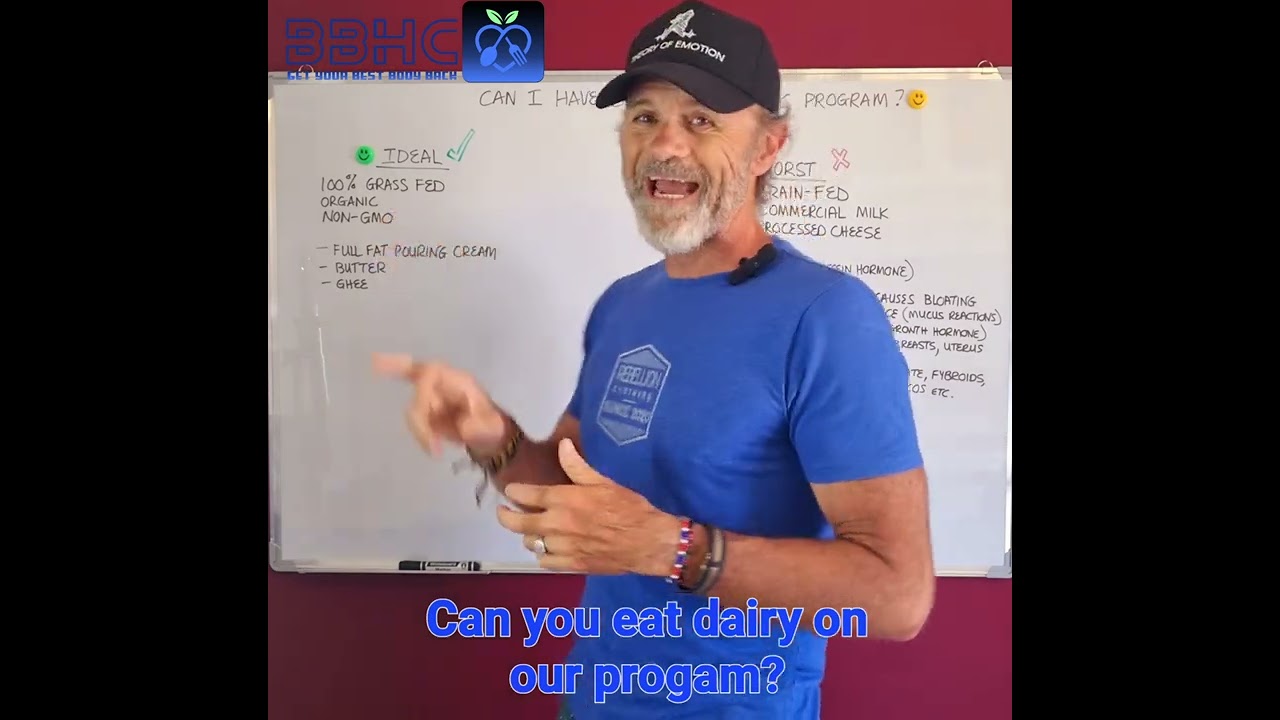
In this video Nick, the founder of Best Body Health Coach, explains why the 2‑month health program limits dairy consumption and outlines which dairy products are permissible. He first describes the typical commercial dairy supply chain—grain‑fed cows, GMO feed, rBST hormone treatments, and processing methods—that result in milk and cheese loaded with endocrine‑disrupting compounds such as estrogen, IGF‑1, and casein. These substances are said to block fat‑burning hormones, promote weight gain, and trigger a range of health issues including prostate enlargement, breast and uterine cysts, PCOS, endometriosis, skin disorders, and hormonal imbalances. Nick then contrasts this with the recommended dairy sources: 100 % grass‑fed, pasture‑raised, organic, non‑GMO products such as full‑fat pouring cream, grass‑fed butter (e.g., Kerrygold), and ghee. He argues that full‑fat dairy is superior to low‑fat or fat‑free options because removing fat leads manufacturers to add sugar, which fuels obesity and diabetes. The video also frames the 2‑month program as a boot‑camp reset that eliminates harmful dietary exposures, educates participants, and yields sustainable weight loss without calorie‑restriction. After the boot‑camp, a new, more flexible food list is provided. The program is delivered in English, Afrikaans, and Spanish, and is marketed globally with a community‑focused approach.
Chapters
Hi, Nick here from Best Body Health Coach. So in this video, I'd like to talk to you about dairy and why we restrict it on our 2-month health program. Okay, so firstly, let me get into, you know, what kind of dairy we are all exposed to commercially in the chain stores, in the shops, and so on. And you'll see why then we restrict it quite a bit on our program. So the worst kinds of dairy that you can have, and these are— these will not only restrict weight loss or stall weight loss, but they'll actually cause weight gain. And the reason for that is they are endocrine disruptors. And that means they mess with your endocrine system and as a result produce fat-burning blocker hormones. Okay, cool. So the worst kinds of dairy. So you get grain-fed dairy, so you get cows out in the field, actually they're not out in the field, they're normally in pens, and they're basically fed a grain Which is 99% of the time GMO grain, alright? So that's a genetically modified organism type of grain, not meant for any kind of human or organic consumption. So any organism shouldn't really be consuming this stuff because it's grown with toxins in it, usually to prevent pests like bugs and mites. Right. From getting into it and also funguses growing on the grains and so on. Okay, so anything that's grain-fed, even if it's— even if the grain that they are getting is non-GMO, cattle are not supposed to eat grains. They're supposed to be out on pasture eating their grass. All right, then commercial milk, um, it's also basically coming from huge dairy farms. You've got to think with it now, you've got these dairy farmers who are trying to make as much profit as they possibly can, they're trying to make as much yield out of their cattle that they have in their pens. So they're going to feed these cattle as much as they can, that is going to increase their milk production, and also their meat production. for that matter, if it's a meat farm. Alright, so commercial milk is full of all sorts of stuff, which I'll get to a little bit down the list. Processed cheese basically comes from commercial milk, which is full of all sorts of hormones, usually GMOs, and it has other stuff that's been added to it, obviously, to make cheese faster. Than the old traditional way of maturing cheese. Anything that's GMO, so most of the stuff out there in most countries in the world are from GMO. I know in South Africa it is almost impossible, if not impossible, to find any kind of grain or wheat that is GMO-free, unless some guy's just growing it in a house around his little kraal or whatever it is, a little house. you won't find non-GMO. Then you've got rBST, which is a protein hormone, increases the production of milk. So basically, you've got these cattle all in their pens and they have these huge udders and they're just getting milked like day in and day out and just producing more and more and more and more milk for us to drink. Now, if you think about How they get this to happen is to get these things to grow with a growth hormone. They get them to grow their endocrine system to a point where they are just continually basically producing milk. Obviously, they give these cattle a bit of a rest in between, but they get as much as they possibly can out of these cattle. All right, casein in milk. It doesn't matter what kind of milk it is, casein is something that most people are allergic to. It doesn't really agree with the human body, so it causes bloating, it causes all sorts of problems with the human body. A lot of people are lactose intolerant. So basically lactose creates mucus in the body, which means the body doesn't— it doesn't agree with the body, so the body's trying to get rid rid of it, and that's why the glands start filtering the stuff out of your system, and it causes mucus. I find that if I somehow consume anything like this, which I try to stay away from as much as I possibly can, but when I do, I find within an hour I have a blocked nose, I've got a croaky voice, and generally not feeling great. Alright, so the other thing is, these things are also full of different kinds of estrogen. So, and then IGF, which is a growth hormone. So they're trying to, like I said earlier, like get as much yield out of these cattle as possible. And this estrogen is a massive endocrine disruptor for human beings when they consume this stuff. So if you're a male, you'll start getting like noobs, what they call man noobs, and all sorts of other things start to happen. in a male's body when he has too much estrogen. It targets the prostate, so if you're someone who has a prostate problem, an enlarged prostate, just stay away from dairy. There's a very good chance that it will alleviate that condition. So it also causes trouble with breast cysts, cysts in the uterus, and ovaries. So like I said, it causes an enlarged prostate, fibroids, cysts, endometriosis, which is a tissue that's supposed to grow on the inside of the uterus, starts to grow on the outside of the uterus, starts to grow on the ovaries, fallopian tubes, and also sometimes is even found growing in the intestine. So that's what These products cause PCOS, which is polycystic ovary syndrome, also cysts growing on the ovaries, causes all sorts of problems with menstrual cycle, also causes skin disorders, causes hair growth, female hair growth on the face, also loss of hair on the head for the females. So stay away from this side of things. It's like, you want problems with your body, just keep consuming commercial dairy. Alright, so let's cross over to what we can have. So that's, that's why we don't allow much dairy on our 2-month health program. But what we can have Is 100% grass-fed, pasture-raised. These cattle need to be roaming. Sometimes they call it free-range, free-range eggs, which means basically the chicken or the animal is allowed out. It doesn't have to even be for very long, and then they're brought back into the pen. So they can call that free-range. So what we're looking for is grass-fed, pasture-raised, which means these animals are out busy living life the way these animals are supposed to live life. So 100% grass-fed, organic, which means they don't have any of these pesky hormones that are injected into these animals to make them produce more yield, and non-GMO obviously, so hopefully they are fed feed that is— they are being fed feed that is not of a GMO source, it's of a natural source. So basically, we go for full-fat pouring cream, very nice in your hot drinks like coffee or tea, it actually sweetens it up nicely. The fun fact is that probably about 50 years ago, the big food industry Started removing fat from our diet, saying that it was bad for you, and when you remove fat from food, it actually takes the sweetness out of the food, becomes very unpalatable. So you've got this low-fat food which is actually horrible to eat if they don't add sugar. So they add copious amounts of sugar to this fat-free food to make it taste better, whereas if they just left the fat in there, and left the sugar out of it, man would be a lot healthier and we wouldn't see the obesity and diabetes levels that we see out there at the moment. So stay away from fat-free or low-fat, that's just a fad and it's very unhealthy for you. So full-fat pouring cream, zero carbs, it makes your coffee really sweet. In actual fact, for me, I've been doing this for 10 years. I really don't like sweet stuff, so I have very little bit of cream in my coffee. It's just too sweet for me. I don't like sugar. I used to, I used to have a very serious sweet tooth, in fact. However, now I'm just like, I can taste if I eat something out there in the world where I haven't actually made it myself, Or cooked it myself, and I don't have any other way of eating but buying some food somewhere, I obviously look at all the ingredients before I eat something, but sometimes they put— they're very, very clever, they put some kind of code on there that you can't— you don't know what it is, and you try and Google it and it doesn't come up. So you eat that, I can immediately taste that there's sugar in something, and they do do that, they hide all sorts of stuff in the commercial food. So we have pouring cream, doesn't mean you can eat or drink lots and lots of pouring cream, it means you can put some in your coffee in the morning. Butter, so make sure that your butter that you get is also grass-fed, organic, non-GMO. So that means there are certain brands out there that are better than others, and I like the Kerrygold brand, I only buy Kerrygold. There are other brands that are pretty good, but for me the best one is Kerrygold. It's pasture-raised, grass-fed, non-GMO, and it's actually very nice tasting. It is a little bit more expensive, but it's not as expensive as hospitalization. So, that's a joke. And then ghee, you know, so ghee is high fat. So if you're staying away from carbohydrates, And staying away from sugar, you need to be upping your fat. And if you do that, you will become very healthy. In fact, obviously there's other things you've got to eat for other kinds of nutrients, but if you can get those carbohydrates and the sugar out of your diet, you're definitely on the way to improving your health. So that's basically the good and the bad. That's why we restrict the Very. On our 2-month program. Obviously, after the 2-month program, we give you a new acceptable food list, which makes it very sustainable, and you can continue on with this health journey after the 2-month program. Kind of consider the 2-month program as a boot camp where it like resets the body, and the body gets healthy, and it gets over all the damage that's been done over a lifetime of environmental exposure and bad diet and just all the junk that's being put into our food these days. The body resets itself, you become educated on things like this and other things so that you can continue the journey and just get healthier and healthier. We do get a lot of weight loss on our program as well, which is actually a symptom of a healthy body. So if you're losing weight because you're starving yourself, that isn't a very good way of going about it because it actually then does more damage to the body. Low calorie diet, so you count your calories in, you put calories out, it kind of doesn't work now with new ways of of getting the body to burn fat and take in nutrients into the cells so that the body is like as healthy as it could possibly be, digesting your food properly and so on. So we have clients all over the world, so it doesn't matter where you are in the world, we can help you. We deliver our program currently in English, Afrikaans, which is another South African language, and in Spanish, so we can help the entire Spanish-speaking world. Community with our program. So we'd really like to help you. Please contact us and let's get you cracking.