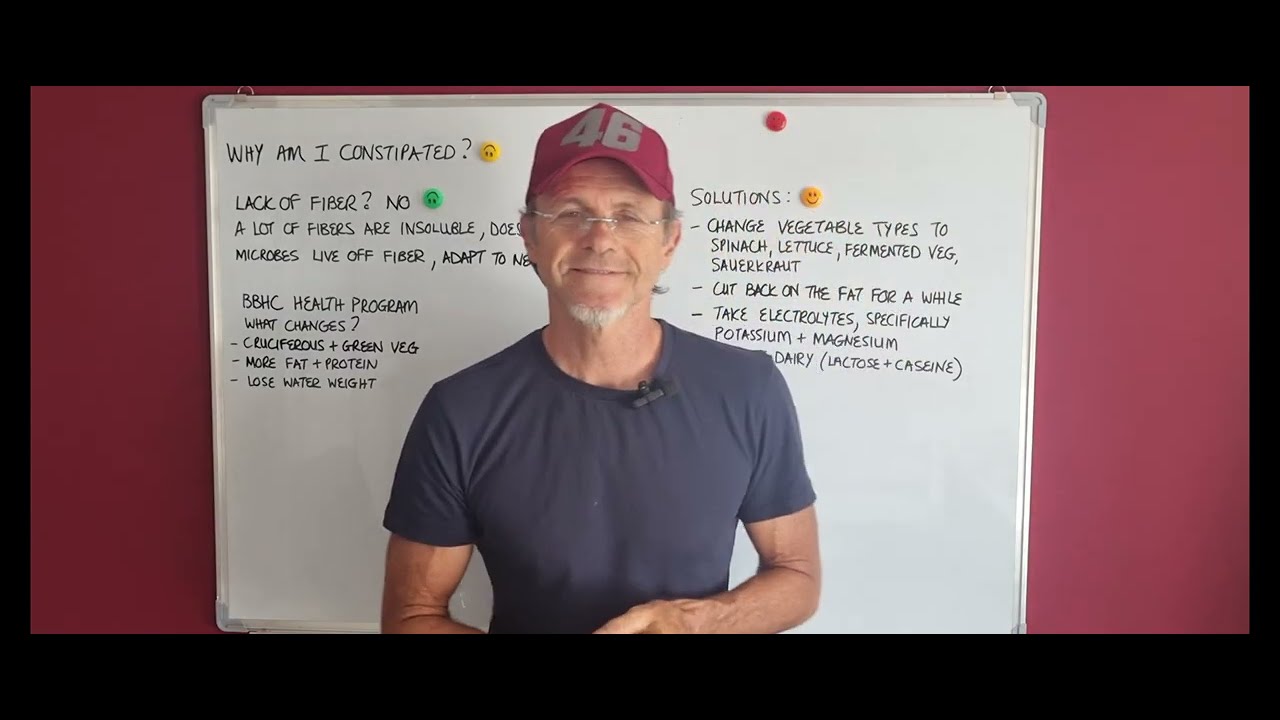
In this video Nick from Best Body Health Coach explains why many people experience constipation when they start a ketogenic program and offers concrete strategies to prevent it. He debunks the common belief that more fiber is always the answer, noting that most dietary fiber is insoluble and can actually bulk up stool. He describes how the shift to high‑volume green and cruciferous vegetables changes the type of fiber entering the gut, requiring the microbiome to adapt, which can slow digestion. He outlines additional keto‑related factors that can cause constipation: a sudden increase in dietary fat that overwhelms the gallbladder and bile production, rapid loss of water and electrolytes (especially potassium and magnesium) that are essential for colon muscle contractions, and the presence of casein in dairy products. Nick then provides practical solutions: vary vegetable choices and cooking methods (steam or boil instead of raw), incorporate fermented vegetables—especially sauerkraut—as a source of beneficial bacteria and vitamin C, temporarily reduce fat intake to give the gallbladder time to adjust, supplement with potassium citrate (which also supports kidney health), and eliminate dairy while on the program, re‑introducing it modestly after weight goals are met. He shares personal experience of cutting cheese and seeing weight loss and digestive improvement, reinforcing his recommendations. The overall message is that constipation on keto is multi‑factorial, but by adjusting fiber type, supporting gut microbes, maintaining electrolytes, and moderating fat and dairy, the issue can be resolved.
Chapters
Hi, this is Nick from Best Body Health Coach. So in this video, I'd like to talk to you about why you get constipated on keto. So, you know, there's an old kind of fallacy that, you know, when you get constipated, you're supposed to eat more fiber, and that's absolutely not really the case. The reason for that is It's not a lack of fiber that causes constipation. Most fibers are actually insoluble, so they don't get digested. And as a result of that, undigested food blocks you up. All right? So then, the other thing is your microbes in your stomach, which help digest food and process your food, level of fiber. And when you start doing keto, especially our program, you'll find that the type of fiber that's going into your body, like high volumes of green vegetables and cruciferous vegetables, is different to the fiber that you have been putting in there. And the microbes need to adapt and they're just not adapted. So, The food's not getting processed, hence you get backed up. So you've just got to look at what changes were made when you started our program. And it's usually cruciferous vegetables, like the green veggies, so there's a lot of that going in now. So that's one thing that it could be. You're eating a lot more fat and you're eating good protein. You're not supposed to be eating any dairy, so we can cut that out because dairy has casein in it, which is the type of protein— Casein. protein in dairy, and that can also cause you to get backed up. But you're eating a lot more fat, so it's difficult to break down when you're not used to it, when your gallbladder is not used to it. And also, you also start losing a lot of the excess water in your body that, from all the water retention from the high carbohydrates and high sugar diet, your body retains water, and when you get onto keto, that water just starts to come out. And with it goes your electrolytes, which is something that can also back you up when you're lacking potassium and magnesium. Potassium is— the muscles in your colon actually operate off potassium, and they're the muscles that massage the stool out, basically. So that's another reason that you could be getting constipated, because there are actually a lot of variables and to why one gets constipated. But generally, if you just have a look at the changes that are made when starting our program, you can kind of narrow it down to what it is. And we have some solutions here. So the vegetables that one consumes may not agree with you initially because of the fiber and the different types of fiber. You just change up the vegetables and you change up the way you cook the vegetables. If you've been boiling them, then steam them. If you've been eating them raw, then steam them or boil them or whatever it might be. You could change it up to spinach or lettuce. Fermented vegetables are actually very, very good. They really help digest your food and also cultivate the correct gut bacteria for for digesting high amounts of fat and also green vegetables. Sauerkraut is also fantastic for getting rid of constipation. So, you'll see on your program and on everybody's program, we put sauerkraut. It's high in vitamin C, natural vitamin C, first thing. And secondly, if you consume sauerkraut every single day and better with every single meal, it doesn't have to be a lot, like a tablespoon, a heaped tablespoon full of sauerkraut. You won't, you shouldn't get constipated. It's just like you shouldn't get constipated. That's the first question I ask our clients when they get constipated. I say, are you eating osana kraut? Generally, the answer is no, because it's not the best tasting stuff. However, I like it. So, okay, cool. So, you can also just cut back on the fat for a while because the body is not used to processing so much fat, so it can back up that gallbladder and back up the liver. And as a result, not enough bile going into the system. Bile helps the The gut move. So, it washes down the fat and makes it ready for digestion, and then also can push it through. Like, for instance, too much bile will give you a runny tummy. So, it gives you an idea that it helps move everything through the digestive tract. Okay, so, what I spoke about earlier is your body loses a lot of water when you go onto our program. All the excess water that it's carrying around, that puffy skin that you have, That starts to go away because of the water that you're losing, but you also lose your electrolytes. So you really need to get in your electrolytes, specifically the potassium and the magnesium. That's very important. So make sure that you're doing that. And we like to use potassium citrate because it also helps keep the kidneys clean, it helps to keep all the calcium deposits out of the body. Okay, I cut out dairies. It's got lactose and casein, which definitely stops you up. So like hard cheeses are high in casein. Soft cheeses, not so much, but you get Greek yogurt, which is high in casein, and various other dairy products. You just count them out of the program while you're on it. After you finish the program and you're down to weight and you're quite happy with just managing the weight that you have, you think you're at a nice ideal weight for yourself, then you can add a bit of dairy to your diet on a daily basis. But again, don't eat copious amounts of dairy. It's actually not that good for you. I drink a bit of fresh cream in my coffee, and once in a while I'll have a little bit of cheese, and once in a while I'll have a little bit of yogurt. And that's kind of the amount of dairy that I do use. In fact, I'd been doing keto for many years before I stopped eating cheese. I used to eat a lot of cheese. I liked cheese, and I just wasn't feeling good. Didn't feel good. I didn't really put it down to the cheese, but in the back of my mind, I knew I ate too much cheese. And the moment I stopped eating cheese, a whole lot of body issues went away and I improved a lot. I also lost a whole lot of weight. I got even thinner than I already was when I stopped eating cheese. So it just shows how certain things can stop the body from losing weight, back up the digestive tract, back up the colon. So I hope this video helped you. And, um, no need to be constipated. Let's get that tummy working.