Boots and suits - what can corporate and family farms learn from each other? - Kate Bourke
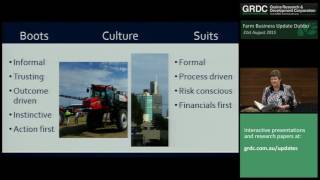
Kate Bourke compares corporate and family farming cultures, showing how each operates. Corporate farms are process-driven and risk-averse; family farms are nimble and instinctive. She argues corporate farms need to adopt rural flexibility while family farms should adopt better record-keeping, risk management, and people practices.
Chapters
I think I'm actually the steak knives in today's list of speakers on the. But wait, there's more. I think it was one of the other planning committees brought up this topic and so they threw me into Dubbo as well. So you may not have been expecting it, but bad luck, you've got me. A great pleasure to be here and thank you to all the other speakers because you've pretty much put all the detail that I was going to cover in my talk. So I can just stand up here and show a few nice pictures now and have a bit of fun, I think, and we'll get the messages. But before I start, you'll notice I've called my topic Boots and Suits, so I just need a couple of props. So, Kieran, I met you earlier, could I just have one of your boots? Thanks, mate, that'd be good. Tar beauty. Thank you. Who else got a decent pair? So we'll whack that up here so you can see what we're on about. It's a good specimen. Steel cap, shoe. Just need a pair of. One of a pair of shiny rms. They're a bit dirty. Hang on, I'll find something. Oh, here we go. Here's our beauty. Thank you. Black too. They're the sorts that the Collins street or Pitt street executives use under their boots and okay, so that sets the scene of boots and suits. So just this is what we'll go through today. I'll give you a bit of context is to fill in a few gaps that Gavin left out and I'll leave out our stories from early 1990s with Gavin in Horsham or La Trobe University with Catherine. But thank you, Catherine, for weighing soil samples. In 1997 when I was doing my PhD you finally acknowledged publicly. What I'd like to talk about is ultimately there's a lot of stigma around corporate farmings and rural communities get a bit nervous about it and them and us thing. Ultimately they're very similar organisations having worked in both of them and some people are really good at it and some people aren't so good at it and there's a lot of strengths in there that we can learn on. So I'd like to just touch on those things and just to add to the bio, a bit of needed to find some New South Wales credibility and stuff sort of north of the Murrumbidgee. So I have actually got relatives from Cowra and Andrew Farrah, the team manager of the the Blues, is actually a cousin of mine. So that's my Northern my New South Wales credibility. Just a bit unfortunate what happened this year. So a little bit about me to give you the context, as Gavin said, raised on a farm in central or north central Victoria, the youngest of six kids. So when I was little, Mum would, Mum and dad were. They had us really involved in the farm. Mum loved her sport and she was a city girl so she was about as interested in farming as Angela was. So what Mum used to do though is take the older kids off to have a hit of golf or teach them to play tennis. But the only way she could do that because there was a six year gap, was for me to be off doing something with dad. So she said to dad, can you come and get Catherine at 1:00 and go around the sheep and then the rest of the family would go into the golf course or the tennis course. So it was because of that that I actually became really keen on farming and then went on to university and whatnot. And our farming system at Aalmore is very similar to the farming system you have here in central New South Wales in more recent years. The last three years I spent working as commercial manager of a company called Warakiri Cropping and we heard earlier there was a great lead into my talk when people were talking about superannuation investment in agriculture. Warakuri cropping started in the early 90s as an investment by retail employee Superannuation Trust in Cropping Cropping Country. The philosophy behind it, it was actually set up the management part of it. You may have been familiar with dirt management and their philosophy was to take the corporate discipline, the good things about corporate culture and take the best things of family farms and build them together to produce good returns on investment for superannuation funds. So that was the philosophy I got involved only in the last few years. So that company itself has had, you know, it's got its 10,000 hours up well and truly. I learned a lot working in corporate agriculture and being based in the city. And a lot of what I learned was just how city people and rural people think differently, operate differently and often that's the bit that's not understood so well. So let's start with the similarities. Okay, so basically, ultimately, regardless of the ownership structure of the farm, we're pretty much, we've heard today we need to make money. The other objectives, I won't tell you what your objectives are, you'll know those, but I'm sure some of the things up here on the board will be will is what you'll relate to for us and in the role I had the last three years, it was very clear we had to meet investors expectations. We knew what they wanted us to return and that's what was expected of us. So we need to manage those expectations. And one of the things that occurs, and one of the reasons why there's not a lot of investment in agriculture by institutional investors is that the expectations that they are sold are often way higher than the reality. So they'll get given those top 10% figures, so they'll be expecting a return. That 10% of the farm businesses in Australia return is what we market to our investors. So 90% of us are doing this. We're building up investors who don't understand agriculture that well, but they're going to get this and when they get something that's in between that they're not happy. So we need to manage their expectations. So that's my little high horse on investment. But ultimately we need to make money. So that's something similar. And, and it helps a lot if you're clear about your objectives, and that's been a great thing in the last presentation, is that they're obviously very clear about their objectives. We've all got stakeholders. It was really refreshing to hear Angela talking about the stakeholders. In my years working one on one agronomic consulting, particularly through those drought years, and then looking at how people made decisions and who they thought about when they made decisions, it was quite interesting. And one example I would give was after years of drought when some subsidies came along, rather than shouting the family a well deserved holiday, I went and bought another header front. So who are your stakeholders and what do your decisions? If you're in the ute and making intuitive but quick decisions that are going to cost a lot of money or could generate a lot of money, who are you affecting by those decisions? Yes, you might be your own boss, but there might be an extended 10 people that your decisions are affecting. And that's the challenge that I put out to owner operators, particularly those that are making the day to day decisions in family farms. If you are set up as a trust or a company with directors, you'll have some legal obligations. And it's interesting, I've been doing a bit of a survey of farms that are set up as trusts and when you actually ask them what their legal obligations are, they're not really sure. They've been encouraged to go down that structure for certain reasons by their accountants and their advisors, but they haven't read the fine print. So if that applies to you, go and read the fine print. When we were in the corporate role, it was pretty clear there was very. The hierarchy was there. You knew who you were responsible to. We knew at the operational level that we were operating with someone else's money. It was a privilege for us to be farming with someone else's money. So we couldn't do, as Basil would say, farming the way you want to farm as opposed to the way you need to farm. We couldn't all farm the way we wanted to farm. All of our farm managers would have loved nothing more to have a brand new sp. If they are into red machinery, a Case Patriot, or if they're into green machinery, a John Deere. We had to justify everything we did because it had to be in the best interest of our investors. So again, that's my challenge. Your decisions in the best interest of your investors or your stakeholders. Okay, successful farm business traits. We've heard enough about that today, so I won't go through those, but I think they're fairly similar and there was a lot of themes that came up throughout the day. So what are some of the differences? And this is where I just want to touch on a little bit because this is often why the when we do talk about co investment or we talk about corporate farms not integrating into a community, or we talk about family farms trying to take on corporate principles and then not being able to carry them out, often it's to do with these cultural differences. So just to illustrate that, I'm going to go back to a bit of history. Any Banjo Patterson fans in the room? Because I think I can't describe the differences any better than A.B. patterson described when he wrote Clancy of the Overflow. I'd written him a letter which I had for want of better knowledge sent to where I met him down the Lachlan years ago. He was shearing when I knew him. So I sent the letter to him just on spec addressed as follows, Clancy of the Overflow. And an answer came directed in a writing unexpected and I think the same was written with a thumbnail dipped in tar Twas his shearing mate who wrote it and verbatim I will quote it Clancy's gone a drove in and we don't know where he are in my wild erratic fancies Visions come to me of Clancy gone A drovin down the Cooper where the western drovers go and as the stock are slowly stringing Clancy rides behind them singing for the drover's life has pleasures that the townsfolk never know and the bush has friends to meet him and Their kindly voices greet him in the murmur of the breezes and the river on its bars. And he sees the vision splendid of the sunlit plains extended and at night the wondrous glories of the everlasting stars. I am sitting in my dingy little office where a stingy ray of sunlight struggles feebly down between the houses tall and the fetid air and gritty of the dusty dirty city. Through the open window floating spreads its foulness over all. And in place of lowing cattle I can hear the fiendish rattle of the tramways and the buses making hurry down the street and the language uninviting of the gutter children fighting comes fitfully and faintly through the ceaseless tramp of feet. And the hurrying people daunt me as their pallid faces haunt me as they shoulder one another in their rush and nervous haste with their eager eyes and greedy and their stunted forms and weedy for townsfolk have no time to grow, they have no time to waste. And I somehow rather fancy that I'd like to change with Clancy, like to take a turn at Drovin where the seasons come and go while he faced the round eternal of the cash book and the journal. But I doubt he'd suit the office Clancy of the overflow. So I guess you see there the differences between sitting in a dingy office in the city, which I had the pleasure of doing for three years and I had a view, I looked out my window and I saw another brick wall. So the culture in that environment really is a formal process driven and it's not all bad, risk conscious culture where financials come first. And there are good things about that culture. The good things about the rural culture is it is quite informal, it's friendly, very trusting, it's very outcome driven, it's instinctive and it's action first rather than process first. So I think the challenge is to blend the best bits of both those cultures. So the process from the suits culture doesn't hold up the timeliness that you need to survive in a rural environment and particularly in a cropping environment. But the instinctiveness and that impulsiveness of just wanting to get on with the job in the rural culture doesn't actually bring you unstuck if it's not quite the right decision to make. So what are the strengths we can bring? One of the things that's been touched on today is that the lack of process sometimes in how we do business on the family farm. So I think that's one thing that we can Bring from the suits culture is that formal communication. And it looks like the o' Brien family's done that really well over generations and particularly in the last few years, reporting financials, identifying risk, documenting policies, all those things that those of you that work in the bank and for the local accountants would do those sorts of things. But recognising from a family farm point of view is that you're running a business, you're running an asset that's worth millions of dollars. There's a lot at stake there. So it's well worth putting the discipline into that side of the business and you don't have to do it yourself, as the o' Briens have pointed out with their farm secretary employee. We can do that too. If you don't like record keeping, get someone else to do it. And I've just started my own business. I've only got 1200 hours up, so I'm a bit like a brand new tractor, not even up for my first service yet. But I've worked out already that I hate recording things, I hate administration, my husband hates it even more. So my first business goal is to earn enough money so that I can employ a bookkeeper because I know I'm not good at it. And our accountant is going to get very grumpy with us very quickly. So I think in the paper I talk a lot more about some examples on process and risk, but it is, there are some good things about corporate discipline that could really benefit family farms. And the other part I think I had on in my notes that I was scribbling as the guys were talking this morning, I just said, do what Basil says, do what Simon says, all those talks that you got earlier today, and do what Mike says really is about bringing some of that discipline. The other area I'd like to touch on, and this isn't in the paper, but when I spoke to people about I'm doing this talk on corporate and family farms, what do you think? One of the quite sobering things was that a lot of the people that had worked for both organisations said to me, tell them they need to manage their people better. A quote from someone I used to work with said, I'll never work on a family farm again. And that's a real indictment, I think, on us as family farmers, if people won't go and work for a family farm again. And the sorts of things they were talking about was the opposite to what the o' Briens were encouraging. So being in a position of responsibility until the 22 year old son comes home and starts handing out the orders, never having seen a written job description, never having a formal meeting about their salary or their improvements, working hours, management, being promised the world and really not receiving the world, being expected to work unsafe hours. And so these are the sorts of things that I was, I suppose you sort of know it, but it was quite a bit sobering when this was the message that was given to me time and time again by people that worked for organisations, non family farms and said they'd always try and get a job in a non family farm after that experience and would never go back. So I'm sure there's lots of good family farms out there that value their employees. And if you want to know more about it, there's a book sitting there on your table, the Farm Labour Book. But I guess this is part of the cultural problem. This book talks about a guide to farm labour as if it's just like a pallet of chemical as another commodity you're using. I went through this book and I got to page 30 before it mentioned the word people and it's really from page 30 to 60 that it talks about incentivising your people and about the human factors. So if this is the sort of information and culture we're promoting, I think we sort of need to just rejig how we think about people. There's been a massive increase in the number of people employed on farms that are not related to the family in the last 10 years. So it's a permanent part of what we do now and it's something we really need to be better at. And I suppose, respectfully, perhaps we rearrange the order of this book to get people up the front and the legislation stuff at the back. Training is one of the biggest things that often as family farm employers, we're reluctant to send staff to things that cost us money. And really training is something that doesn't cost. It costs a lot less money to send someone to a training course than it does to give them a bonus at the end of the year and they really appreciate it. Training and acknowledgement, really things that don't cost a lot. They develop the people and their human potential. They'll reward you in spades. So that's just something worth thinking about. Okay, so I've giving you a few hits over the head there, so we'll go back the other way. The strength that family farms have, or farms that have been in the one area for a long time is that they've got very good response times and just a real Sense of knowing what to do and when to do it. Greg talked about buying land when no one else is buying land, for example, and, and that's a good example of just being able to act quickly when an opportunity comes up. The challenge for larger organisations is that the processes that you have there sometimes get in the way of being nimble, and particularly for season changes. So if a weather event occurs tomorrow and it's going to be a better option to actually cut your crops for hay, if you're a corporate farmer, you need to have the systems in place that you can act quick as quickly as a family farm would. And particularly in droughts, for corporate farms with livestock, the need to be able to make the same decision that a family farmer would, to be able to destock or just manage that situation. And so that's a real credit to family farms and how they can either take opportunities or adapt quickly. Along the same lines in our family worked out before that, Grandpa farmed for 50 years, dad farmed for 70 years, my two brothers have farmed for 40 years, and there was another generation before that. So you get pretty good at knowing where the good soil is in your area, where the bad soil is. You've got a human simulator of seasons. You would have heard, you know, dad talking about the 67 drought in 64, the rain that came and going back to the 40s, and then in more recent years 83, blah, blah, blah, blah, blah. All that stuff. Though you can't get that off a spreadsheet. You can get rainfall records of a spreadsheet to do your analysis if you're a agribusiness analysis analyst, but you don't get the nuances of when that rain fell, or if it was a cool season like 2001 was, or like last year finishing off was, or if it was a season like 2004 when there was warm weather in November, or 2009 when it was 40 degrees for two weeks as the crops were ripening. They're all the things that don't get flagged in the statistics that you can buy from the bureau. We heard today also about being technically good, and I was really pleased to hear that in the business speakers that spoke today, because often that doesn't always come out. You do need to be good at your agronomy, you need to be good at growing wool, growing meat or growing crops. So in summary, what suits can learn from boots, that combination of being quick to respond, intuition isn't always a bad thing, and the subtle nuances of farming and I guess all that adds up to why spreadsheet projections don't always come true. What Boots can learn from suits is how to be good employers and safe places to work, to maintain that business focus, to get some discipline into your documentation and your reporting. And there's a couple of examples there. So I think it's really simple. My bent been to cropping and that wasn't because I dislike livestock, it was just I worked out at uni, if you specialised in cropping, you didn't have to go in and feed the animals on weekends. So it's pretty simple, really. If you're good with people, crops and money, you can be successful at farming. So thanks very much.
More from Gerri







GRDC National Variety Trials (NVT) Case Study: Helping Oat growers make informed variety decisions



Managing rhizoctonia in wheat and barley: Impact in low and medium rainfall zones 🌾🌾
