Continuity in business ownership and management: A planned approach - Alison O'Brien
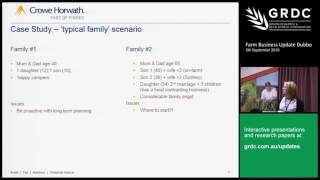
Alison O'Brien presents on succession planning for family farms and rural businesses, stressing that succession should be an ongoing part of everyday management rather than a one-off event. Key themes: start early; separate management transition from ownership/control; use estate planning (wills, family agreements) to back intentions; maintain governance and business systems; train and identify successors; monitor financial indicators (operating cost ratio, return on capital, cash flow); consider valuations, equity lending and compensation arrangements; and involve professional advisers. Practical family scenarios illustrate common tensions (on-farm vs off-farm members, multiple heirs) and the need for communication and compromise.
Chapters
Thanks, Andrew, and thank you for your invitation with ORM to participate today and of course, GRDC for the opportunity to present to you. It was interesting Andrew's feedback regarding the steering committee, which I thought was a very practical approach about the subject of succession planning and thinking. Oh, what haven't we covered in the past? Over the years with succession planning, but with the input from all the different regions, it was more about how to make it a continual part of your business ownership and management, not to pull up and make it an event when we've suddenly woken up one day and thought we need to do something about succession planning. So this talks very much about how we can inbuild it into our everyday management and I do apologise. I've got lots of notes on the bottom of my slides. I didn't want to make them too busy, but there's a lot to talk about in this subject. Just quickly on the disclaimer. Whilst we're invited here to talk to you today, it's a really good idea to go to your trusted advisor to talk further about anything that you've learned here today to go through it. One of my favourite slides in my area, I work a lot with, as Andrew mentioned, estate planning as well, and I find this quite representative of. Of the position that some take. Can we relate to this? Can I just get a show of hands in the room? Who has actually started to think about the next transition in their business? Excellent. So this is not representative and there's no. Why I ask too is not for us to dwell about the importance of it, because obviously you're here today because you appreciate that it is a very important topic too, to start to transition in your business. In the 10 years that I've been specialising in estate and succession, I have found a movement from clients to move from this, to be more proactive and not to have that. Typically I would hear that it's easier for them to sort it out when I'm gone. Well, believe me, it's not. It can actually tear families apart and unnecessarily cause more problems than solutions. If you gain nothing else out of today, my talk here today, I would encourage you to go home and look at a document called your will, because I find that is where all roads can tend to meet and it can dictate whether the road's going to be smooth or bumpy going forward. Also, I'd like you throughout the session is to just jot down any questions so that we can have a pretty productive session at the end. Because I think find that that's often where the feedback is really valuable with everybody else's insight into it. So please don't hesitate to jot down any questions that you've got. A number of years ago one of my colleagues and a principal at the firm with us, Vicki o' Connor wrote in conjunction with GRDC two of these really good books that are still available on the GRDC website. So I'd encourage you to use those as, as tools as well and refer to one being Succession Sustaining Families and Farms and the other one on the communication piece and the ultimate risk management tool. So please, I do invite you to refer to those because I find them very valuable. Often you might find that you have the older generation hell bent on a top down approach and the younger generation desperate for a bottom up approach. You can understand how conflict's going to arise in this area with those sorts of attitudes coming through. Drawing on my own experiences, experiences of my colleagues and experiences of clients is what we've tried to put together as a guide to help you with ways that you can actually inbuilt this into your everyday management ideas. Some of the key areas of focus that we looked at look, it can be complex. We're dealing with two different things, one being the management and one being the control. And by the control it's more referring to the ownership of the assets. We actually find in practice that it works better if the management the transition of the management can actually precede the transition of the control. So the transition of the ownership of the assets and don't underestimate the role of training and education in this component. The ultimate handover can be a really emotional time. It can signify a sense of worth and belonging and it's not a given that it's easy. So please, we need to all appreciate that from all all avenues to refer to some interesting statistics I came across when I was looking to put this presentation together. KPMG complete a family business survey every year. So last year's survey actually revealed that senior Decision makers refer CEOs are typically between 51 to 60 years of age and this also correlates in their studies that the performance of the family businesses peak at those sorts of ages. Likewise, they can identify that performance actually declines at around that as we approach our 70 years of age plus so what's an ideal time? Look, everybody has a case by case. It's an individual decision for the family as to what's ideal and but I find that that's indicative of when typically our personal goals and cognitive abilities and risk profiles change as well. So being able to recognise that when is it time? Because timing is key. That same report went on to reinforce that the timeliness of the business handed over, it's a key differentiator for that business's performance. They recognise that 72% of businesses will transfer ownership in the next five years. So that's the majority sitting in this room here today will experience some sort of transition. So what are we doing about it to prepare and hopefully it's already ingrained in our processes, our systems that Natasha was talking about with all that governance issue is critically important so we are likely to experience in the near future. We've got typical family scenarios. We're all different but we're all similar. Like family number one, I just wanted to point out you've got mum and dad in their 40s, the kids are just sort of coming out of primary school, pretty happy campus. Probably more worried about what's happening at P and C and all those sorts of politics. But their issues are around being proactive with long term planning. Whereas we've got family two sitting over here as a snapshot out. Mum and dad are in their 60s, one son's back on the farm with his wife and children, another one's off farm in Sydney working with a wife and children and they've got a daughter that's in her second marriage, has three children, is working in a local contracting business. If you feel already that there's considerable family angst in that situation, then you might go back to my original diagram and think, where do we start? It's hard and this is atypical of a family situation, but it's not too hard if you've already got the mechanism in place. It was interesting with Sam's typical farm that he presented this morning. Look, $9.3 million. I would have thought that's quite healthy, isn't it? You'd be pretty happy about having that, but go and put that in the bank. Earn conservatively 4%, that's $370,000 that you could get without doing too much before tax. But what you need to do is view more critically at what that means. How many families are expected to live off this going forward? It might be okay now, but is it going to be okay for the next generation? And so on. So it's looking at that and asking those sorts of questions of it and looking at the best options on how to use the equity and the profits. Mark Gardiner's talk that some of you may have attended this morning Would have been looking further at that. What is the best use of your profits and how to maximise things and equity at 75%? Well the bank's probably quite comfortable with you, but is that the best use of your money? What are you doing with it? Are you considering lending equity with off farm siblings or on farm children, wanting to move into next door, et cetera, Those sorts of things and critically analysing and, and making it work for it can all play a role in how it will transition. The other part of the case study was looking at the numbers and again putting a magnifying glass over that and the take outs there, $1.4 million gross income. Okay, that sounds really healthy and it is. It's becoming the norm to have million dollar plus businesses. But I think with that comes that responsibility for more governance concern to manage those turnovers. We've seen significant growth over the last 20 years in farm turnover, whether that be commodity price driven expansion, et cetera. But it has grown and all of a sudden we have quite reasonably big business to manage. One of my favourite management tools is looking and talking about things that are quicker to put your attention to is the operating cost ratio to that gross income. So if you look here with the direct costs as we saw there, the net profit before tax was 245,000. You think wow, that's pretty good, I'm pretty happy with that in isolation. But when you break it up and you see that your direct costs, your overheads, your equipment, finance, granted there's probably some capital component in there, but we'll slot it in and interest all of that totals up to about $1.2 million. 86% of your turnover all of a sudden is gone. And that leaves 14% to do the critical things of capital improvements, paying tax, paying the bank back, putting the kids through school, going on holidays, all that sort of stuff. So I view it the less you can spend to make the same dollar, the better off you're going to be with having more at the other end to put into the other discretionary stuff of expansion, et cetera. And it's about then the flow of it. And Sam alluded to that if you get the numbers right and build on that and you saw the top 20 alongside does make this process easier, but we'll touch on that later on that it's not necessary to be able to do this process but it certainly makes it easier. But things that you can do is really control what you can control. This is really hard to control. We can't control what commodity prices are going to do. But being in control of the other stuff is where our strengths could be. Just from a management point of view, okay, things such as ensuring that your potential successes are identified and trained, that there's a career path and that the timeliness for the process of handover has been established. You've communicated that there is a financial ability for you to retire. Lots to do with that liquidity piece. What's left over? Don't wake up one morning and think, okay, I want to retire tomorrow and I need a house. Etc, Etc. This is an ongoing thing that you need to start planning for from the start and that your intentions are communicated. To make these sorts of decisions, you need good data. You need to take that magnifying glass constantly to your business and have a look at what those strengths and weaknesses, opportunities and threats are so you can act on any of those at any moment. Recognise that the young have energy and ideas and the old have wisdom and experience and bring the two together and leverage off that rather than working at opposite spectrums because we're coming from different directions. Something from experience sharing with a colleague too, is the importance of getting valuations along the way. Things need to be valued because things change and it is a good idea to have those valuations done at critical times. A workable plan is one that has options such as the role changes and stay or move on the farm, lease, sell, downsize, upside. So be flexible and be prepared that it's a moving target sometimes and all roads lead, as I mentioned, right at the start to the estate plan. Make sure the estate plan backs it up with your intentions and supports those intentions. Recognise that it's inevitable. At the risk of using the cliche about death and taxes, it's something that you do need to think about. You need to separate family from business and that corporate governance that Natasha spoke of will help you do that. We need to step up to run. Whether your business is doing a million plus million less, it's still relevant that you imply these things. Recognise that it can be voluntary or involuntary. We might not have a choice. It could be financial circumstances or family breakups or an unexpected death in the family or accident that forces you to then have to suddenly start to think about these things. Be prepared by revising your estate plans that accommodate all the scenarios and again at the risk of flogging the term. But the governance will help you do that. Once you've got that more structure in place and don't be afraid to put it on the table. There are circumstances in families where they really need to share those sorts of things. And that's where getting help from other professionals in all facets of whether it be communication, financial planning, accountancy, legal, etc. That can help you deal with some of those factors. Consider introducing family agreements. Often we cover off on a lot of stuff, but if members need surety about what's going to happen down the track, then some family agreements around that will help satisfy that need. The earlier you start, the more options you're going to have. I can't stress that enough. And be prepared to compromise. Compromise is very important. Set clear intentions and understand that mistakes are a valuable learning tool. One of my reflections on experience is that it either costs a lot or it hurts a lot. We just hope that neither are too extreme that we can't recover from it. But really when you slot it in but you learn from it is the main thing. And don't be afraid to let the younger generation make those mistakes as hard as it is for them to be able to learn. And you need to watch that. Cash flow really important. It's the lifeblood of your business having cash flow. It determines your day to day run ins, your ability to plan, to hire, to fire, to expand retirement, all sorts of things. Introduce others to the business, invest in improvements, all sorts of things without cash flow that becomes very difficult. And using tools that will help you as well. The farm management scheme, terrific tool to help people with their cash flow planning and obviously other tax management issues, et cetera. But really really important. Debt management, the whole lot. Redraw facilities, gross margin budgets, projected cash flows, constantly reviewing those all very handy tools that you can just inbuilt as part of your day to day management that helps with all of this transition. Have good business systems in place. That's your record keeping and your financial systems, your information systems all need to be to be in place and have appropriate business structures to accommodate the transition. And by business structures I'm referring to companies and trusts, partnerships, sole trading, superannuation funds, all set up to help with what's appropriate at the time. And you can only do that with involving new key professionals at those pertinent times. But those structures can help you in that transition process. Be supportive of everyone's needs and resource. It is another factor. Identify the risks and the plans to manage them. Be prepared to be flexible. If it's not working, change it. And how do you know you have that governance approach where there's the review process, etc. You can, you can workshop things as to whether things are Working or roles need to be changed or pay structures need to. But be prepared to be flexible. One thing I often talk with, particularly estate planning and farming more importantly, is it's important to be fair. You can't always be equitable, but it's important to be fair. So bearing that in mind as you move through as well, play to your strengths, do what you do well, more type thing that's I think quite valuable to understand what those strengths are and do more of it and ensure that there's an understanding of what you're trying to achieve. Part of the brief too was to sort of understand whether succession and scale had a link and obviously profitability and viability that we talked of this morning was really quite important. But at the end of the day I think you've got to be realistic and realistic for everybody. All the participants need to have the opportunity to set their own realistic goals and expectations. Not being profitable and not having scale is not a reason not to do succession because it's a transition that is going to happen in one way, shape or form, so we can't make excuses for it not to do. And again, dwelling on the fact that cash flow is critically important, if we can really concentrate on getting systems around that to make that work, as Sam alluded to this morning, the other things actually do then fall into place. If you can get some, some of that under control. And what's your indicators, what's your break even point before you get out of bed every morning? What do you got to make to break even? These are quite easy indicators to measure on a regular basis. Return on capital I gave that put 9.3 million in the bank at 4% earlier. And I think one of the indicators that Sam had alluded to the farm's return on Capital was 4%. We're very critical of looking what anything else returns, but sometimes we forget to put a magnifying glass over our own situation and dismiss it for some reason. Monitor that change in net worth. I find quite a good indicator too how things are moving there. And obviously it's probably been quite positive to do that of late, with land prices as they are, but I find that a really good indicator and something easy that you can build in to quite a regular review. And again, that operating cost to turnover ratio that I talked about there before, all your costs, what does that represent of turnover? So what does that leave me to buy the farm next door or to put the kids in in boarding school or to go on that bigger holiday or lesser holiday or a holiday that's where all roads are. That's what our purpose is really to being able to do those sorts of things. Off farm family members definitely need to be considered and I believe it's really the responsibility of the successor to plan for off farm members to do that. You start financing your retirement early back when you start you can start to be putting things away. It's all for. There's a goal in place as to what you want to use it for. But retirement is something that we all want to achieve. Why not start financing for that or thinking about that as ways early and use estate planning tools to do that. We don't know in our case study back then in family one whether the 12 year old or the 10 year old are even going to come back on the farm. They all might or none of them might. But if we don't start planning for that we won't have the options at the time. The concept of lending equity that's 75% in the local farm that whether that's lent to an off farm family member to move into a business or a new home that they're planning to buy or whether it's an on farm child that wants to buy next door and you just want to help them out with a bit of equity because it's pretty impossible to just go and buy an asset assessed on its own, particularly if it's a business asset. So lending that equity to to facilitate that for all purposes. But I do stress too with any of those sorts of agreements that you document it, you agree and you document it is very important. Often I find clients are very focused and a lot of their planning will be around a marriage failure and it is, it's everybody's fear. But that could be parents or children at any stage. So don't let that be an over focus but be aware that there's other considerations and there's tools available that can help you to minimise those sorts of risks. You could consider the appropriateness of early or late payouts with various children too. Again, depending on what your equity levels are and your cash flow is as to what your options are to be able to facilitate those sorts of payouts and look careful to you need to be aware of there's a family provision act that if we aren't perceived as being fair by members of the family, they can actually come back and claim later on. So I think again as the successor it's our responsibility to make sure that our planning is in place so that those sorts of things don't happen. Using your estate Planning tools also to assist with this and whether that be life insurance policies, superannuation, off farm investments, the earlier you start to do these sorts of things, the easier it is to accumulate. And certainly in my experience with insurances, the earlier you start, the more likely you are to get it. It's actually quite hard to get those sorts of things as you get older. So again, starting early to help the needs of off farm families so that it's not such a burden on the farm when the time comes and be prepared to draw a line in the sand. What I mean by doing that is recognise that assets change value and we actually recommend that you consider a value at a point in time by family consensus and allow for an agreed compensation mechanism. Acknowledge adequate compensation for family members who actually work on the farm and ideally from the outset, because often we find experience that. But you've bumbled along possibly for a period of time and there's really been no structure around what that compensation looks like for the people that have actually stayed on the farm compared to the ones that maybe have moved off, got their degree, moved off. That to me is an investment in their future. Just like an on farm sibling coming home and buying the block of land to get started, you need to allow for the compensations of the what fors of what's been given up. So really the takeouts of this or the key points that we identified were that start early and manage the order of transition. That was that whole transition of management for full control, communicate and compromise the two Cs really important. Understand what attributes everyone can bring to the table with the age of the wisdom and the experience and the youth, with the ideas and energy and be realistic in your goals and expectations. Some interesting statistics I came across lately with the young farmer business approach project that's happening, I found it was quite sad that the biggest hurdles, some of the biggest barriers for them to enter into the industry is 85% of them felt it was finance, 65% of them felt that it was access to land, and then 40% was business knowledge. That whole education, training component. I think if the key areas of focus are considered as part of our ongoing business management, it would help our young farmers address some of the what they see as being prohibitive for entering the industry. Okay, well, there's just a picture of us all. I'm in the Dubbo office here at Crowhorse working closely with Tom Larkin that's here today and Pete Carnell, both principals of the business, working quite extensively with rural clients in this area. And again we really do try to build it into the ongoing. It's not just about tax, how much tax you're paying. It's so much bigger than that. That's just a picture of where we're situated all over the predominantly east coast. And that was principally through Crow Hawth, who quite a number of years ago adopted a strategy of buying regional firms. So we're all regional people, and a lot of us from regional backgrounds on rural backgrounds, which I think we work closely together, can facilitate the offerings that we can give. Okay, any questions on any of that?
More from Gerri







GRDC National Variety Trials (NVT) Case Study: Helping Oat growers make informed variety decisions



Managing rhizoctonia in wheat and barley: Impact in low and medium rainfall zones 🌾🌾
