Ecology and management of feathertop Rhodes grass
Webinar presentation (Mark Congreve) summarising research and grower experience on identifying, ecology, spread, resistance and best-practice management of feathertop Rhodes grass. Key points: the weed establishes rapidly on bare ground with shallow-surface germination, has a short seedbank (≈12 months), is competitive when first to establish but is suppressed by existing cover, and feathertop Rhodes grass populations are confirmed glyphosate-resistant. Recommended actions emphasise prevention, removal of isolated plants, cultivation plus residual herbicides for large patches, and careful use of Group A herbicides with double-knock strategies and attention to plant-back constraints.
Chapters
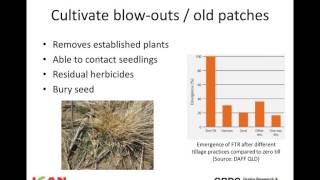
Hello and good morning and welcome to the next in our series of webinars sponsored by our GRDC Northern Region ICN16 project. So just while we do some introductions, like to acknowledge the resources of GRDC in allowing us to bring these series of webinars to you. You're listening to Mark Congreve from icann. I'm going to be running the webinar today and presenting compilation of research from the weeds research team and the grower solutions groups and some of the herbicide manufacturers and try to pull it all together as we talk about dealing with feathertop rose grass, which is becoming a significant problem, particularly in our wet summers. So what I want to cover today is to use the same format that we've used for other weed specific webinars we've run under this series. We're building a bit of a library now of how to tackle these key weeds and the way we address it is to look at the ecology of the weed, what is driving it as a weed problem, where we can find the weaknesses in the weeds ecology and work out where the best place is to attack it from our management tactics. Then we'll talk a little bit about resistance status as far as herbicide resistance goes and then we'll move into what are the best management approaches that we can take to reduce this problem. So firstly, just understanding the beast we're dealing with. And for those that aren't, probably most on the conference call are very familiar with feathertop Rhodes grass. But I did have a question from a grower the other day of just understanding do actually have feathertop Rhodes grass or not. So here's just some pictures of what it looks like. Hopefully the quality is coming through okay on the webinar. The key point being it's relatively easy to identify when it's in a seedling state. The stems of these young seedlings appear very flattened and very characteristic to this weed and different to most of our other weeds. So if we're seeing that very flattened stem in there, fair chance it's feather top rose grass. As the plant gets bigger, the other really obvious identification trait is the seed spikelets and panicles. So as you can see, hopefully you can see in this photo, the panicles remain very erect with feathertop rose grass as opposed to common rose grass where they splay out. So that's very obvious. Once you see feather topped rose grass in flower, it's pretty obvious to identify it. Under dry conditions, the plant can move very quickly into flowering stage on a relatively small plant. But as we move over to the picture on the right, under good moisture conditions, it can grow very large and get up to 50, 70 centimeters tall. And as you can see in that photo there, it's basically out competing with a sorghum crop under good moisture conditions. So it can be very aggressive in that situation. So how does it spread? We commonly see in fallow paddocks, like this paddock down here in the photo on the right, a plant or individual plants out in the middle of a paddock, or maybe a small clump in the middle of a paddock. And how did that plant get there? The seed attaches very well to livestock. So if we've got cattle moving across the paddock, we've got kangaroos moving across the paddock, the seed does adhere to their hides and can easily be dropped out in the middle of the paddock. And that's probably one of the most often explanations as to why we see these individual plants popping up out in the middle of the paddock. There's certainly plenty of evidence of movement alongside roadways, particularly where councils are spraying with glyphosate, creating a bare area. And then we're getting transport movement along the roadway, spreading feather top Rhodes grass pretty much throughout the main roadways and highways throughout Australia. It will get spread in flood water. So if you get a flood going across the paddock, that can deposit seeds out in the middle of your paddock and the seeds can be wind blowing. But when you actually look at the dispersal, most of it falls within a few meters of the plant, so it's unlikely we're going to get them to move out into the middle of the paddock from roadsides or something like that. But obviously if there's a whirly wind or something like that, that could be a source of dispersal. So what else do we know about the ecology of the plants? So we need to look at the germination establishment. So some research out of CUDAF in Toowoomba basically shows that it's going to be the first weed to establish on bare ground. It only Requires about a 10mil rainfall event to establish in spring conditions and it will germinate and be out of the ground in about two days at a 30, 20 temperature range, about three days at 25, 15. So that's going to be a lot faster than most of our other grass weeds that we're dealing with. So generally speaking, it's going to be the first weed up and out of the ground at probably the lowest temperature and some of the lower moisture constraints. It doesn't like Germinating from seed buried less than 2cm deep. So it's very much a surface germinator under good conditions, produces a fairly high amount of seed, but it will rapidly go to moisture stress and set seed rapidly go to seed under moisture stress. And as you can show in the photo down there, even small plants can start setting viable seed when they're running out of moisture. So that's something to keep in mind as well. When we try to look at the weak lengths of feathertop rose grass, one of the key areas we can attack is the seed bank persistence. So the seed persistence is very short, approximately 12 months. And this is one species which is very unlike the norm. Normally with our weed species, when we bury them, the seed oil persists longer. It doesn't seem to be the case with feather top rose grass. It doesn't seem to matter whether we bury the seed or leave it on the soil surface. It becomes unviable fairly quickly. And you can see in that graph down there that regardless of whether the seed was at 2 cm, 5 cm or 10 cm, the viability of the seed dropped fairly fast over the coming months. And by 12 to 18 months, there was basically no viable seed left in that situation. So what does that mean in practice? It means if we go for intensive management for one to two summers, we can largely eliminate the problem we had at the start because we've eliminated the seed bank. But that's reliant on not getting any further incursions of seed replenishing that seed bank. Also wanted to talk about competition. So feathertop rose grass, as I mentioned before, will generally be one of the first weeds to establish itself in spring. And once it's established, it will quite often out compete many other species that are also trying to germinate and establish. But on the flip side, it really doesn't like competition itself. So if there's already an existing cover, germination and establishment is generally quite low. And I added this photo of a sorghum crop outside of on the darling downs there, which I think shows quite nicely what's going on in this situation. So along the roadside here, we've had an established grass species, mostly common Rhodes grass in that situation, and there's very little feathertop Rhodes grass establishing there. In our soybean crop on the other side, obviously the farmer has cultivated this paddock, he's put down his soya beans, he's probably added a residual herbicide in there, and there's very little feather top rose grass establishing there. But on the verge between the crop and the grass, obviously there's been some bare area there probably no herbicide in that situation, and there's just been a wall of feathertop rose grass established in that situation. So it just shows what competition can do with regard to this species. So, moving on to resistance, first let's deal with glyphosate. Feathertop rhavesgrass has never been on the glyphosate label. Why is that? It's basically always been highly variable and generally not effective. So it hasn't been ever registered for control. Typically when we talk about resistance, we look at something that was controlled by glyphosate that is had been on the label before and now isn't controlled. And we claim that as a resistant species. Because feather top rosegrass has never been on the glyphosate label, it's taken us a lot longer to confirm glyphosate is now confirmed. Feathertop Rhodes grass is resistant to glyphosate. But some work by the research teams in 2005 identified populations that hadn't been sprayed before, compared those to spray populations and have confirmed in late 2015 that glyphosate, the feathertop roadsgrass, is now resistant to glyphosate, and it's been officially added to the list of glyphosate resistant weeds in Australia. As far as group A and group B herbicides go, they're often a couple of our alternative management solutions that we're using quite frequently to manage feathertop Rhodes grass. While we haven't got resistance or confirmed resistance to those species, to those mode of actions at this point in time, what we know about those mode of actions is that the gene frequency for resistance is generally fairly high. And overuse of those herbicides, especially if they're survivors, would normally lead to rapid selection for resistance management. So I want to talk a little bit about that and the importance of double knock and the importance of managing survivors as we move into the management tactics. So if I start talking about how to manage feathertop Rhodes grass, I guess I wanted to start with the key point here, that prevention is better than cure. So this weed, once it's established, and particularly once the plants have got some size on it, is extremely difficult to control with our herbicide options that are available to us. So we really need to try to keep it out of the paddocks and life will be much simpler if we can prevent it from getting in in the first place. So what sort of things do we need to think about? Obviously, general farm hygiene, particularly around areas that we traditionally leave bare. So roadsides around buildings and things like that, those bare areas are left to the top. Rhodes grass to establish it can really set a lot of seed from those areas. So from a herbicide point of view, as we mentioned before, glyphosate not very effective anyway and you would need frequent applications of it. Your Mazapur based herbicides. So arsenal, Arsenal Express or some of the generic Mazepur herbicides are registered for long term residual control in not crop areas. They are group B herbicides. So they are potentially at risk of resistance development. But that is one tool that is available to us to give long term residual control in those non crop areas around roadsides, around buildings and things like that. In a paddock context, if we find individual plants out there, we probably should be looking to take the time to individually remove those plants. Now that may be pulling them out, maybe spot spraying might be chipping them out, doing something like that. One plant can set a lot of seed. If we only find one plant, we can remove it. It will keep that seed bank down and keep the weed burden out of those paddocks. If we find clumps, you may be looking at some sort of clump management, GPS marking those clumps, maybe using some residuals, maybe using some spot cultivation and then coming back and monitoring for that next flush of seeds, particularly likely over the next 12 months as that seed bank replenishes and really try to eliminate those small clumps where it's possible to do so. If we've got blowouts, we've got big patches, we've got infested paddocks, what are we going to do? Growers that have been reasonably successful in managing feathertop Rhodes grass on a large scale have probably mostly resorted to cultivation of those large clumps and old patches to really be able to get on top of the problem. What I've tried to show there in the photo, hopefully it's coming up okay, is you've got an old established plant, it's probably being killed off by frost, but you've got a whole heap of seedlings all germinating underneath it. And just to try to control those with any sort of contact with a post emergent herbicide is going to be extremely difficult to achieve. So what can happen if we do bring cultivation into the management tactics? We can remove the old established plants, we can open up the country so we can get to those seedlings. Cultivation and removing those old plants will assist with residual herbicides and getting good even cover across the soil surface and Potentially it will bury seed and as I mentioned earlier, providing we can bury seed probably more than 2cm deep, the feather top raised grass really isn't going to germinate and establish from that depth. So if you look at the graph on the right hand side of the screen, under a zero till we've got very high levels of emergence of the seed that's there with different cultivation types, that emergence has been substantially reduced. It obviously won't be eliminated because with any cultivation type we're always going to leave some seed on the seed, the soil surface. We're never going to be able to bury 100% of the seed, but if we can bury most of it, the germinations that come away will be substantially less and then obviously we're going to need a follow up tactic on those germinations to actually be able to stop the proliferation of seedset. The use of residual herbicides, particularly in that fallow context and often following cultivation, can be a really important tactic to manage this seed bank. We do have now isoxaflutol or balance registered for control in fallow contexts. We're still working on updating labels for a lot of the other traditional grass herbicides that also are likely to be effective but currently aren't on labels at any point in time. If you look at the graph below, this is a trial which had mixed infestations, had a barnyard grass germination at 25 days, of Feathertop Rhodes grass germination at 69 days. The Barnyard grass herbicides and combination mixtures that were in this trial all provided good control of the barnyard grass balance in there, you can see, also provided very good control of feathertop Rhodes grass in this trial and we do have some options there to be able to manage it. A lot of these other herbicides that also provide us useful barnyard grass control are looking fairly promising and are probably being used out there in paddocks where there's mixed infestations of feathertop rose grass and barnyard grass and can really reduce that next flush of weeds, particularly after a cultivation situation or as we're moving into an early fallow. One point I would point out is we need to watch the residual of some of these herbicides, particularly if we're going back to largely sorghum as a following crop. With the exception of Jewel Gold which is obviously registered for pre emergent use in sorghum, many of the other crops, 10 many of the other herbicides have substantial plant back constraints, particularly to sorghum and to a lesser extent but also significant in a lot of situations. Plant back to cereals also needs to be managed according to label directions. Knockdown herbicides need to touch on that because they're still used quite frequently as well. So as I mentioned earlier, glyphosate alone is usually ineffective and and as I also mentioned isn't registered for Feathertop Rosecraft because it basically isn't effective. A traditional double knock of glyphosate followed by paraplot I've described here as highly variable. Sometimes you can get good control on young seedlings. Generally speaking, once plants get a bit of size to them, control is highly variable to poor in most situations. Our group A herbicides and particularly our FOP herbicides within the group A subclass are generally reasonably good providing we're treating small weeds and providing we've got good application conditions when these herbicides are being applied. So there is a permit in Queensland for the use of haloxypop followed by paraquat as a double mock prior to the planting of mung beans. So that's been in place now for a few years and as of December 2015 Shogun is now registered for use in fallow and cotton, sunflowers and peanuts. So we have some options available to us. So if we're going to be using these group A's I just wanted to spend a bit of time talking about how to use them most effectively. So first bullet point I put up here is the choice of adjuvant is really important for group A herbicides follow label directions. They all have their specific recommendations for adjuvants but it's really important to follow that to make sure that we've got good penetration into the leaf. We need to also watch the plantbacks. Generally speaking, these group A herbicides we consider them as post emergent herbicides. If you look at the Loxi FOP label there's a 12 week plant back to cereals and that's at 150 mil per hectare maximum label rate. As per the label, the haloxy FOP permit that I mentioned previously is registered up to 300ml hectare and plantbacks haven't been adequately tested at those rates but obviously it's double the current label rate. Shogun not as persistent as haloxifop and the label there has four wheat plant back to cereals. I've also mentioned the need to target small weeds up to early tillering and when they're actively growing. So if we're targeting this size weeds that are in the photo we can get very good control with these group A herbicides busy slide but I just want to spend a little bit of time talking about the Shogun label and the comments with regard to weed size which is applicable to a lot of the other group A herbicides but very well demonstrated by this data set and the label. So if you look at the use pattern for cotton, sunflowers and peanuts, there's two rates on the label. So smaller weeds at 2 to 8 leaf, 500ml hectare, 8 leaf to 3 tiller. So as the weeds are starting to get longer, larger, 900 mils. And also consider that in all those situations we've got the benefit of crop competition working with us in fallow where we don't have that benefit of crop competition. The target size is free leaf to early tillering and that's at 500 mil per hectare followed by a double knock application of paraquat seven to 14 days later. So we look at this data set down here, it explains why the label is written the way it is. So in this situation, this is a trial done by Andrew Somervale up on the darling downs we've got a situation where Shogun was put out on the blue bars. I'm comparing here. So we had 500 mils applied to two to seven leaf weeds and we got up into the 90% control. At the 900 mil rate we got up to 100% control so there's a dose response there to application rate. The other blue bar there we're on to bigger weeds. So we're now at 3 kilogram seed heads. We're now down into the sub 75% control and that's probably not acceptable hence why it's not on the label. Going up in application rate, yes has improved the control but probably still not getting above 90% control. So again probably not acceptable as we're getting to larger weeds now this trial was left go for another 11 days. No further. Rain conditions were drying out, further weeds had grown larger and the same treatments were put out. So again at the lower rate of 500 mils the smaller weeds now were at the six leaf to three tiller stage and you can see a drop off in performance there. And then as you go to the bigger weeds now at 3 till of the seed head, a marked drop off in performance on those large weeds, particularly under drying conditions and likewise even going up in application rate we're still getting less than ideal control in that situation. So the secret to group A herbicides, good growing conditions, small weeds. I already mentioned high resistance risk. So double knocking fallow where we don't have crop competition working for us. Really important. Just wanted to reinforce that point. So again if I look at this is some data out of CQ grower solutions in this situation with verdict combinations across a range of weed sizes as a double mock and you can see here that when glyphosate or roundup power max in this situation was put out across a range of trials and followed up with a double knock variability in results. So if you were up at the top here and you were getting up in the high 90% you're probably happy with it. But if you're down here and are getting 60% controlled, you're unsatisfactory overall average a bit over 80. So that's why glyphosate isn't recommended for this week. The verdict permit label there 150ml of verdict as a double knock. Very good control and very tight application combination of in these trials where glyphosate and verdict were put out followed by double knock. Again very high levels of control in that situation. But the key to it is the importance of this paraquat to make sure we've got fewer survivors as possible going through and setting seed. And the last one if we're talking about group A herbicides is just thinking about compatibility if we wanted to mix things even with that first application in a double knock or we're using them in a in crop situation. So again so reporting on some data provided to me by Adema for Shogun from Andrew Somervale's trial work that was completed for them. So this is looking at compatibility of tank mix partners with Shogun. So we have Shogun by itself at 500 mils. We've added fluoroxyper, we've added clopyrolin, we've added glyphosate and there's little difference and no significant difference between those different treatments when they're added in that situation as a single application on feather top rhythm. But the herbicides that had 2.4D in them in this situation Tortan 75D or Zulu 300 have shown a substantial decrease due to the incompatibility between 2.4D or the phenoxy group of chemistry and the group A herbicides. So in this trial these treatments were all double knocked with paraquat and that did get up to 100% control with all of those treatments including these two 4D treatments. Can see there that there's incompatibility happening with two 4D products and group as fairly well understood just be something to be very Careful of if you're starting to use those mixtures. So try to pull that together and understand what we can do as a bit of a wrap up. So obviously if we've got small infestations, let's do what we can to prevent them from becoming big infestations. Prevention better than cure. Remove those old, those individual plants, combination spot spraying, chipping, whatever needs to be done. But if we've got a paddock that's blown out, what can we do about it? The best management approaches that seem to be the most consistently working is to not try to worry too much about using herbicides to knock down existing mature plants and really coming back to cultivate, ideally before that seed has shed onto the ground and removing that above ground material that's there. Depending on the crop rotation that we're looking at, we may have the option to bring a residual into that mixture, especially if there's a further germination possible before winter. So we get that residual on to try to reduce any of that next establishment following the cultivation event and then thinking about what we're going to do in the following summer. So probably a couple of different tactics we've got available to us so we can go. If we're going to go for a summer fallow, we probably really want to be reliant on a residual herbicide such as balance applied before that spring rainfall to get those early germinators. And then looking at having available to us either an optical sprayer such as a weed seeker type technology or a double knock probably with a group A followed by paraquat, just to pick up any of those survivors that may have escaped the residual herbicide and try to keep a clean fallow throughout the summer. Or probably my preferred option would be to consider a broadleaf summer crop, one that's suitable to us certainly would avoid grass summer crops such as sorghum or maize. We just really don't have good enough pre emergent and post emergent options to be able to keep the feathertop Rhodes grass out right throughout the sorghum or maize crops. But for our broadleaf crops we've got generally some pretty useful options of residual herbicides. Pre emergent, we've got the options of in crop group A herbicides and we've got crop competition. All of those working for us should basically come out of that broadleaf summer crop free to feather top Rhodes grass. We can do that for this year and probably the following year. We probably should have converted a blowout paddock back into a paddock that has very few feathertop rose grass plants in it and potentially back into full production. So right on the half hour as I planned to be with this presentation, that's really what I wanted to cover off on at this point in time. Certainly like to acknowledge and thank the GRDC for the project to be able to bring this information to you and also particularly the research team out of DAF in Queensland, New South Wales DPI Central Queensland, the Grower Solutions groups out of NGA GOA cqfarming Group when they were operating and in this trial Adama this situation Adama provided me with some useful information as well which I presented this morning. So recognise all those people. We do have some useful further reading if you want some more resources on feathertop Rhodes grass. So the CQ Grower Solutions Group in 2014 produced a manual on management of feathertop Rhodes grass. Very useful publication and some of the data that you've seen this morning is coming out of that. So that's available at that web web link there. There's also a fact sheet on feather top Rhodes grass produced by DAF Queensland, so that's also available there and reference to the IWM hub on the GRDC website. There's a whole heap of information on feathertop Rhodes grass and other integrated weed management topics also at that point.
More from Gerri







GRDC National Variety Trials (NVT) Case Study: Helping Oat growers make informed variety decisions



Managing rhizoctonia in wheat and barley: Impact in low and medium rainfall zones 🌾🌾
