Farm Business Scale - is it a profit driver? - Simon Fritsch
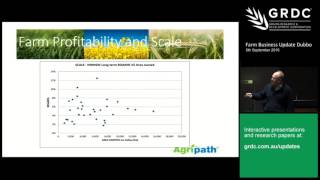
Simon Fritsch argues farm size alone doesn't guarantee profit. Using Australian farm data, he shows that within the same scale, returns vary widely. Top performers focus on yield, enterprise choice, low overheads, and timely operations instead.
Chapters
So what are the key messages? Well, first and foremost, one of the key messages is that our long term benchmarking data over 10 or 15 years for most of the regions that we deal with consistently show that there is no real correlation between farm scale and profit and farm profitability.
So that's good news.
If you're sitting in the audience at the moment thinking, I I'm only a small operation, how can I compete with the big boys?
We'll look at some of that data.
I want to reiterate that profit, particularly from a grain farming business, is driven by yield, but also enterprise choice, gross margin and having a low business overhead. And these are directly influenced by how you guys manage. You have an impact on each of those items. The decisions that you make on a day to day basis will impact on your profitability. And we'll look at some of that data. Making good decisions about machinery can reduce your costs by up to $100 a hectare.
We'll have a look at some of that data.
And understanding these interactions mean that your business can find a sweet spot, a level of profit that it can run at good profits and enable you as individual growers to do the things that you need to do with your family, to provide the wealth for your business, to provide succession, to provide the wealth to school the kids, provide the wealth to buy the neighbours, provide the wealth to do the overseas trips and provide the wealth to build the kitchen and the house extensions and those sorts of things. So it's really about understanding your business profitability and how we work with that to build that wealth.
Our databases from Agripath, this is a.
Bit of a heat map of where.
We are located and how we work with our growers.
We really base a lot of the data that I'm going to show you.
Today are based on regional groups which extend from into Queensland right through the.
High rainfall region of just out of.
Geelong, in the high rainfall region there.
And it's really from our perspective about trying to understand what drives profit in each of those sort of geographic areas. So that we're getting away from the issues of well, it didn't rain on my place and it did on that one in the north of the states.
So the profitability is different.
We're really starting to look at business profitability over a long period of time in Pacific regions.
Over that period of time. I want to start first of all.
When we talk about sweet spot, we're really talking about profit.
Where is it that your farm is generating good performing return on its assets in that environment?
And the way that we measure that, or I call the engine that measures that, is the operating return on profit.
And it's basically calculated by taking the.
Gross income of the business that it generates. And from that we deduct those costs. Those costs we call direct costs, which are the costs that you incur to generate that income. So in the farming business, that's things like seed chem fert, but it's also your labour, the machinery costs that, that you put into growing that crop, cartage, those sorts of things are also important costs in terms of generating the income. We also then deduct what we call the overhead costs of the business and they are the costs that you incur that don't generate you any income. So from a business perspective, if we go out farming in the central west region of New South Wales, we all have a certain level of fixed costs in our business that we incur, regardless of what we do or choose to do on that, on that asset. So with things like rates, insurance, R and M on the ute and the family car, to get to town, a bit of your own time to manage the business, bank fees, accountancy fees, all.
These things are what we call the.
Overhead costs of the business. And they have a big bearing on.
The profitability that equals the operating return.
And from a profit point of view, when we focus on that, we're looking at putting that over the assets you managed in the business. So in your case that includes the livestock, the land, the water and the machinery associated with running the business. We like to at Agripath call list the engine.
So underneath that is a whole host of things which some of the previous.
Speakers have already talked to about, including my colleague Sam Newsom. Today there are things like the interest that your business occurs, the drawings that your business occurs incurs, the maintenance of.
The capex on your assets that your.
Business incurs and the tax that your business pays.
They are what we call discretionary items.
And they become below the line. So when we're trying to look at.
Farm performance, we're really looking at your business to say, how well is that engine performing? How well is that engine creating significant.
Enough profit to cover the drawings, to tax the loan repayments, the interest that the business is incurring. So from a benchmarking point of view, we generally focus at this level to enable us to understand those concepts about what is it about those top performing businesses or their engines, how well are they performing and what does that mean? And part of what we do at Agripath is really help you as growers, put your information into a format so you can therefore make better decisions about your engine, about how well that engine needs to perform to achieve the things that you want to do, such as school of kids and those sorts of things in your business. But more importantly, what are the things that I can directly influence as managers that will improve my profitability for my.
Business going forward over that period of time?
So my focus now going forward is.
Really about not the things that we.
Want our engine to do for us, but that engine in itself in terms of what makes a good engine, what do we need to focus on as farmers? What are the things that drive that outcome to give us higher profitability out.
Of our businesses going forward?
So the first thing I want to look at is this issue of scale.
So this is some benchmarking data from northwest New South Wales. It could be our Central west data set.
This is long term return on assets managed.
So each one of these dots represents.
A farm in the data set and it's looking at their average return on.
Assets over a five year rolling average. In other words, these farms, this farm.
Here has achieved over the last five.
Years a return on assets of about 10.5% on its asset base. This farm over here has returned a return of about 5.8% return on assets managed. So we've got return on assets managed.
As I said, operating profit over the.
Asset measured as a percentage. In other words, a farm here that's got $10 million worth of asset, that's.
Achieving 10% return, is achieving over a million dollars worth of profitability every year over five years on average. Sometimes the profit will be higher, sometimes the profit will be lower.
But over that five year rolling average, it's achieving about a million dollars worth of profitability over that period of time. What we can see from that data point is when we look at each of these farms and compare that with the area cropped, including Fallow, because we're in the north, that profitability varies greatly amongst the farms, including on scale. And in fact, some of the largest scale businesses above 10,000 hectares have actually had some lower performances than some of the smaller businesses.
And I think that's good news as.
An operator for everybody in the data set, because it means that everybody's got opportunities. From our perspective, some of the issues.
Here is to say, well, you would think scale would be benefiting farm performance.
And the profit of the business.
And I think it comes back to this question that as the business grows, so does its overhead, cost structure, and probably more importantly, so does Its ability or its locus of control over how it can manage things and do things on time starts to wane a little.
Bit as the locus of control gets larger and larger. So we tend to see a drop off in profitability.
That said, when you look at long.
Term returns on assets compared to Abare, anything up around 5% and 6% is a pretty fair mark. And as Mark said before, in terms.
Of add that to your capital gain.
Over 6%, you've got businesses that are.
Still performing at over 12% return, including capital gain over the last five years, which I think beats anything in terms.
Of the equity market. The encouraging thing here is for businesses that have got smaller scale, we have a large range of profitability, varying from as low as 2% right through to.
Over 10% for various similar scaled businesses over that period of time. And from our perspective, that starts to.
Make us wonder, well, what is it that some of these businesses are doing.
Compared to their peers that drives that.
Extra profitability that allows them to operate.
Their engine at a level that's generating.
10% returns compared to some of these.
Other businesses that are down around 2 and 3% returns on asset? When you think about the average asset in that group being about $20 million.
A return of 10% compared to a.
Return of 2% is an 8% is a $1.6 million difference in profitability between.
A farm performing at 2% and one.
Farming at about 10% in that environment. So one of my key messages is that it doesn't matter whether we go to the northwest, to the central west.
Or the southern high rainfall zones.
What we see when we start looking at farm performances is large variations in profitability. And yet when we talk to those growers and they look across the fence, they say, well, I don't understand why that is happening.
I think I'm growing the same sorts.
Of crops and I'm getting the same sorts of prices as my peers. Why are there big differences in profitability? And the answer to that is it's a lot of it's to do with management and the ability of people to.
Get performance out of their assets.
So how do we find a sweet spot? So the challenge for us is to.
Take business sitting in here. And if we think about our average farm business at 4,000 hectares in the data set, we've got quite a large range of variance around that sort of level for farming up around 10% and as low as 2% type returns for.
Businesses in that environment.
So how do we take a business that isn't performing well to a more profitable type of business.
My first message is that you need to focus on margin. Margin is probably the most important component of helping generate high returns for a business.
This chart just looks at the Central West.
Again, it's long term data. So it's from our Central west clients.
Encompassing the Warren Conamble region in this environment.
And it just looks at return on assets managed.
Again up the left hand side here, ranging from 0 through to 8%. And along the bottom here is what we call the long term crop gross margin.
So this is a gross margin that is generated year on year. The average gross margin generated year on year from all the crops grown, including the fallow. So we take the entire farming area and divide it by the total crop gross margin to give us this average long term gross margin. So it includes the gross margins from the wheat that you might have grown. It includes the gross margin from the canola or the chickpeas or the lupins.
That you might have grown. And it's looking at how that lines up in correlation in terms of return on assets managed. And we can see that. What we're seeing is the top performing farms in that part of the world are generating margins in excess of $250 a hectare compared to these guys down here generating 1 and 2% returns with.
Margins of around $100 per hectare. If you take the average farm that.
Sam put up earlier in the morning and talk about 2,700 hectares of farming, the difference between what these guys achieving and these guys achieving at about an extra $150 a hectare on 4,000 hectares of farming is about $600,000 a year.
Extra profit as a result of that performance compared to their peers. So it's a lot of money individually for people.
What does that mean in terms of performance?
Well, what's driving that outcome?
Well, one of the main things and one of the keys is a focus on yield. And when we look at just gross margins in the northwest for short fallow wheat in 1415, the top performing farms generated margins above 5 and $600 for their wheat crop at yields above 2 and a half tonne to the hectare. And as the margin dropped away, as the yield drops away, so does the.
Margin in that environment. So as key focus for growers going forward is that you do need to be focused on yield.
Yield is a major determinant of driving profitability in your business. But it's a little bit more than that because profit is about income, less the cost, as we've seen.
And that income is not only driven by yield, but it's driven by the.
Price that you achieve in your business for your commodities. It's driven by the scale and the arability of your business.
So how much of your country is devoted to farming, how much is devoted.
To livestock and what the appropriate mix.
For that might be given the environment.
And the relative profitability of each.
And more importantly, from a farming perspective.
It'S also driven about enterprise choice and.
This thing called cropping intensity. How intense do we drive? What level of intensity do we drive.
Business performance in your environment? The other component of the profit is the cost.
So we have things like area yield and TPML costs. TPML cost being your plant machinery and.
Labour costs that your business incurs.
And I'll talk a little bit more about them a little bit later in my talk. And the farm overhead costs and the need to keep the cost down in that environment. All right, when we think about yield.
Yield is a function of plant available.
Water and water use efficiency. And one of the things I think.
That the top performing farms do is they understand their environment.
They understand the environment that they're working in and what impact that has on their ability to produce yield and profit.
Out of their businesses going forward.
All right, when we talk about plant available water, we're really talking about growing season rainfall. We, which we all know right at the moment we've got plenty of probably more than we wanted.
But we're also talking about this issue.
Of stored soil water. And particularly for farms north of Dubbo.
Stored soil water becomes a very important.
Component of the profit factor going forward. That's influenced by how well we do some of these things, how much stubble.
We retain, how good our weed control.
And how timely that is, and what sort of tillage systems we maintain in.
Our soil system all impact on that starting soil moisture, as we know.
But what we don't think about enough.
And what I encourage growers to think.
About is what environment are we actually operating in. So if we take an environment like.
Coonamble or Warren in this environment, what.
We do know is that when we run 100 years worth of rainfall data, we get about 277 millimeters between October and April. And if we're good farmers and we.
Store that moisture at 27.5% water use efficiency or fallow efficiency in that environment.
That means when we plant the next crop, we have about 84 millimeters on average in that profile as starting water in that profile.
Yet we're working on profiles that hold.
150 to 210 millimetres of moisture in those environments. And what I do know is that.
The top performing farms that have resilient.
Businesses, engines that perform well, understand that really well about their environment.
What it means when we have 84.
Millimeters of starting moisture is that as.
Average, it means 50% of the time.
We have less than that. 50% of the time we have starting moistures in our cropping systems with less than 84 millimeters and 50% of the time we have greater than 84 millimetres.
And it's what you do that in terms of how it affects your farm.
Profitability that is one of the big.
Differences between what top farmers are doing and what average farms are doing in that environment. What does this mean? Well, if we looked at that same data and work on plant available water for wheat on short fallows and chickpeas on short fallow, on average sort of rainfall, it means that our plant available.
Water, when we include the 84 mils of starting moisture plus our in crop.
Rainfall in that environment is about 270 mils environment.
When we look at standard water use.
Efficiency work, which we've validated with benchmarking and the closing yield gap project, we're really talking about achieving an average attainable yield long term in that environment of 2.4 tonne of the hectare. And for our chickpeas, about 1.4 tonne of the hectAre. If we use what we call long term wheat prices and long term chickpea prices, and we're generating those sorts of incomes and we're incurring those sorts of direct costs to give us that sort of margin over that environment, then if we deduct the overhead costs for those two crops, we're achieving these sorts of returns. $145 a hectare for our wheat on short fallow and the following wheat crop, chickpea crop at 1:98, giving us a return of about $345. If we choose just to long fallow, in other words, store the moisture from that wheat crop and grow it in that crop in that same environment, we.
Actually can produce a very similar profit.
$339 a hectare from only farm once every two years. But probably more importantly, we're only spending $375 instead of $655 to get the.
Same profit in our business. Does everyone understand that concept? So Mark talked about risk before and how do we de risk a business? It's about understanding the environment that you are in and changing the language from guess what that happened this year because it didn't rain to we do these things in this environment because we know one year, in five it's not going to rain enough.
We know that two years in five.
Our starting moisture is going to be less than 84 millimeters. And we do these things specifically in our environment. Because of that fact, the further east.
We go, we have a different conversation.
We say we do these things in our environment because of these reasons, because we accumulate moisture, we don't have the.
Profiles in our soils to store that moisture.
And we do these things as a result of that in our environment to enable that to happen as part of our risk profile. So it's about changing that conversation from.
This is what we got because of it.
This is what we do because we know this about our environment. And I think that's what good performing.
Farmers do very, very well. How else do we find your sweet spot? Well, one of the important things is.
That we need to recognise that some crops are more profitable than others. And we need to be measuring our performance individually and as peers to understand that over time so we can learn about which crops are more profitable.
And some crops add a lot more.
Value to your cropping sequences than others.
So some crops like cereals on cereals.
Take away from the cropping sequence performance, where crops like lupins and fava beans and chickpeas can add a lot of agronomic benefit to your cropping sequences.
Going forward. And getting onto this issue about what.
We call crop frequency in terms of particularly where you are further west in.
Lower rainfall environments with big profiles, we.
Really need to answer that question about what is appropriate cropping frequency for my environment. How much fallow do I have in my farming system? And I do these because it's more.
Profitable for me to do that over a period of time. The other component is that we really.
Need to be thinking about low cost businesses.
What is it? How can we keep our costs low in the business? And we'll look at some overhead cost data shortly.
And if you are small scale, I believe one of the big challenges for you is to find ways to leverage your time. Unfortunately, you have time.
Growers with 5,6000 hectares plus are probably full time managers.
Farmers with less than 2000 need to start thinking about how they can leverage their time or their son's time or the next generation's time going forward. So that might mean that you will take, you will run the business of farming, but you'll also do other things. I've had clients that have worked on oil rigs to get into farming. They've gone and done their two weeks on and two weeks off and run a farm while they're doing it. I've had others that have worked on the live sheep trade into sordie, just into the Gulf, managing, managing, being the livestock manager on that sort of business just to get leverage on their time.
So they can apply it.
So small farms, one of the key issues for you guys is how do I leverage my time? Is it through contracting, is it through doing things off farm? How do I leverage my time to.
Get that sweet spot in my business? So what is the importance of crop choice? This is the long term again, five year average gross margins for wheat, barley, chickpeas, lupin, canola and the average crop gross margin for farms in the Central west region over the last five years, rolling average in that environment. The blue is the average what the average growers have achieved and the orange.
Is what the top performing farms over.
A five year period have grown and achieved. And we can see that their focus has been primarily wheat and chickpeas. And as a cereal, they have been the two most profitable crops again.
So if you start thinking about the.
Difference between farm performance on a crop like lupins or canola in that environment.
Compared to chickpeas, you're giving upwards of $100 a hectare.
If the land is suitable for growing chickpeas in that environment compared to some.
Other crops in that environment on a couple of thousand hectares, that's $200,000 worth of profitability between the difference in crop choice. So crop choice becomes a really important component. So when we're looking over the fence saying why is it some farms perform.
Better than the others? Some of it's due to yield, some of it's due to the types of crops and the sequences they actually use in their businesses. Going forward. When we talk about overhead costs or running low cost businesses, this is the Central west five year long term. Again, average overhead cost per hectare for businesses versus their scale across the bottom, ranging from 0 through to 10,000 hectares.
And again, we can see that for.
Businesses that have got similar scale, we've got large differences in overhead cost. So we've got businesses sitting here running at about 140, 160 to $170 a hectare and equivalent businesses running at about 60 to $70 a hectare.
On our average farm that Sam put up this morning, that $100 a hectare is about 3 or $400,000 extra profitability.
That some of these businesses are enjoying.
Over some of their peers in that environment.
You can see there that the overhead costs do drop as the scale of the business, business increases. But I really want you to focus here at this level and say that it is possible for small scale businesses.
To have a low overhead cost business. So again, these are things about how you use your time, how you make.
Decisions about insurance, how you make decisions.
About your utes and vehicles and those sorts of things on your farm, how you make decisions on R and M.
On those vehicles and things over time.
Can reduce the cost of your business going forward over that environment.
So quite dramatic differences in profitability achieved by those farms.
So again, when we look over the.
Fence, we're saying, why is it that some farms perform better than others?
Part of it is that they run a very low overhead cost business component.
Compared to their peers.
Right. Toyota Plant machinery and labour from an Agripath perspective, the challenge has always been about machinery. How much kit do I have?
I'm going to stand in this camp.
Over here and say, I love heaps of kit. I just want to get the job done. I want to stand over in this camp and say, I don't like lots of kit. I think it's expensive to own. It depreciates. I want to do it as cheaply as possible.
So what is the right argument in terms of machinery, in terms of how we use it?
We meet that challenge by looking at what we call total plant machinery and labor costs. So it's essentially the addition of all the contracting costs that your business incurs in it. So contract spraying, contract harvesting.
Thank you.
Penny Contract harvesting, contract planning, if you do it, plus all the costs that are associated with running or owning machinery. If we run our own machinery, we're incurring R and M, we're incurring wages for people who operate that machinery and we're incurring depreciation on that machinery. The fact is we either buy machinery and watch it lose value or we buy machinery and watch the price of new machinery go up much higher than what we bought our last bit for. Either way, it's depreciation that we're incurring over that business. And when we start lining up those total costs to do the operations to.
Get a crop of wheat in the ground, this data here just looks at short fallow bread wheat TPML costs, total plant machinery costs across a data set of farms. And it just shows that for some farms it's costing as low as $100 a hectare and for some farms it's.
Costing over $200 a hectare. So again, we take the example farm that we have in front of us in your books. At 3,700 hectares, $100 a hectare is $370,000 difference between that sort of farm and what these farms are achieving just through the decisions they've made from machinery.
And I know this is a very confusing chart, but if you look at some of this top, this farm over here, it's chosen to do everything by.
Ownership, so owns and own setter, owns.
Its own planter, owns its own spray rigs, operates it, does all that and it's costing $140 a hectare. And we've got another farm sitting in the middle here, which is this one here, which has chosen to do it.
All by contract, very similar cost.
So we've got farms that are fully contract with very little labour input from.
The owners compared to other farms that are choosing to do everything themselves with very similar TPML costs. And the variance across that data set is over $100 a hectare. So as growers, we need to say.
Well, what is the cost and what is right for us going forward? When we look at that in terms of scale, does owning lots of machinery help us in terms of scale? Well, the answer for that is probably yes. If we have small scale, then the.
Cost of machinery ownership, it kind of.
Makes sense that it's going to be a little bit more expensive and it gets a bit out of hand. This is Western Plains TPML wheat costs with costs getting really high. In this case, it was a year.
In 1415 where some people didn't plant a lot of their area because of.
Fallow, but we've got large variants in cost. But it's equally important if we focus down here that despite scale, we can have businesses even with small scale again.
That are achieving TPML costs that are very competitive with their larger scale peers. So as a challenge, we need to understand what our TPML costs are for your business going forward. And I would advocate the only way you can do that is actually by measuring your TPML costs through something like benchmarking. So you can get an understanding of that. Remembering that there's up to $100 a hectare better performance out of by getting it right.
And why does this occur?
Because I think when we think about efficiencies, we generally think in terms of machinery ownership. As the scale of the business rises, we generally believe that so does the efficiency of machinery use, but it's actually not the case.
It's actually a little bit of a roller coaster component and it really looks like this, this is a one man show running the right amount of gear.
With the right amount of area.
To.
Plant that, that crop and get everything done on it. But if they choose not to plant.
As much, which is what we saw in the prior slide, these guys, because of dryness, then their efficiencies get really inefficient really quickly.
And equally, if they choose to plant more with that plant, then they start to run into other issues in terms of planting time and stuff and their.
Efficiencies drop off pretty quickly. A two man show. We've probably got a little bit wider before we drop off in efficiency and then we can go to a big Harris green tree model where we can.
Probably tack on another couple of thousand acres and it's not going to impact on our efficiencies.
But the relevance here is it is.
Possible to be an inefficient farm with high scale through the choices that you've made. And when we look at that TPML cost across farms, look at the scales.
We'Ve got differences between some farms and others as a result of it.
Just one issue to talk about in timeliness in terms of its impact and a lot of people talk to me about this and say, well it's, I don't know, I want to have a high TPML cost, I don't care because.
I get things done on time.
And to some extent I agree with you. So if your business is a business that has a high TPML cost but it has high gross margin and the engine has high profitability that allows you to do the things it needs to do, then that's great and I would support you on that. If your business is a business that has a high TPML cost and low margin and low profit, then it's probably something you should look at going forward in terms of what is appropriate for our business.
Is there a better way to do that?
And what we do know is that.
As the businesses move from scale, is.
That what we did yesterday or last year doesn't always work going forward? So often if we buy a block.
It might mean that we need to.
Use, think about using contractors instead of.
Kidding up because we're going to end up in one of these little holes.
As a result of it going forward.
Which will affect business profitability. That said, the importance of timeliness. This is some work done by Graham in 2014 on time of sowing with 26th of April through to the 5th of July for both Gregory and Suntop at Narrabri. Yields dropping from five and a half.
Tonne down to three tonne.
So quite dramatic loss in yield. When we look at that in terms of profitability, if we had a full profile of moisture in that environment, we're really looking at a difference in a mid May plant to a late June plant of over $500 a hectare in.
Margin as a result of that yield difference.
If we've got low starting moisture, we're still looking at a difference of over.
$200 a hectare in margin as a result of that outcome. So when we're talking about machinery issues.
And the lessons associated with it, we.
Need to ensure that whatever decisions we.
Make, they need to be timely ones.
In other words, getting things done on time. I want to finish the sweet spot.
Difficult to find, but it's really about focusing on margin. If you focus on margin and the.
Things that drive it, then it's possible for every business, despite its scale and.
Its size, to have a sweet spot.
And be very profitable and achieve profitability that allow you to do the things that you want to do. Pay the school fees, do the holidays, buy the farm next door, pay the.
Debt back, provide succession for the next generation. If you focus on margins and things that drive it, you can achieve it.
You need to know your numbers and be very adaptable in terms of, particularly with machinery and crop choice and understanding that impact of starting moisture on your.
Profibilities and the decisions that you make around it.
And I'd encourage you, if you're interested or want to be challenged about trying.
To find your sweet spot or building a more profitable business, talk to us about our farm focused process and get involved in benchmarking.
Because if you don't measure it, it's very difficult to have a conversation about some of these things. Thank you.
More from Gerri







GRDC National Variety Trials (NVT) Case Study: Helping Oat growers make informed variety decisions



Managing rhizoctonia in wheat and barley: Impact in low and medium rainfall zones 🌾🌾
