The Plant Breeding Institute walks through how they test cereal rust samples from Australian farms. They process about 300 samples a year, identify 5 to 10 strains annually, and return results in three weeks. New strains show up roughly every two years.
Chapters
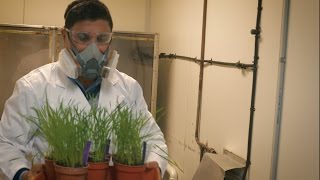
So the first step in the race analysis here at the Plant Breeding Institute is that when we receive a sample, it's actually accessioned, it's brought into the laboratory, its details are recorded, and then it is placed in a glass tube ready for inoculation in the greenhouse. In this particular example, we have a sample of wheat leaf rust that's been sent to us from Victoria. It's quite a good sample. You can see importantly, that it's been sent to us in paper envelopes, which is crucial. If the samples come to us in plastic, the rust dies. And secondly, there's adequate rust for us to inoculate a differential set directly. If the sample did not have enough rust on it, we would initially have to do an increase and that would take an additional three weeks. So with a sample like this, we can process it and get an answer back to the growers within three weeks if there's an inadequate amount of rust on the sample. And that process is going to take us six to eight weeks. So once the accessioning process is complete and we recorded all the details, the next step is to take the sample to the greenhouse and inoculate some seedlings. And that's where we're going to next. So the inoculation process starts with the addition of a, a light mineral oil to the rust sample, which is then agitated to form a spore suspension. Once we have an adequate spore suspension, the sample is applied to a set of indicator lines by using an aerosol can. The differential set is inoculated from a number of different directions to ensure uniform deposition of the sample on all indicator lines. Once inoculated with the rust, the plants are transferred to a misting room. To ensure there is no cross contamination between isolates, the inoculation chamber is misted as well. To induce infection, the plants are placed in a misting room where they receive an artificial dew treatment. The dew treatment is extremely important because the rust spores need free moisture on the leaf surfaces in order to germinate and infect the plants. So following a 24 hour Dew treatment, the plants are brought out to the greenhouse where they are placed in a temperature controlled micro environment room for about two weeks. During this period of time, the rust grows and develops and at the end of that period we're able to record the results. And now it's time to determine what strain is present in the sample that's been sent to us. The way we do that is to look at each genotype or each different wheat variety and determine whether it is resistant or susceptible to that particular rust isolate. The ability of the rust isolate to infect different wheat genotypes tells us what the strain is. So in this particular case here, we have a sample that represents a new strain of stem rust. What we've done is we've increased that strain of stem rust on a selection of susceptible variety here. But importantly, we've also included a differential set. So here is an example of a differential set that's been inoculated about two weeks ago. And we work our way through each of the differentials. Each of these is a different wheat variety to determine the resistance and the susceptibility and that allows us to identify the strain that's present. So you can see here on this one, this variety is actually susceptible to this isolate of stem rust. This one here in the middle is actually resistant. There's no evidence of the rust infecting that at all. So in an average year we would receive anything up to about 300 samples for each of the rust pathogens that we do strain analysis on. From those two to 300 samples, we would identify between five and 10 different strains for all of Australia. Now, occasionally, let's say once every couple of years, we do find an isolate in a sample that represents a new strain. And when we do that, it is very important that we purify that strain, increase it and put it into our collection so that we can use that in our breeding and genetics work. Once we are happy that the isolate is actually pure and it is what we think it is, we will collect the spores off the susceptible variety, dry them down and put them into liquid nitrogen storage. In liquid nitrogen storage, that isolate will remain viable indefinitely. We have isolates so that we retrieve from liquid nitrogen that have been there for more than 50 years and they're still viable, very important resource. We use those isolates for our genetics program and also to test all of the wheat breeders material that's sent here each year. So the final step in the process of the race Australian identification surveys is for us to send out the information, the results, the that we get for each of the samples that are submitted initially. When we receive a sample, they're accessioned, there is an email acknowledgement that goes out to the person that sent that sample in. All going well. If we have a very good quality sample, about three weeks later we are able to send a result back again by email to the person who sent the sample in. This example here shows a sample of leaf rust that was sent from Western Australia to us off the Bali variety bass. And we've been able to identify that as pathotype 5 4. Once a year, we compile an annual report where we bring together all of the information from the rust surveys all the way through to our rust testing of Australian wheat varieties. And that is a detailed report that can be downloaded from our website that gives the expected responses of cereal varieties to the current rust strains that are present in Australia. So the whole success of our 95 years of surveying rust pathogens in Australia has relied upon collaborators sending us rust samples from cereal crops. So please, if you find rust, send them to us so that we can include them in our annual strain surveys. We have an address at the University of Sydney Plant Breeding Institute to which those samples can be sent. We can send you pre postage paid envelopes. Just send us an email and we'll send some of those envelopes out to you.