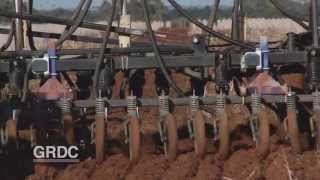
Southern Farming Systems tested 15 different seeders in high-stubble paddocks for GRDC, comparing disc, tine, and other rigs under 16 tonnes per hectare of retained crop residue. Nearly 400 growers attended the demonstrations, with drones tracking early vigour and biomass throughout the season to measure yield and profitability.
Questions this video answers
Barley sown at 15 millimetres depth.
Strips of 12 or 24 metres at 80 kg/ha seed rate.
MAP at 70 kg/ha.
Up to 16 tonnes per hectare.
About 200 participating grain growers; nearly 400 growers visited the sites; about 180 attended a related trial.
Chapters
Where would you see 15 different seeders in action in one place?
The answer. Have Southern Farming Systems run a crop performance trial on your property. As part of GRDC's national stubble initiative, SFS, with grower support, designed this demonstration to allow growers to who see firsthand how best to maintain profitability while retaining stubble in their farming systems.
A lot of farmer feedback we've had from SFS and whatnot have said, you know, trial plots are great, they're a good starting point, but we want to see paddock scale stuff. So we came up with the idea of saying we'll invite a few of the neighbours over and do some big trial plots. It got a bit out of hand.
The few neighbours grew into 200 grain growers, all very keen to see how the different seeders coped in this high rainfall region, country where stubble loads can get up to 16 tonnes to the hectare. A test for any seeder.
We really want to find out what sort of ability each of those machines has, and we get that in a couple of ways through the trial work that we're doing, but also talking to the growers. The growers are using those machines every day and they're using them in retained stubble wind situations. So they're the guys that know how they work and know how they don't. And it's about sharing that information across the broader group.
To compare the seeders, barley was sown at a depth of 15 millimetres in either 12 or 24 metre strips at 80 kilos to the hectare, and with 70 kilos of map, we're sowing it.
A bit late, and that's because logistically we have to wait till everyone finishes their sowing program so we can get all their seeders here. So we're probably disadvantaging some of the implements. Maybe the late sowing is an advantage for the disc seeder, but I'm not really sure and I'm really excited about seeing the outcome in the end, really. I mean, I hope that we see some variation.
60K'S further west of this lighter country, clay soils prone to waterlogging are more common. In a related trial, heavy stubbles were burnt to allow soil moisture to be intentionally lost. Nine seeders, either disc or tine, were used and about 180 growers turned out for that demonstration.
I guess the key to our trial at Bradvale with our grower operation is to analyse the profitability of each system. What's the efficiencies you're going to get out of a disc with. Speed and timing going to relate to profit at the end of the day versus seed placement, weed control, strength and reliability in stony soils.
That's been a question on nearly every seeder today, asking, well, how does it handle rocks? What's it like for maintenance in hard ground in tough conditions? And so we're actually getting that information out of the growers and they're using it over a whole range of different soil types.
As the growing season moves on, drones equipped with infrared capability will help quantify crop performance.
So the idea of using the drone, we'll put it over the crop four or five times. That will make early vigor and biomass, see how that correlates to yield. Sfs will do the same thing and see how that stacks up on the retained stubble environment at the end of the year.
While it's early days for these paddock trials, nearly 400 growers have already set foot on these demonstration sites. That would seem to be a fair indication that this retained stubble management project is heading in the right direction and for all the right reasons.
Grau is a committed to research and they love to see their money going back into on farm demonstrations where they can come and see stuff and check stuff that really impacts on their enterprise. So yeah, this is a really fine example of how GRDC or the growers research levies are used for the betterment.
Of their industry as well as helping to provide local solutions. Data from these paddock trials will be fed into the national Stubble initiative. Meanwhile, at the other end of the season, Groundcover TV will be back to find out how it all went. Keep watching.