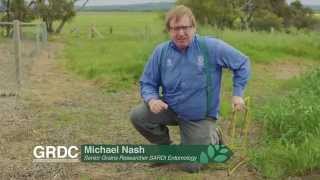
Short instructional video demonstrating subsampling methods for counting snails using quadrats. The speaker explains challenges of high-density snail populations along fence lines, suggests varying quadrat size (smaller or larger) as long as it's representative and recorded, and recommends subsampling to reduce counting workload when performing multiple quadrats.
Chapters
So we've come over here like the snails. Moving over in the summertime to the fence lines and moving up onto posts. As people have usually seen to maintain their moisture over summer. The farmer's done a really great job along here. Of getting rid of all that plant material that they can hang out on. So we've actually come over here to do some sampling to see how many is over here that are still alive. So we can take our standard 30 by 30 centimeter quadrat. We're using out in the crop and pop it down. But, gee, there's an awful lot of snails there. I don't want to can all them. And if I'm following the Bash and Bate and Burnham book. And I'm actually doing 20 of these quadrats, that's a lot of work. So we'll introduce the idea here of subsampling. So the idea is, if you've got a population that you can get along fence lines of 6,000 per square meter, that's an awful lot of snails to count. So you might consider using something a lot smaller. So here I'm using this quadrat here that's about half the size. So I pop that down, I've got seven dead snails. But I have got a live snail over this side here. So maybe more representative is actually using a bigger quadrac like that. The thing is, originally, sampling protocols were developed using a standard size. But as long as you're doing something that's representative of your snail population, you can use any size you like, as long as you record it. So I think subsampling is a really good tool that. That you can include in when you're snail sampling and you're doing your 20 quadrats. You just vary the size. So you're not counting a thousand snails per quadrat. Good tip for you guys.