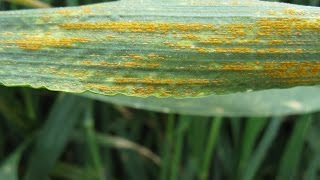
The LR67 gene gives wheat resistance to all three major rust diseases. Evans and colleagues discovered it works by disrupting sugar transport, triggering the plant's defenses. Unlike the durable LR34 gene, LR67's resistance peaks late in the season.
Questions this video answers
More than 150 known genes.
LR34.
LR67.
Evans and his team.
A unique variant of a sugar transporter that interferes with normal sugars and triggers plant defenses.
Chapters
With more than 150 known genes that provide resistance to rusts in wheat, wouldn't it be great if one gene resisted all three types? When we talk about rust, rust is actually caused by three different pathogen species, so leaf rust, stem rust and stripe rust. But in weed genetics, a triple rust resistance gene is pretty rare. Even rarer is knowing how it works. And it just so happens that there is such a gene known as LR67, and it's playing a central role in the breeding arm of the Australian Cereal Rust Control program. So we are fascinated by this gene, LR67, because of its ability to work against all three RAS pathogens. Now, there are a few of these other genes. There's one other gene that's been around for a while called LR34. The interesting thing about this gene is that it's provided durability for over hundred years. However, we know very little about how that gene functions. LR67 is a different story. Evans and his team have figured out how it operates within the plant. And it's all about sugar transport. This sugar transporter carries a unique variant form, and this unique variant form has the ability to interfere with the normal sugars that are present in the plant. And when that happens, it tends to trigger the plant's defense system to fight off invading pathogens. Breeders try to combine genes to get the ultimate disease control. But if two genes have the same fighting function, say sugar transport, the pathogen only has one mechanism to overcome. So to understand LR67 in such detail will not only speed up its commercial application, it will also help to identify how other similar genes work to ensure that when they are combined, the pathogen is faced with a number of different hurdles. So the idea now is to now gradually transfer OR introduce the LR67 gene as one of the sources of resistance into Australian wheat varieties. Triple rust resistance is only one of a suite of projects under the acrcp, funded primarily by GRDC and led by Professor Robert Park. And it's one reason that Australia is at the forefront of global research into combating the most serious disease of the world's most important staple crop. There are some tremendous benefits from the point of view of getting multiple disease control from a single trait. So breeding is a pretty challenging process. We need to package lots and lots of genes into a variety to get the right combination. Some of those genes clearly confer resistance to diseases. Now, putting 2, 3, 4, 5 genes together for disease control is quite challenging. If we can actually use one gene instead of five to get broad control, then that makes the whole breeding process much, much simpler. Simpler, yes. But it may still be a few years until we see these traits appear in our own varieties. Now, this research won't provide all the answers, as LR67's resistance is concentrated in the later part of the growing season. But nonetheless, it's an exciting development from a really important research program.