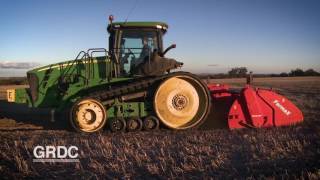
A short video transcript describing a GRDC- and DAFA-sponsored trial at the Fulwood family farm in Meckering (and other WA sites) testing methods to incorporate clay-rich subsoil into sandy topsoils to reduce non-wetting and compaction. It outlines trial locations, implements (deep rippers, spading, topsoil slotting plates), target depths (40–70 cm), expected yield benefits (≈0.5 t/ha or more) and management recommendations (rapid seeding into wet soil, cover crops, controlled traffic systems).
Chapters
Ripping the depths of Meckering's subsoil, cracking compaction and reaching clay to improve sandy soils and help reduce water repellency.
Generally we've got yellow sand and gravel and some clay. So at depth or 30 to 50 centimeters, we've generally got something better than pale sand.
The Fulwood family has worked this land for more than 35 years. Soil amelioration is a big part of their farming system. So they've joined a GRDC sponsored trial across western and southern regions to test methods of incorporating clay rich subsoil into sandy topsoil.
We've been looking quite closely at a number of things to ameliorate our soils with the deep ripping, ploughing and spading. And it's actually a bit of a coincidence that GRDC and DAFA were interested in running a trial that really fitted what we were trying to do.
Sites at Badgingarra, Moora, Meckering and Esperance are being trialled with different implements to combat non wetting soils that pervade millions of hectares across these growing regions.
Really all the evidence seems to show that by increasing that clay content up to anywhere from 3 to 5% that the benefit of that can last for decades.
The Meckering trial is comparing several options.
At the one location today we're using a standard deep ripper, which is deep ripping to 40 centimeters. We're using that with and without type of topsoil slotting plates, which sort of allow seams of topsoil to be slotted into the soil. We're also using a very deep ripper if you like, which can actually deep rip to 70cm. And again we're using that with and without topsoil slotting plates.
Growers are eager for results.
We would sort of be expecting yield increases of at least half a tonne or more.
But the Gemelling Meckering sandy plains are amongst the most stubborn. Despite relatively good rains, it has received.
100 mils of rainfall cumulatively in the last month. And still dealing with some very, very non wetting soils at the soil surface.
The Fulwoods are willing to invest to improve their land. A new spade are the latest family addition which was immediately put to work as part of the amelioration trial.
So whilst a number of growers are very comfortable with their investment and the results that they see, the direct comparison is particularly important in a trial of this scale and geography and soil type specific as well.
Crop management is critical to amelioration success.
It's just really important to try and seed a crop as soon as possible into the wet soil after amelioration and try and get some cover on the ground. This area will get seeded to barley as a cover crop and we'll be able to see sort of straight away, once the crop starts to emerge, whether we're getting more even.
Establishment a controlled track system is another strong recommendation.
Will really sort of optimise the benefits and it will minimise the number of times you actually have to then go back in future years and potentially re rip that soil to get rid of any compaction. We want to see the establishment be more even and more consistent and we want to see sort of better crop growth, better crop vigour and ultimately better.
Grain yields for the fullwoods digging deep into their pockets. And the earth is what it's all about. With a confidence the results will deliver.
A lot of the research that's been done so far, far, and the economic analysis of that suggests that a lot of the payoff can be significant and can be long lasting. So I'm focused on trying to ameliorate these soils sooner rather than later and reap that benefit over more years.