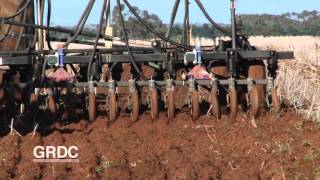
Video/voice transcript of a June 2015 Southern Farming Systems (SFS) demonstration trial run under GRDC's Stubble Initiative showing 15 seeders to ~200 farmers (video got ~1300 YouTube hits). Key findings: large variability in seed placement (about 40–50 mm between machines); disc seeders handled stubble better and tended to place seed more accurately but are less suitable in wet conditions; tine (tyne) seeders and deep cultivation were better on heavy Bradvale clay where discs left anaerobic conditions. A replicated Bradvale clay trial (about 60 km west) showed deep ripping/cultivation improved seedbed and produced the top yields; there was a 15% yield gap between top and bottom performers. A record dry spring reduced yields below the regional 5–6 tonne/ha barley expectation, and machines with high early dry matter suffered penalties later. The transcript emphasises the importance of machine setup and ongoing adjustments; full tables are hosted on the SFS website.
Chapters
Remember this? 15 seeders, 200 farmers and 1300 hits on GRDC's YouTube. As part of GRDC's Stubble Initiative, Southern Farming Systems held a demo trial in June 2015, giving local growers a unique opportunity to see a wide range of seeders in action. In one place, I think the biggest surprise was the variability. In each of the seeders. We were seeing 40 or 50 millimetres difference in where the seed was placed. And that was one of the real draw cards for growers to be able to look at the subtle differences between the machines. Even though they were broadly categorised into disc or tine setups. There's some rules of thumb with your disc seeders. Basically, they won't handle as wet a conditions, so if it gets wet, sometimes you have to sit back and wait. They will handle stubble a lot better than your Tyne seeders and generally, overall, they're a bit more accurate with their seed placement. However, if we look just 60 kilometres west to Bradvale, where heavy clay soils are common, a similar but replicated trial showed that in order to get good seed placement, the machine must first get through the hard clay pan. The difference between tine and the disk systems at the at bradbale was the ability to be able to cultivate below the seed to create that fine tilth underneath where the seed lay in the seedbed. The other difference in the heavy clay was the disc didn't really open up the seed bed like the time machine did, so it actually resulted in sort of anaerobic conditions. So much so that there was a 15% difference in yield between the top and bottom performers, with deep ripping machines coming out on top. And if we stay on yield and, and look back at the SFS trial, the record dry spring didn't help the results. Well, normal season we'd be looking at 5 to 6 tonne in our barley here, and we didn't get anywhere near that this year. Any of the seeders who had high dry matter levels early in the season basically suffered a yield penalty later on in the season. And in this trial, where conditions were tough, it has really highlighted those aspects that growers may not always pay enough time to like accurate machine setup on the day. The guys that spent more time setting their machine up I think had better results and it just showed how important it is to keep tweaking your machine all the way through the year for the different scenarios that will pop up. And with grower groups like SFS keen to keep on top of the important issues, expert advice on seeder setup may be something the group will explore for future events. But for now, the results from the CEDAR trial have given local growers a lot to think about. At the end of the day, it's about having the right system for your own soil top and knowing what works best in your systems. And having generated so much local interest, a trial like this one has reinforced the need for growers to actually see how other growers are working their systems, question what implements they are using, and why. For the full table of results, visit the SFS website.