Trials in Victoria's high rainfall zone show spring-sown dual-purpose wheat can feed lambs through summer and still yield 4 tonnes per hectare at harvest. Farmer Andrew Cochrane's lambs gained 200 grams daily grazing the crop in 2015, prompting other growers to adopt the practice.
Questions this video answers
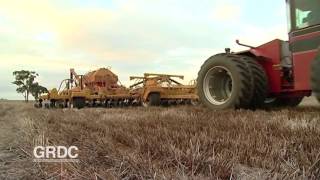
November 2013 on an Invalee farm (Southern Farming Systems trial, GRDC Grain & Graze funded).
Up to 4 tonnes per hectare.
He sowed wheat in December 2014 and reported lambs gaining about 200 grams per day in summer–early autumn 2015.
Chapters
What else can we do with plants in our system and what other rules can we break?
It's a challenging question and when it's applied to dual purpose crops, it's an approach that's helping find solutions for grain growers in Victoria's high rainfall zone. Mixed farm enterprises are common here and providing fresh green feed for lambs over summer is an issue.
Geoclopus crops just looking to fill that summer and early autumn feed gap.
What's unusual is that the research group Southern Farming Systems has been trialling wheat as a dual fodder and grain crop, a project that is funded by the GRDC through its grain and graze program.
The wheat, as I said, was really experimental. It was pretty much saying, well, it's got a vernalisation requirement like the Canola. Can we treat it the same? Sowing winter wheat in spring opposed to in early autumn was a little bit crazy because it has to get through quite a dry, hot period in the early stage of its life.
If it made it through summer and grazing, the plants could tiller in a less stressful time of year and importantly in this high rainfall zone before waterlogging becomes an issue and temperatures drop. However, there were still doubts when the first trial of dual purpose wheat went in on this Invalee farm in November 2013.
The thoughts were that the plant would get that stressed from the heat and lack of moisture that it would just bolt and I suppose try and put a seed head up. So we were pretty surprised when it didn't.
The trial continued into 2014 and although both seasons were particularly tough, the crops were grazed and went through to harvest, managing to yield up to four tonnes a hectare, comparing favourably to the district average for those seasons. Inspired by the trials, Andrew Cochrane adapted his cropping system to include a dual purpose wheat.
We sowed some wheat in December 2014. The root development on it was extraordinary, really. By the end of autumn, not only.
Did the plants have what they needed to carry the crop through to harvest, they they also fed the lambs.
Our lambs in the summer of 2015 and the early autumn were doing 200 grams a day on the long season wheat.
Spring sown dual purpose wheat has created real interest in this high rainfall zone and given some early adopters enough encouragement to include it into their farming system.
There's been a couple of paddocks put in this year in the start of February across the Western District, already on a summer storm, so that confidence to know that the crop is going to stay vegetative for that time is there.
Now, the rule breaking thinking doesn't stop there. Other growers are even experimenting with mixed plantings in the same paddock.
There's been a couple of farmers that have actually said, well, I've got winter wheat in the silo, I'm putting spring sown canola in as well. How about I put them together and have a more balanced feed over the summer and autumn? And then they're spraying the wheat out late autumn and taking the canola through as a grain crop.
Granny and Graze allowed what was just a thought to be trialled and tested. And for some growers, that thought has actually taken root and become a commercial option.
They've got the option up their sleeve on a summer storm. So, I mean, I think that's more than what we had five years ago.