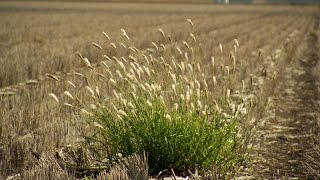
Feathertop Rhodes grass has developed glyphosate resistance in South Australia and Western Australia. Winter-applied residual herbicides, narrower crop rows, and double-knock strategies all reduce populations. The segment covers integrated management tactics including tillage, rotation, and follow-up control.
Chapters
Feathertop Rhodes grass is the latest weed species to have confirmed populations of glyphosate resistance. What's just as alarming is resistant populations have been found in South Australia and the weed has spread into the Western region as well. Nga, the Northern Grower alliance, which is fully funded by grdc, has recently trialled residual herbicides as a means of controlling feathertop Rhodes grass.
So the characteristics of feathertop rose grass that make it such a problem weed. It's a very prolific seeder. It produces a large number of seeds. It's also a soil surface germinator and under a zero till system it can produce corn quite rapidly on minimal moisture.
It wasn't that long ago a double knot spray strategy based on glyphosate was recommended for the control of feathertop. That strategy hasn't always produced consistent results.
The glyphosate followed by paraquat sort of traditional approach, I guess, hasn't really been working. It's not very consistent. So we've been trying to look at some other options to use as a knockdown. Group A has proved to be quite effective, particularly followed by a double knock. That work sort of led to a permit of the group A verdict which can be used prior to mungbeans for the control of FTR and fallow. It should be used on small weeds. So before early tillering.
That emergency permit for Queensland growers to use a Group A herbicide followed with Paraquat expires in August 2016, meaning additional chemistry was needed. That's where NGA's work on residuals comes into play.
We've been using residual chemistries now and that's because we can put it down in winter and then by the time the spring rains have come and the new germination of feathertop is coming through the ground, it is controlled by those residual chemistries.
Of course, the presence of a residual herbicide in the soil would also mean there'd be implications for a grower's sowing strategies.
If you've put down a residual, you're going to have to bear in mind what crops you're going to be putting in the next season coming. Otherwise that might be affected by those chemistries.
Crop competition is another tool in the control of feathertop and earlier GRDC supported research undertaken by the Department of Agriculture and Fisheries in central Queensland indicated the use of competitive cultivars and increasing crop density lowered feathertop Rhodes grass numbers in wheat crops by 30% when the cereal was planted in 25 cm rows compared to row spacings of 50 cm residuals.
Should be used as a part of a management sort of strategy. They can be quite effective. We've been screening a number of herbicides and some show great, you know, some good promise. Balance is something that you can use in fallow. You know, whether you put it down before a spring rain event, it'll give you that good control. Take the pressure off your summer fallow and then, you know, follow up any subsequent germinations with, you know, a weed seeker or another sort of double knock strategy or even a cultivation.
Along with the significant inroads being made by the Northern Grower alliance is the good news that unlike some other weeds, feathertop Rhodes grass seeds only remain viable for a relatively short time frame.
Control those patches, control that paddock and those fallows for a number of consecutive seasons, they can really get on top of those seed bank numbers and get their FTR under control.
What this trial reinforces is that herbicide alone isn't going to beat feathertop Rhodes grass. It really needs an integrated approach, a.
Combination of these sort of strategies. Whether it's strategic tillage cultivation, crop rotation, knockdowns, double knocks, residuals manage well. They can really provide some good control and get that seed rate down.
For more information on this feathertop Rhodes grass project or any other R and D investment being funded through the Southern Queensland and Northern New South Wales Grower Solutions Group, contact NGA or the grdc.