Interview with Geoff Thomas (Speaker B) recounting his agricultural career: grew up on a farm in the South Australian–Victorian Mallee; studied agricultural science and joined the Department of Agriculture; worked as a soil conservation officer (starting around 1965) promoting land-capability-based fencing, watering and reduced long fallows; earned a Wheat Industry Council scholarship and studied rural sociology and farm business economics; worked in research–extension liaison and regional development, then moved into consulting (including formation of Australian Grain Technologies); managed the Low Rainfall Collaboration project (for the better part of a decade) which shifted farmer focus toward profit and risk and encouraged new break crops; in 2013 he received the GRDC Seed of Gold award.
Questions this video answers
Around 1965 (in the 1960s).
GRDC's Seed of Gold award.
For the better part of a decade.
Where does the Geoff Thomas career start?
It starts on the farm in the South Australian Victorian Mallee, of course, which is that area, vast area east of Adelaide, running through much of the northern part of Victoria. Not enough room on the farm for me. So I went off and did an ag science degree and then joined the Department of Agriculture. And I suppose that was really the start of the career back into the mallee again, this time at Loxton and. Yeah, as a soil conservation type person. Yeah.
So that was in the 60s, that was in 65.
And much of the work that I did there was part of a program where we believed that there was great gains to be made in farming land according to various land types, according to its capability. So we set about a program of fencing and mapping that and fencing and watering and farming using farming technologies according to that capability.
So how was it that your role became such a significant role in determining what others were doing on their properties?
Well, I was a. I was a soar conservation officer at the time, you know, making sure that the country didn't blow away. And I suppose looking at it in the systems terms, one of the things that we did do, of course, was a shift away from a lot of the long fallows which were there at the time, leaving the land exposed for long periods.
Was it difficult to convince farmers that you had some ideas that they really should be adopting?
What we had was we had intellectual adoption. In other words, farmers realised the need to do so, but. But couldn't do it because of financial situation. But as soon as the financial situation became good, they did it.
Where did your career take you next?
I was fortunate in getting a Wheat Industry Council scholarship and went to Melbourne and did a diploma NAG extension and that. I suppose the major parts of that which were particularly interesting to me was the rural sociology and the farm business economics. In other words, this whole business of what drives farmers to make decisions and what are the constraints, those sorts of things. And that really, I guess, formed a large part of my. The direction of my career. I stayed in the public sector and I concentrated largely for a while in the southeast of South Australia down at Narracourt, on what I called research extension liaison, in other words, getting the messages from research to extension and to the farmer. That was a specialist position. I then left that and went to the Victorian department at Mildura, back into the Mallee again, doing much the same stuff as I was before, although with a fair wallop of horticulture in that situation, obviously from Mildura, sun rising, then back to South Australia to Loxton again, back into the mallee again and still in the irrigation but, but still pushing for improved farm systems but with as I said, this increasing level of complexity, good complexity, but nevertheless complexity and had to be smart in terms of extension.
So by this time we're talking about the 1970s.
I went off, I had a section in regional development for a while and then I thought, well I'll, I'll do something different. I wasn't sure what it was going to be but I thought I'll do some consulting. Because there was a demand there, a demand for the sort of consulting that, that I was doing which wasn't purely technical consulting but was really a project management consulting. And yeah, I was asked to do the formation of Australian grain technologies. I was asked to do the sort of the business management career wise.
What was the stimulus for you to change direction again?
I had the opportunity to do the Low Rainfall collaboration project. What emerged at that point was I believe a substantial shift in the successful farmers thinking. If I ask you 50 years ago, how'd the season go? You said, oh yeah, the wheat averaged about eight bass, you know, not too bad now you're more likely to hear, you still get that but you're more likely to hear, you know the answer in terms of profit, whether you made it quit or not and risk.
You manage the Low Rainfall collaboration project for best part of a decade. What do you see as being the main achievement of the project?
I think this whole business of collaboration and communication between the groups on systems of, of like interest. I'm not too sure how you measure that in dollar value, but I know that it's been, it's prevented duplication, a lot of duplication. The program did give rise to the emphasis on the need for low rainfall canal. It did give great emphasis in future projects on the need to look for new, for new break crops. And there's no question that it's changed the focus in terms of profitability and risk.
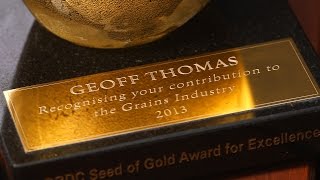
In 2013 you received GRDC's Seed of Gold award, only the second time it's been awarded at this point and the first one was five years earlier. What did it mean to you to receive it?
Well, firstly, I'd never heard of the award. So A it was a surprise and B, I was gobsmacked. Yeah, I mean there are various awards, you'd never seek them. But you know, I was really chuffed and pleased that not just for what I'd achieved but for what those teams and that had achieved because really to a degree it was an award for the team. Not just for me specifically, but, yeah, as a gobsmacked. Somebody even said. They said it's first time we've known you to be lost for words, which I suppose is some sort of compliment.