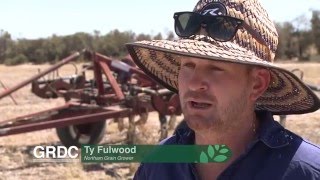
A Western Australian trial used slow-motion video and colored sand to show how different ploughs mix soil layers. A mouldboard plough, rotary spader, and large-disc one-way plough each redistribute topsoil and subsoil differently, affecting yields and returns over time.
Chapters
Technology is taking growers to the root of soil constraints.
So the blue sand that's on the surface gives you an indication of how much surface soil is actually left on the surface by the different machines.
Soil inversion is commonly used to combat constraints, but a GRDC sponsored trial in WA is helping to reveal how different implements mix the soil.
We know a lot about how soil inversion buries weed seeds or changes the wet ability of the surface, but we don't know how it mixes the overall soil profile, which is important when you start talking about renovating a soil and including lime or clay or nutrients.
Trenches of coloured sand helped to illustrate and measure the mixing efficiencies of different ploughs.
Yeah, it's been very successful, so it provides us a way of showing contrast so we can clearly identify where soil from different layers has been moved to.
Digital images captured where the topsoil ended up.
So the SLO MO footage provides a visual illustration of how the implements move the topsoil. So, for example, the mouldboard plougher really rolls the soil over and depending on how much that breaks up, that governs how much mixing you get as well. So a mouldboard plough will bury most of the surface organic matter at 20-30 cm. A rotary spader will distribute it more evenly through the top 30 centimeters. But also a one way plough with big discs, 65 centimeter disks, will also create quite an even redistribution of the topsoil. The rotary spader creates a much more even redistribution than say, the mouldboard plough. But other work has shown that the way that a malboard plough redistributes soil depends heavily on its water content, whether it's wet or dry.
Soil management after inversion is very important and it differs depending on the implement.
Say for rotary spaders that have press wheels behind them, they don't need any further management, but you may do for mouldboard ploughing.
Collaboration has crossed borders with GRDC's investment, enabling the University of South Australia to provide an important perspective on soil profile.
The computer modelling especially is helping us to gain some insights that we wouldn't get from fieldwork or that are difficult to get, especially around the redistribution of subsoil layers and the way that they move through through the ploughs.
The trial aims to help growers make informed decisions.
The more information we can have up front about how different pieces of machinery.
Work, I think the better off we are to make that decision. It's a huge investment for growers in the first place, and to recoup that money. We are getting results that are recouping in the first year but it is a five to ten year program that growers are looking at but with upfront benefits in the first year.
The type of benefits growers are expected to see in the long run are also being evaluated.
The risk. There is a long term site near Geraldton where the long term benefit over eight years is about $400 cumulative benefit over that eight year period for mouldboard ploughing. So that cumulative benefit is about two and a half times the cost of the mouldboard ploughing.
You have some fantastic results. We're getting up to a 40% yield increase by renovating the soil through mouldboard plowing and that's having a fantastic impact. Back to growers bottom line.
It helps fit into that decision making process of deciding what's the best option for a particular paddock. And that's because the decision is not just about fixing the problem now, but what do we need to do to manage this paddock in the future.
GRDC will publish the research and a model will be produced for growers to predict how different machines change their soil.