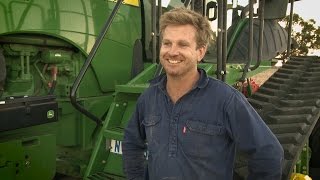
Ty Fulwood farms near Mena and has spent years fixing sandy, water-repellent soils. He's tried mouldboard ploughing, deep ripping, and recently bought a spader to work clay deeper into the ground. He expects the benefits to last five to ten years.
Questions this video answers
1979
About 30–50 centimetres
2013
Approximately 5 to 10 years
Chapters
So we're in Mena, which is midway between Northern and Meckering. This farm was purchased by my family in 1979 and they. And we've been farming it ever since. A lot of this farm is quite light soil, so pale sands to probably yellow. So we have a lot of non wetting issues at depth or 30 to 50 centimeters. We've generally got yellow sand and gravel and some clays, something better than pale sand. We've been looking quite closely at a number of things to ameliorate our soils. The idea is really to trial a broad spectrum of interventions to see what the actual results are. Because we've got a great site, we've got access to good equipment, there's no reason why we can't really test everything that we are testing, which is quite extensive. So we've trialled mouldboard ploughing in 2013. We've done deep ripping last year and this year we purchased a spader to begin a spading program as well. We've done a bit and we also have used a lot of wetting agent to help get crop emergence. I think with the deep, deep ripping with spading, I think we'll be able to ameliorate the vast majority of our country that needs it. And anything where we can't reach clay or reach a sand that has a higher clay content, we might have to look at delving and spading, but I think that'll be a small minority of the property. With our farming practices, which are controlled traffic and our operations that we might be able to get five to 10 years out of our deep ripping and maybe even longer. But if it's anywhere in that period, be very happy. But we are trying to pick the low hanging fruit first and invest in the things that give us the greatest return in the shortest period of time and hopefully get to a point somewhere where we're no longer spending several weeks every seeding with a deep ripper or a spader. If you think that your soils and your farm can benefit from ameliorating them, I think yeah, participate, talk to people who've done it and maybe even run some trial strips on your own farm because you never really know until you've seen it and you've seen it on your country. And we've still got a lot of learning to do, but we've started that process and hopefully we can get to the end of it at some point.