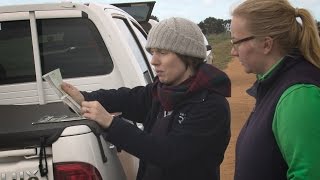
Nine graduates rotate through government, grower groups, and private agronomists in a GRDC and Victorian government program. A field trial of Faber beans on Dan Jess's property tests acid-tolerant rhizobia strains to help growers manage acidic soils in the Western District.
Questions this video answers
Nine graduates over three annual intakes.
Each graduate spends six months with a department, six months with a grower group, and six months with a private agronomist.
A trial plot of Faber beans on Dan Jess's property in Victoria's Western District.
The Optimising Fixed Nitrogen in Grain Legumes project.
Chapters
A joint initiative between GRDC and the Victorian government to fast track agronomy graduates experience and build research extension networks has hit the ground running. The joint venture between the GRDC and Agriculture Victoria will give nine graduates over three annual intakes the opportunity to work on agronomy trials and learn from researchers and regional department staff.
Each graduate will spend six months with a department, six months with a grower group and six months with a private agronomist. So Catherine was working with me this year. She actually sowed this site, which was good. And that was when we got Southern Farming Systems to help us with the sowing.
Sowen was a trial plot of Faber beans on Dan Jess property in Victoria's Western District. It forms part of a national GRDC funded program, the Optimising Fixed Nitrogen in Grain Legumes project.
The acidic soils here in the Western District have really been a limiting factor to growing pulses and getting them to nodulate and getting the most out of them. So this project will definitely benefit us.
It's a handy crossover that will ultimately deliver benefits for both programs.
So it's really getting research that the GRDC is funding and getting it out to the after the growers. And this is a great example of that. We've got Ross Ballard and Liz from Sardi with this acid tolerant rhizovia strain. We've got a trial in Victoria and we've got good relationships with the farmer and we'll have a couple of field days here later in the year, maybe hook up with some of the lion people. And it's just a great opportunity to expose some of that work and not too far down the track. If it's all successful, we should have a, a new acid tolerant strain of rhizobia that will be suitable for beans.
Learning from senior researchers and agronomists will give graduates such as Catherine experience that could otherwise take many years to obtain. And just listening to growers will give valuable insights into how research programs such as this one will deliver meaningful results to their farming systems and enterprise.
We can value out our lambs on the bean stubble. So I'm keen to keep going with them as to how much as a percentage of the program. We'll just have to see how successful they are.
I suppose if growers such as Dan can get the R and D outcomes they need, it will be a win win for them. And if the graduates gain experience and extension skills from this agronomous development program joint venture, it will be win win for the entire grains industry.