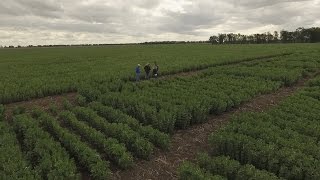
Queensland researchers tested row spacing, plant population, and sowing time for faba beans and chickpeas. Narrower rows of 50 centimeters or less and about 20 plants per square meter often produced higher yields. The work continues to examine water efficiency and optimal sowing timing.
Chapters
Higher yields and increased profitability, leading to a greater uptake of grain legume crops by northern grain growers. That's the aim of the GRDC funded Queensland Pulse Agronomy Initiative led by the Queensland alliance for Agriculture and Food Innovation, in conjunction with the Department of Agriculture and Fisheries. The initiative's first couple of years has focused on field testing agronomic principles.
What we're looking at, first of all is some row spacing, plant population and some timeless sowing work so that we can actually double check that the research that was done around 20 years ago is still applicable for the varieties that are currently available and for those that are actually in pre release form at the moment, so that we can have an agronomic package available when they come out ready for the commercial arena.
What the initiative's early work is confirmed is that narrower row spacing has a yield advantage of up to 20% over conventional wider rows, an increase seen in chickpeas and the other major winter pulse Faba beans.
We've trialled faber beans at 25 centimeters, 50, 75 and 1 meters. Our peak yields have always been at 25 centimeters. However, statistically there hasn't been a lot between the 25 and 50 centimeter row spacings.
Increase row spacing any more than 50 centimeters and yield is penalised. The recommendation is to keep to 50cm or lower.
So what we're saying to growers is if you can narrow them up as much as possible, you'll get a yield benefit from that. Not in all situations is it possible to come back to 25 cm. From a practical point of view, we are actually finding some issues with that from a checking for pests point of view, things like that. So, so basically, if you can narrow them up at all, you'll find you'll get a yield benefit from that.
And there's two very good reasons why.
The first one is, and what we have been measuring, is just light interception. To grow a bigger crop, you've got to convert more light into plant material. So by changing that row configurations, we're actually intercepting more light.
The other reason is due to what's happening below the ground. Wide rows leave untapped moisture between the rows. Narrow rows allow roots to extract moisture from the entire soil profile.
While we've done some measurements, we've still got to do a bit more work there. But it's showing in all of our pulse crops that we are probably extracting more moisture and on our narrow row spacings.
In the past year, the team has also begun investigating Planting populations at this and other sites, Faber beans were sown at 5, 10, 20 and 30 plants per square metre.
So what we've been finding so far is in the lower populations, we're actually not getting as much yield as what we're getting in those higher populations. However, similarly, we're actually finding we've got a tipping point as well. So anything over that, 25 plants per square metre, we're actually not getting a yield benefit from that. So that's an extra cost, extra seed in the ground, extra diesel to plant, but you're not actually getting a high.
Yield once you get to 20 plants per square metre. That seems to be ideal plant population for most of our pulse crops, but in particular faba beans.
The grower hosting this trial has seen the benefits first hand.
You've had experience where the crop is thinner, you only have that maybe 10 plants per square metre or so. It never seems to yield as well as that 20, 18 to 25 plants a metre.
Wade Bidstrup gets his faba beans into the ground by mid April. Time of sowing is also being investigated as part of the trials.
I think if you plant too late, they don't get as much biomass and they don't protect themselves from frost as well as they might if they get a bit more crop about them. Well, they've seemed to be quite frost tolerant. For me, you need really, really savage frost to do too much damage to them. You can see this crop here, they're flowering away. There's been frost for the last couple of weeks.
The initiative's Faber bean trials have shown late sowing in May or June results in reduced biomass and lower yield. Just how early beans can be sown is being evaluated this season.
The trial that we're standing in at the moment has its earliest planting date of the 5th of April. Just trying to see if we can push it any earlier.
While research outcomes are already being delivered from the initiative's first two to three years of work, there's more to be done.
So GRDC are backing up the growers on the ground here who are really expressing that Faber beans are becoming far more popular and they need to know that the research is being done for that, and so that's why we're here.
What's next for the Queensland Pulse Agronomy Initiative is to add better water use efficiency to their investigations.
Well, one of the things we'd like to explore is some of the issues we encountered last year with large biomass crops and not actually being able to convert that into grain yield. So that's what some of the things we're looking at in the future is. Is there a way that we can manipulate that crop in order to conserve more moisture for later on in the season so that we can actually get that yield that we're chasing?
The more comprehensive the agronomic packages the initiative ultimately delivers, the more likely its goal of increased pulse plantings and profitability will be achieved. For more detailed information on specific trial outcomes, go online to see GRDC's Faber Bean and Chickpea update papers.