GRDC in Conversation: Bec Kelly
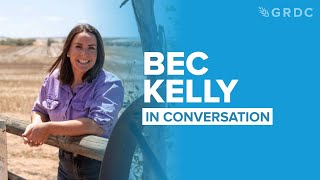
Bec Kelly, a third-generation farmer from Minganu, WA, grows wheat, canola, and lupins. She studied marketing before returning to the farm in 2018 and won a Nuffield scholarship to research how farmers negotiate with energy and resource companies across Canada, the US, Germany, Scotland, and the Netherlands.
Questions this video answers
Minganu, about 400 km north of Perth, ~25 minutes inland from the coast.
About 72 years (third-generation farm).
2018.
~29 mm up to 31 May, then rising to '3,380 mil' for the year as of September (transcript quote).
Canada, United States (America), Germany, Scotland, Netherlands (and about five other countries).
Chapters
This series is a GRDC investment that takes you behind the scenes as we sit down with some of the people shaping our grain industry, uncovering their journeys, learning more about their passions and the projects that are part of their everyday. We are over in Western Australia. This is now the third part of what has been the GRDC In Conversation podcast. We've covered southern Australia, we've covered the north, across New South Wales and Queensland, and now we've headed west to meet with all sorts of growers, advisors, researchers and people involved in the Aussie grains industry. Welcome to the next series. To start off, we. And I think the best part of that I get out of coming on the road is I get to go for a bit of a look around different people's farms. But there's lots of people who are probably listening to GRDC podcast and haven't either come over to the west or don't really know much about the wheat belt over here. So if you're able just to give me a bit of a run through and the listeners as well of like, whereabouts are we on the west coast and what's this region best known for?
So we're in Minganu, which is about 400ks north of Perth. I'm located about 25 minutes inland from the coast and we're a wheat growing area. So we're wheat canola lupins and we grow some pastures on my farm and around the area there's also a bit of barley grown as well.
And so if we're to choose a couple of words or a couple of sentences to summarize the 2024 season for you, how would you describe it?
Oh, I think every year. So I've been here eight years now and every year has been so vastly different and it's really hard to, to find a pattern or to make sense of it. But this year we were really dry up until the 31st of May. I think I'd had maybe about 29 mil up until that point. And then from May 31st until today. So we're in September, it's just been raining nonstop. I think I'm up to 3,380mil for the year, which has been phenomenal considering it's only been a couple of months.
And so you've been home now for, for a few years. So since you came home. 2018 was it?
Yeah, 2018. So we went to Marcus together, um, before that. So I finished. I went to boarding school in Perth and then started marketing and then I took a gap year that went for a couple of Years longer than one year. So I, I lived in America for a bit teaching kayaking and canoeing and then moved down to South America and ran pub crawls for a little bit and then I moved to Europe and I was a tour guide over there for a while and then I came back, we did a uni degree together and then I've been home on the farm since.
Okay, so there's a little bit to dissect there. Let's jump back. So this property where we are here, always been home for you and your family?
Always been home. So I'm third generation on this farm. We've had it for over 70 years, I think. 72 years.
Amazing. And so school down in Perth and you said you studied marketing. So was agriculture of interest to you growing up?
Yeah, I loved it. I didn't know how it fitted in with my personality. Personality and where I saw myself going, but I always loved it. I always loved coming home and it's a beautiful farm.
If we rewind back to I guess those mid teenage years like that, 15, 16, as you start to choose subjects and potentially think of what that university degree looks like, what were the interests and what do you think defined you back then?
So back in primary school I always wanted to be an agronomist. So that was on my, I think it was probably the longest word I knew early in primary school, so that's where I wanted to go. High school. I think I was more interested in the communication side of things. So I saw myself going into marketing or events or somewhere along those lines and then took a gap year and was always driving past paddocks and wanted to know what was happening in the paddock. So I'd be driving in Albania or I don't know, Russia, places like that. And I wanted to know what was going on. So when I decided to come home to the farm I did an ag degree and then tried to give myself the best chance of being here and I've been here for about eight years.
What do you reckon the time overseas and the time away from the farm, like being a kayaking instructor and other things like how's that benefited you and why was that time away from the farm so important?
I think it was important so that it wasn't. I knew what else was out there. It's. I didn't, I didn't just, I don't know, not try anything else. I've tried a whole heap of things and worked out that this is exactly where I want to be and so I think that was important. I think I'm the kind of personality that likes to, to experience a lot of things and if I'd just come home straight to the farm when I was 17 straight after year 12, I might have been burnt out already or wanted to explore and go on my gap years now, whereas at least I've done that and I can give this a crack.
Yeah. And that marketing degree partnered with studying at Marcus Aldem came in quite handy I guess in your first agriculture career type job.
Yeah, well, I still haven't finished marketing. I went on my gap year ends and then changed track. It's. I think studying anything is handy. I don't think it matters what you study, it's just that it gives you the ability to learn and the curiosity, I guess. So it's not so much about what you study.
And how was your time in Sydney?
Yeah, so after Marcus, I went to Sydney. I loved it. I lived in this beautiful apartment with a friend of mine, Leah, and we lived. You could see the Harbour Bridge outside the lounge room and it was right in the heart of it. And yeah, it was, it was fantastic. I loved living there. I don't think I'd want to live there forever, but it was definitely perfect for then.
Did you find you met many people in ag circles when you working in Sydney or not so much?
No, no, not at all. I, I think I worked in an ag company so I worked for Syngenta and there was a lot of people that were maybe more ag adjacent than coming from, from farms and things, but everyone else I socialized with were. They were brought up in cities. They still don't know what I do on a farm. I think they think I grow cotton.
But slightly wrong side of Australia for that.
Yeah, yeah, exactly.
And then coming home for you talk to me about that. The decision to leave Sydney and leave the corporate side of agriculture, was it something that you'd long for or was it just the timing to give it a. A shot came about?
It was just the timing. It was my parents were at a stage where they wanted me to have a little bit more direction if I wanted to come home or if I wanted to continue doing ad roll somewhere else. And yeah, I needed to come home and give it a crack and see if it's what I wanted.
So if you, if you go back to 2018, when you first came back, what was the first season at home like? And what did you, what did your parents have you doing?
We've always like, they've allowed me to do anything. I, you know, I could turn this farm into a carrot farm. As long as I had done the right amount of research and report writing. Like, they're very open to change, they're very open to new ideas, not stuck in their way, and they're quite progressive. I can't remember what 2018 was like, but I know that 2018-2024, not one season's been the same. Every year there's something I learn and I like, this is fantastic. I'm going to take this into the next year. I'm, you know, I'm this little bit more advanced in whatever I've learned. And then the following year comes and I have no idea what's going on yet again. I think the more I'm here, the less I actually work out. I know.
Yeah. It has a funny way of humbling you, doesn't it?
Yeah, it does. And there's so much out of my control as well. I have found that hard the whole way through that. The lack of control over a lot of these elements. Like you can do everything right and try your hardest and still have a terrible year. Financially, it does take a while to get used to. And I definitely think there's a lot of, I don't know, the right word, maybe courage or bravery for people that are doing this year in, year out and not knowing the result.
How do you get comfortable with that when it comes to. Because I'd say my world is so far removed from that. So when it comes to a new season and fronting up again, how do you personally approach it, knowing that the end result is not guaranteed and there's so much having it?
I think you just have to get comfortable with not being comfortable. So it's. I'm not sure. I don't have an answer. I. I still haven't worked it out. It's still. It's still something that you can control, what you can control. But, I mean, I come from two very positive and optimistic parents and we get along really, really well. And if you can't change it, just don't worry about it, don't stress about it.
How quickly and can you talk through that transition period that happened? So from coming home alongside your parents to now, obviously still working with them, but it's slightly different now.
Yeah. So we. We make every choice together still. I reckon I'd. I'd talk to him on the phone ten times a day every day. Like, just. Just so that everyone's got the free rein to make their choices and you automatically know what someone else is up to. It's been quite easy. We get along. We get along really, really well. And there's different parts of the business as well. My parents have definitely given me a lot of free rein to do what I like. But they are here for every decision if I want them to, or I can make it myself if I want to.
And so who's involved in the business today alongside you?
Yeah. So my parents, myself make the decisions for the farm. And then we've got brilliant people that work with us as well. We've got great staff and we've got a lot of great contractors and a great community around us. So that side always helps.
The township of Minganu. I've only literally driven through, went to the bakery after going through some of the other towns. It is absolutely bustling in there at the moment. It's all happening.
Yeah, it looks like that, but you give it a month. So our town is really famous for wildflowers. And right now it is one of the best wildflower seasons you've ever seen. So I'd say there's probably. I don't know, how many cars would you have thought were there? 30?
I reckon there's probably like 15 people in the bakery.
Yep. But that, that will change in a month's time. It will start getting hotter here and. And no more tourists. But at this time of year it is. It's a bustling town.
And there's a few different businesses down the main street there, like the. The grower group and obviously the bakery. But the town itself, not huge, but a pretty important center.
Yeah. So we used to be the grain center. So we used to be the highest or the largest inland receivable point in wa. So there's a fair bit of grain around here. And we've got lots of great businesses. We've got. Mig is one of them. So Ming and Erwin group. And so they do. Yesterday we had a field day. And so it's. I don't know how many people, maybe, maybe 60 odd people. And we go around and look at crops and chemistry and fertilizer applications and try and have group learnings from it.
And that side of things. Can you explain that a little bit more in terms of how you've used the different grower groups and how you've surrounded yourself with the right people both in the day to day, but also outside.
Yeah. It is all about the right team around you, isn't it? So we've got great agronomists, We've got a great community. The grower group is fantastic. So they do trials Every year. And it's very specific to the town. So we know exactly what the best variety of wheat that was growing here in 2024 or 2023 or whenever it was. And we can change our practices to make sure that as a community we're getting the best results.
Yeah. And so what came out of yesterday's field day?
Yesterday was really good. It was a really varied field day. We looked at firebreaks and so new chemistry on firebreaks. We looked at sclero in lupins, we looked at noodle wheat. A few different varieties coming through. We had the AJIC team up and they did a tasting of noodle wheat so we could look at what the Japanese market actually looks for in their noodles. So we did udon noodle tasting and we had a talk from Swarmbot which is robotics financial implications on wheat net zero. So it's quite a varied program. It was a good one.
And I think we'll get to your nuffield in a sec a second. But even that you've talked to a few different topics right there in terms of autonomy, chemistry, I guess in consumer and market insights. How are you staying across what's happening and what are the things that you're really prioritizing, I guess for your business now?
I think WA has a lot of advisors in general compared to the east coast. So we've got grain brokers, we've got agronomist teams, we've got accountancy teams. So we've got a lot of people advising us, We've got, yeah, farm consultants, a lot of people advising us on areas that they are the authority on and and can provide that information. So it means I don't look at the grain prices from all the different companies every single day. I get one message from my broker every single day telling me where it's sitting, where it's sitting on the world markets. His advice on where to go next. So I think that really helps cut down a lot of what makes me more efficient.
And do you find yourself talking to many of our friends and people you enter Marcus Alton with on the east coast as well? Like from a business insight perspective?
I probably, I don't enough. I definitely should. But I do have a range of different people I consult for where Australia sits on the market and where prices are sitting or inputs and outputs. So I do talk to a lot of people.
I do want to ask you about your nuffield topic and you've literally kind of stepped off stage presenting it. So a big couple of years building up to this point firstly, I guess what does it feel like at the other end of your nuffield Won't call it an experiment but your nuffield like scholarship and yeah, the journey you've been on around the world over the last.
Couple of years I felt like it was good to finish it but I've been advised by everyone that you're not like this is just a start, this is the two years are done but now it's what you can give back and where else you can grow and learn from. So I don't think it's. I kind of. I didn't put as much emphasis on the rest of the process but it's been good. I presented on Wednesday so I think there was 17, 17 in my cohort and about 14 of us presented and it's. It was great. I was so proud of everyone getting up there and what they've done in a couple of years.
So was there any particular topics that you, I guess, yeah, listen to extra closely?
I listened to them all. I was taking notes and yeah, I've heard a lot of their topics over the past two years. We've got a really strong cohort and so we've been talking the whole way through and I knew what they found and the direction they've gone but yeah, it's so varied. There was every animal you can think of. Every topic you can think of was covered in the last. Well, it's been covered in nuffield but we had someone representing it in the last couple of years.
Yeah, that's awesome. And so your topic. Can you explain your topic and what it was that you set out on a couple of years ago?
Yeah. So when I came home in 2018 we had a knock at the door from a gas company and so they wanted to put a few gas rigs on the farm and we can grow wheat, we know how to grow lupins and canola but we were out of our realm or out of our depth when it came to this gas. We didn't know which way to go for information and a lot of the information online is sponsored or funded by some of these resource companies so it's quite hard to know if the information is biased or where the benefit for farmers are. So I did enough field on that subject and it was about the negotiations with the energy companies so it's. I've got gas but it could easily be wind or solar or telephone lines or roads or something like that and it was just a negotiation process and it's been great. I went to Canada America, Germany, Scotland, Netherlands and about five other countries as well, looking at energy negotiations. And I thought I was going to come away with a, with a formula or a theory or, or a way to really make it work for us. But I did find that most people are getting taken advantage of or most farmers are getting taken advantage of in most countries. Slightly different with renewables because it's on your topsoil, so you get more of a, more of a say of how it goes and you're, you're compensated a little bit higher. But for the gas and the mining, it was, yeah, a lot of learnings.
And because I think like. Well, I feel like it came up at university a bit. But you technically, I think it's only like your first six inches or something of soil you technically own. And then underneath that is where the mining companies and whatnot could come in and realistically, like take it out from underneath your feet.
Yeah. So it's different. So it depends on your title. So some of my titles I own down to the core, so it's, it's called a heaven to hell title is the nickname for it. And you can go the whole way down, but you don't own any of the natural resources. So I don't own Gold, Silver, Petroleum, Oil, some of the Royal Minerals. And then some of my other titles are 2,000ft. I've got a few at 80 meters. So they, they change metrics as well.
And did you find that, like, early on in that process you were literally just trying to get yourself up to speed, like, thinking, did you come in at it as a blanket understanding of, oh, we must own that?
Yeah, yeah.
It's a big, big educational journey too.
Yeah, huge. I had no idea what we owned. And it's been a whole roller coaster the whole way through thinking. Yeah. Not understanding what our rights were and then understanding what our rights are and sometimes getting a little bit disheartened that everything is full. Everything comes from an act that is, I don't know, 50 years old. So it's been a big learning so.
Far and so traveling the world, the, the questions and did you have like a hypothesis or something that you started with, that you wanted to test?
Not really. I didn't even, I didn't even know what my hypothesis should be. I, I just wanted as much information as I could and I think because I broadened it, it couldn't have a hypothesis because it was, it was over six different enterprises that could come through.
So it was really looking at, like, how to, when it comes to not Farmers pushing back as such. But yeah, when it comes to understanding where your point is of what you can give versus what you can get, that's what you wanted to understand whether. And it was across whether someone wanted to put oil out or gas or put solar panels on or as you say, a telephone line kind of through the property.
Yeah, exactly. It was working out what the loopholes are, what can be in it for farmers, what are the repercussions where people have gone wrong and what I should look out for because it's a 30 year contract, it's trying to do things like I know what I know today and it's hard working out what I need to know in 30 years time to make sure I'm still benefiting from the situation.
And it's so hard going into that because things are going to change so much as well.
Oh, exactly. Yields, prices, inputs, what we're growing, what the land looks like, the environmental issues, it's all, it's so up in the air and, and you can do your best. But I know people that have had contracts for, you know, 30 to 40 years and what they had 40 years ago is worth nothing now. It's worth, I don't know, the paper is written on paper. It's written on.
And so as you went around the world looking at this, what were some of the things that you picked up and talk to me about? Yeah, some of the regions that you went to and why.
Yeah, so the one that I found had the best situation for farmers, for the gas situation, definitely Texas. They own about. Well, if you owned mineral rights, so some people own surface rights, mineral rights, or they can own both. But if you own mineral rights, you were getting up to 28% royalty, which is huge. And then if you owned only the surface rights, you were still getting paid for water rights. So you were still making a fair bit of money out of it that way. And then in terms of renewables, if you were in the EU with the subsidies, you were making more money from that than you were from farming the land beneath it. So it is really attractive in that sense. But it was also like the financial component is such a small component of this. It's. You can be dazzled by shiny numbers, but it is the, the environmental aspect of it or your time that you're putting into it. You need to make sure that your mental health at the end of this is that you're still benefiting from a situation that is mostly out of your hands.
And so when you looked at agriculture around the world, what Were some of the things like what, what hit you as being like incredibly similar, but also what were some of the differences that.
You had just with agriculture?
Yeah, just agriculture generally.
I think, I think that Ireland or the eu, but especially Ireland is so much more environmentally focused and environmentally strong than we are. And it's something that we're getting into. It's something that we're getting a lot of push back on and we're going to have to go that direction. But we are so far behind in that sense. I think another one thing about Australia is that we are fairly good with our grower groups and I think we're very good at being transparent with information. Yeah, I don't think that's a strong enough answer, actually. I'm not sure what I have. It is so varied. I haven't actually sat down and put it together where I think Australia sits in agriculture compared to all these other countries.
And then from a coming back to the nuances of your topic, what were the. Some of the similar things that you learned across the board?
I know this is going to be not like a wishy washy answer, but I think it comes down to the people. It's. Yeah. Good people. Wherever we went, everyone's so invested and excited and, and you have to love what you do. It's not, I mean there's good seasons, bad seasons, you're not going to make money every single year. But if you enjoy it and you're learning from it and you're surrounding yourself with the right people, then it's, it's a good way of life.
And for you right now, like, what is it? What, like why are you, what are you really getting out of farming here at home?
What am I getting out of being here? Yeah, I enjoy it. Like we went, I mean my, my day to day.
I.
Yeah, I had two meetings over Zoom this morning. A little bit of farm work. Went for some bugs and then. Yeah. Drove around the farm with you and looked at gastrics and beautiful wheat crops. Because I'm not trapped in an office for the entire day. I can plan my own time. Sometimes it is very busy and you run off your feet, but other times you, you're able to sit back and enjoy it.
So enjoy having a cover on the, on the veranda.
Yeah, exactly. Yeah.
And so looking ahead, what's. What's next for you? What do. If we look down the barrel of maybe, yes, 10 years time, what, what do you think it looks like here for you personally? Farming here at Minganu.
So a lot more robotics Coming into it, hopefully a little bit more certainty on how each season is going to play out and know where you can maximize inputs and outputs. Growing more wheat, growing better wheat. I'm not sure, still enjoying it, sitting outside with a cuppa.
So on that. Is there something that you want to throw into a time capsule in 10 years time? You'd love to remind yourself of where you're at right now and I guess, yeah. What's got you involved in agriculture? What's something you'd like to tell back in 10 years time?
I feel like it's easier to tell my past self 10 years ago information. What would I want to know in 10 years time? I'm not sure I, I've never thought about this before. Where would I. So ask me the question again.
Well, I think yeah, just to throw something in a time capsule, what would you love to open up? Whether it's yeah, a few words, a paragraph or whatever. What would you love to be able to remind yourself of in 10 years time of where you're at today?
Definitely a photo of the weight crop behind me. I, I think I want to remember that one and maybe just how, how it all looks at the moment, how the community looks, the grow groups look, the information that we've got on hand at the moment and just see where it changes in 10 years time and what, what else is available to us.
And so if we go back a few years as well. So for, and I love asking it because I think for young people who are especially in the sector today, like we're not that far out of school, although it feels like it was a while ago. But for kids now who might be thinking about a career in agriculture, what would you love to tell them about the opportunities it's given you?
Agriculture can be part of absolutely any job, any job you go to uni for or any job you do it in general you can have as a form of agriculture as well. I think we need more people thinking this is a viable career option. It's not. It is an exciting area. It's got everything you could want. It's got the robotics, it's got new tech, it's got great people, it's. Yeah. I want everyone to consider it as a career and I want more education and funding to try and push more people going through to see it as a good career.
Is there anything, maybe this is my last question, but is there different things that you've done which you feel like you've benefited a lot from that you could share maybe some, some secret Tips that maybe aren't so secret that, yeah, others could learn from as well.
I think there's such a benefit of being able to ask questions. And so I went to my first field day when I got home and I was so out of my depth and they were using all of these acronyms and I felt like I shouldn't be in that. Shouldn't sit in that room at all. And they said something up on stage and I asked the guy who is a very well known, very intelligent farmer, he was sitting to my right and I asked him what that meant and he shrugged and said he had no idea. Ask the guy to my left. And so I did that and I realized that none of us know and that you have to feel comfortable asking the question because at least I feel I can because I'm newer into the game but no one else knows the answer either.
Very wise. Yeah.
So that whole being comfortable with being uncomfortable is huge. And worrying that you are like the imposter syndrome for nuffield has been talked about at every event we've gone to. But it is, it is so apparent. It is. You never feel like you're, you're good enough to sit in, in the room with these people or that you have enough information. But if we all feel like that, maybe we should just keep on turning up.
Yeah, it's so like, it's so funny when you talk to like even people who we view as like experts and whatnot, and they think like they show up and be like, what on earth would I know and what can I tell these people? I feel like everyone's kind of continually learning and it's just part of continuing to share stuff, isn't it?
Well, I was so nervous about like, I've known you for years. I've seen you at a heap of events. We catch up, we have a drink. I was so nervous about even seeing you to do this interview because I was just worried that there was so many other people that you should be interviewing or if I was the right choice. So, yeah, the imposter syndrome is, is definitely a big part.
But I would say as well, when it's come, when I've looked at potential people that I could interview, whether it's for the grains thing or a young woman in agriculture or whatever it is, I would say you'd nearly always be on that list of people who I'd want to talk to as part of it. And so that's where I feel like this GRDC thing, your name was absolutely there from multiple people and when I was thinking about coming west, I was like, oh, yeah, cool. There's Beck's name. Awesome. Let's make sure that happens.
So, yeah, I thought you were catching up because they're friends.
That too. We can do both.
Yeah.
And I think that's the thing. There's so many different avenues and parts of your story are going to resonate with certain people in the sector and outside. And then there's also people who might necessarily relate to yours, but they relate to Aaron or someone else who we've had on the podcast this time. I think that's the importance of diversity and stories.
Yeah, definitely.
So I reckon there'll be lots of people that will get a lot out of hearing your chat and probably reach out to after it as well.
Well, they're welcome to Beautiful.
Thanks so much, Bear.
Thank you.
Cheers. Thanks for joining us for the GRDC In Conversation podcast. This series is a GRDC investment that's sharing the stories of the people who are living and breathing the Aussie grains industry. Make sure you check out some of our other conversations and hit follow on your favorite podcast app. To never miss an episod.
More from Gerri







GRDC National Variety Trials (NVT) Case Study: Helping Oat growers make informed variety decisions



Managing rhizoctonia in wheat and barley: Impact in low and medium rainfall zones 🌾🌾
