GRDC in Conversation: Ryan Skamp
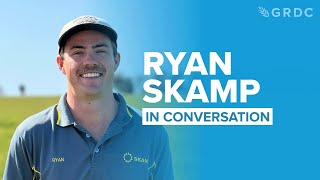
Ryan Skamp, a Perth tradesman turned farmer, co-founded Scan Farming to fix inefficient machinery turn patterns during harvest. The startup entered a GRDC accelerator and now optimises farm run-lines and operational efficiency.
Chapters
This series is a GRDC investment that takes you behind the scenes as we sit down with some of the people shaping our grain industry, uncovering their journeys, learning more about their passions, and the projects that are part of their everyday. We are over in Western Australia. This is now the third part of what has been the GRDC In Conversation podcast. We've covered southern Australia, we've covered the north, across New South Wales and Queensland, and now we've headed west to meet with all sorts of growers, advisors, researchers and people involved in the Aussie grains industry. Welcome to the next series. Is your last name Scamp?
Yeah, SC.
Scamp. So how do we come up with scan?
I just. My wife Talia reckons, like, every time I come with a business idea, like, got to figure out how to get Scamp or Scan into. Well, Scamp into it. And then. So it was. Oh, there was some weird variations of scan, but I just want it to be sk A something. So SCAN was the closest thing we came up with that was near Scamp. I think I tried to call it Scamp at the start and everyone's just like, that's terrible. But, yeah, I just wanted to weasel that into there somewhere. There you go, mate.
You've nailed it.
Yeah, yeah, Scan.
So, yeah, well, I guess how I came across you, well, it's funny, like, it's what. How these things work is someone will, like, say something. So I think it was Melissa. Yeah, Melanie.
Yeah. From the jr, they say. From their marketing network. Yeah.
And so she was like, here's a great story. And then you popped up somewhere else. And then you popped up somewhere else. So. And then I was like, okay, I need to actually reply to this email. And then sure enough, you're literally in the. In the town where I'm coming to. So it's worked out perfectly.
Timing's everything.
It is high. But I think the things that really stuck out to me in your story was similar to my background. Grew up in the city, had friends in agriculture, fell in love with it. You've then gone farming and now you've founded it, an ag tech company, which is bloody cool. So, like, I guess, yeah, starting off, what do I need to know about you, Ryan, to understand, like, how did this love of ag and farming come about?
Yeah, I think. I think you spoke about it really well. There it was, I don't know, I think as a young kid, like, oh, it's just a bit of a sense of adventure. I was pretty, you know, up and about sort of kid. And yeah, went to high School and like you say, just started like the, the country kids kind of stood out from the crowd. They're always a bit, you know, larrikin and yeah, they were just fun to be around and I started hanging out with them more and more and yeah, started going back to their farms on school holidays and I just went, this is awesome. Like, how have I not known about farming? My mum, like her family kind of grew up all around regional wa, so they traveled a fair bit as young kids, but I spent my entire life in the city apart from holidays and whatnot. And yeah, just fell in love with it and yeah, as soon as I kind of got exposure to it through going back to my mate's farms, I knew, right, this is where I'm going to end up some way or another.
And yeah, and so the options for you out of high school, you ended up becoming a chippy.
Yeah, I was a chippy. And it's funny, I kind of look back on it now. I love, now I love problem solving, maths, probably a lot of kind of intellectual problems that at school I thought were the worst thing ever. Like at school, you know, I was, yeah, I, yeah, I wanted to be a tradie. I thought, you know, kind of that was not a route for me at all. I've since found out I really enjoy solving those problems but I was probably just, you know, an agitated and upbeat 16 year old. So yeah, that was. I kind of forgot your question.
No, no, well, and I think it's such an interesting point like where the, like with the benefit of time you actually can kind of grow into these things because I would say at school I was the exact same.
Big time. Yeah, it gave me. Yeah, I never thought I'd pursue this kind of route and now I can't see myself doing anything else. Being intellectually stimulated. Like we were saying, this is the most fun I've ever had is getting up in the morning and using your brain to solve real world problems. Like, you know, I mean that makes it sound pretty grandiose and big but yeah, at the core principle of what it is, that's kind of what we're doing. And yeah, I've definitely grown into that.
Role and love it and so the chippy side of life. Yeah, talk to me. What are some of the perks of being a tradie?
Tradie, which you don't get in farming, which was a rude culture shock for me and something I still probably struggle with is ranchy is pretty good. You get to work at 7:30, you leave at 3:30 or whatever it is. And you don't work weekends typically farming, as I'm sure anyone in farming understands that is not the case at all. Yeah, farming is weekends, big nights, which I don't mind. I like working hard. But yeah, that's probably. The lifestyle is kind of the. The what? Yeah. What could appeal to a tradie?
Are there elements of that like life that you wish agriculture had where you could literally walk out at the end.
Of the day and big time it, it's probably a limiting factor for me. I, I mean I'm married, I've got a wife, we want to have a family. To me being a dad is probably the biggest thing in my life and I struggle to see in a farming role how I can actually do both of those things. Well, in terms I'm speaking from a perspective where I don't own a farm. I am subject to, if I was working on someone's farm, their hours and their program and yeah, 100%, I, I would almost be an advocate of that, of having some more structure around these things because I think it would invite a few more people in. We're kind of in a world now where I think young people want a bit more flexibility in terms of their work life. A lot of people work from home these days. You're never going to get that nag. But what you might be able to get is a bit more structure. It might appeal to some people. Maybe, maybe I'm just thinking about it wrong but yeah, to me it was a big limiting factor for me. Big time.
Yeah, it's something I think about a lot actually and I think as we'll start to get to for you but in running my own business, what I'm trying to do is create the life that I want to have. And so as you say, it's like I'm a long way off having kids and things like that, but actually going well. I want to be the dad that can do the canteen duty at lunch, who actually is present and knows 100%.
That is, that was massive for me. And yeah, like that was. Yeah, it's always been a big priority. If my job can't provide that, to be doing the small little life and dad stuff, then I didn't really want it. And yeah, like I say, if it's not your farm, you're kind of at the mercy of someone else. So I always wanted to be involved in ag, but this is me deciding my future, how that looks in ag.
And so being able to look at the options was Life as a tradie. Able to give you that or not really?
Yeah, I think so. Yeah, I think so. Probably just lack of interest in the work to be fair. I mean houses have been built for ages and they're pretty cool. Like my best mate's a chippy and I know he loves his job and he loves what he does, but yeah, I just didn't find much engagement. I didn't see too many big problems to solve like building houses been done to death. There's, I mean there's literally instructions written out about how to do it. You know, I'm sure you can do it in a new way. But yeah, to me that wasn't a big problem or just interest. Yeah, it's cool industry, but not for me.
So how did you go from living in Perth to then ending up in Moira. Moira Mora. Yeah, I kept saying it wrong.
Yeah, yeah. So I moved to. The first town I lived in was badgingara, which is 45 minutes from here. And so that was where I was living and doing my trade at the time and yet living on a mate's farm that I knew from high school and yeah, doing my trade and yeah, then my chippy boss at the time who's now my father in law, he, yeah, he went farming, he managed a farm. My brother in law kind of went back to a family farm and yeah, I thought, well, why not? Yeah, so more seemed like the place to be at the time. So yeah, kind of transferred my way over here. I had a few different farming jobs after my, after I left my trade around Rajingara. But yeah, I've been here for the.
Longest in Mora, the center of the universe.
Yeah, big time. And for you.
So the last three years you've been farming?
Yeah, well last. I think we're almost five now. This would be my fifth. But three years here at Dave's or maybe four then. Four or five.
And so has been everything you kind of dreamed of when you first got those exposures as a teenager.
Yeah, that's. I actually reflect on this stuff. I don't know, I'm pretty nostalgic person and I tend to reflect a fair bit on oh Ryan in 2017. Would he. Like, this is almost exactly where I thought I wanted to be. And then I get here and I'm like, oh, this isn't everything I thought it was. But yeah, I do. This is kind of. This was the plan. So yeah, I'd like to think that I somewhat executed those goals pretty well and continue to work on them. But Yeah, I think this is, I mean this is farming really. This is reality of it. Yeah.
Talk to me. So from 2017 to now, what were those goals? What did you.
It was, yeah, definitely. I was, yeah, just working on a kind of large scale farm is really what I wanted to do, you know. You know, saw lots of photos and videos of the farms. I was like, oh, this is wicked. I've got to get a part of that. And yet now being a part of it, it is awesome. So ye. Yeah, that was something I was interested in and yeah, kind of, yeah, got into.
And as you stare down the barrel of this kind of next chapter, which I think we'll start to touch on, like, what are you, like what, what has it that's instigated the change?
Probably my willingness and passion to solve problems. Like in the job I am in now, a lot of it is operating machinery, operating tractors. It's a broad oak farm. That's kind of what happens day to day. And not to, not to knock it, but going up and back in a paddock is probably not what I'm built for. And it's probably. I don't feel like it's kind of my destiny, if you will, you know, a bit of a buzzword, but, you know, yeah, I think I was, yeah, I wanted to be doing something a bit more mentally stimulating than just driving tractors. And yeah, this next thing is a big problem solving challenge for me, which gets me out of bed in the morning.
Do you find yourself over the last five years and I don't know if this is an assumption, but you will contest it. You were looking like, did you find yourself over the last five years just constantly looking for something that you could be like, where can I?
All the time? And I've done that my entire life. Always looking, probably to my detriment at times, but always looking as soon as I get somewhere. I wouldn't say, I know, I don't think it's a bad thing maybe, but kind of struggle to just enjoy the moment and just chill out and think, oh, this is pretty cool. As soon as I'm somewhere, I'm not thinking about an exit strategy, but I'm thinking, right, what's next? How do we build on this? Yeah. And hopefully maybe one day that'll slow down. But for now, in my 20s, that's kind of what I'm doing is every time I get somewhere I seem to think, right, what's the next phase? How do we get there?
So what have been some of those ideas, some of those hairbrain ideas that you've had from the cab. Let's talk about solving the world's problems.
Yeah, well, actually, I did want to be chippy again for a bit. I was like, right, I could be a builder. That would be sick. Lots of work around. That was a good idea. What are some other whiz bang ideas? Oh, I like all types of ad contracting. Like, I started doing shape work when I started farming and I thought shape work was the absolute bees knees. I got the sheepdog and I'm like, right, here we go, we're on here. Let's. I'm going to be a sheep contractor. And I was like, right, you know, I could do all the sheep contracting work. Pretty glad I didn't do that, to be fair. Especially with the kind of stay at the wa sheaf industry. That was the next big idea. Then I started drawing machines more. And then next, you know, starry bright night. So I was like, right, here we go. I'll be a Australian contractor. Or I'm an Australian contractor. So pretty much everything I've thought of, I've thought it was a genius idea. And, yeah, haven't done all of them. Probably a good thing that I ended up here. This scene, this was the final one where I could convince my wife that this was a good idea because it didn't require me to outlay half a million dollars to buy a tractor to start. So like I was saying before, I literally started this whole thing on an iPad and a bit of spare time. So, yeah, it's. It was probably one I could do that was a safe gamble.
Talk to me about the. What the idea is and when it. When it came about and tell me like, I know nothing, because I know nothing.
It was started last harvest and driving up and back in the paddock and I mean, people that have been in the paddock know that, you know, if there's funny shapes or angles, sometimes it's not so clear as to which way you should turn at the end of a run to run most efficiently. We had two headers and a chase bin at the time. And I've just kind of been sitting on this thing for weeks thinking, far out, is there not a way? Like, is there not? And, yeah, I was like, surely someone's made a program that can tell me how to do this paddock most efficiently. I figured this had been done before. So I start googling, kind of struggling to find something. I was like, oh, there might be an opportunity here. And so we had this young girl, Lucy, who was driving our Chaser bin. And we were sharing a ute to drive home every night, like to the home farm. And so kind of throughout this week, like, I think it was, it was Monday or Tuesday, whatever, I jumped in the ute and I start kind of floating this idea a little bit. I was like, oh, you know, imagine if there was a little efficiency optimizer or a little program. And I was like, nah, it'd be a stupid idea. And kind of put it to bed, jumped in the ute the next day. And I was like, oh, I've been doing some research and you know, and every day I was just building on this thing. By the end of the week, I was chewing your absolute ear off. I was like, no, I've got an idea. This is going to work. This is the best thing ever. And so the idea was to build a program that could tell a tractor or header opera, whatever paddock operation, the most efficient way to traverse a paddock. And yeah, either with multiple machines or a single machine just to gain efficiency to, you know, negate having all of those small incorrect turns. And yeah, that's where the idea was born.
And so incredibly simple. But literally, if we look out the window here and we go, all right, there's an area of the paddock which goes to a teardrop. And so at the top of it, it's 10 meters. At the bottom, it's 70 meters wide. You're going to have to turn quite a lot.
Exactly.
How do you save 15, 20 minutes?
And I mean, anyone that's done those teardrop turns, know if you take, if you turn right instead of left, whatever the outside factors are. Yeah, it really can take a lot of time. If you're in a header, I mean, you're turning at what, eight, nine k's an hour. You make a wrong turn, you're traveling a fair way to get back. I timed it one. I mean, this was mid harvest last and I was sitting there with my phone. Every time we turned, I was timing how long we were spending out of the ground, not harvesting, depending on the pattern we were doing. Same thing at seeding. I just became obsessed with these like little efficiency timers. And I mean, there's the fucking note in my phone is. Yeah, it was just me going far out. Like, there's so much time we can save you. I think during seed, just the pattern we chose saved like over a panic an hour and 15 minutes or something by doing a different turning pattern. And yeah, my head was just kind of exploding with the idea that far out there's so much time to be saved here and if a mathematical program could tell you exactly how to do it. So yeah, I'll spin it out and for you.
Like it's simple maths in the sense of. It's not. Yeah some big far fetched whiteboard that you need to write different formulas on.
It's not. Yeah it's pretty, it's pretty simple really. It's the machine width, how far to the next run line, what is the most efficient run line, what's the least amount of meters and yeah it's pretty simple maths really. And the way I've come to look at kind of modern day ag is just one big mathematical equation. Like that's how me and Lucky look at it. I've and probably it helps that I'm a little bit removed as, as we've said I didn't grow up here so I don't have kind of these preconceived ideas about farming from my dad or anything. I'm coming into this with a fresh set of eyes and all I can see is just heaps of maths problems and I'm just thinking right, how do we solve them?
And so was maths going back to school. Was math a subject you liked?
To be fair, I actually wasn't bad at maths and didn't mind doing it. My year 10 teacher was Mr. Hussain and I mean we probably talked a bit too much in class but he was a good dude and I've always like, I've and probably was, didn't like didn't mind Bernard Chippy. It's all pretty practical maths like. Yeah. And I think, I think the thing I like about maths is there's always a good answer at the end of it. It's not, it's not very black and white. There's usually a right or wrong answer. Yeah. And as my wife might tell you I'm a little bit particular in terms of answers. Like it's got to be. So yeah, I think yeah maths does that for me.
Not cryptic.
Yeah.
What's the difference between ideas that you've had in the past and actually this becoming a business? Like why is this thing different?
I think probably, probably barrier to entry really. This. All of the other ideas I've had were either going to be things that had to be done right away. Like I mean if we talk about the contract thing that required me to leave my job and start that job black and white, out of one job into the next. Financial security is out the window.
Big season exactly, yeah.
This I've been doing, I mean probably detriment to my social life, but this I can do it on the weekends, I do it at night when I get home. And Locky, obviously my co founder, is working while I'm at work still. So it was probably the ability to, you know, please my own life that it's not going to, you know, turn into a fireball and I can do it without having to sacrifice everything at the start to actually give it some feeling to see if it's going to go anywhere.
Which I think is so important for a side hustle to be able to like, yeah, have that teething time to work out.
Yeah.
Is this actually just an idea?
Yeah.
Talk to me about Locky. Who is he?
Locky is the man, man, the myth, the legend. Yeah, he is my co founder. He's a software engineer. We, yeah, we grew up together. Like we, we got this like family thing like called the Playgroup group where all of us kids that went to playgroup are all still like, all the mums are still mates and we still catch up with each other. So this is, you know, 20 odd years ago. But yeah, Locky and I were to playgroup together. We all used to go on family holidays and kind of lost touch with them a bit as you do throughout your teen years. But yeah, I knew. I bumped into his mum and she said Locky was doing this software engineering thing. I came with, came up with this idea during harvest and I thought, well, you know, I'll just get Lockie's advice really. I was just calling him to see if this thing was doable and Locky was in between. He was working at a medical tech startup. And yeah, I think they, that startup folded. Locky wasn't, he was just working there anyway. He was kind of looking for a project or looking for a job. And yeah, it was perfect timing. I called him up and he was like, oh that's pretty cool. I can probably give you a hand if you want. I was like, yeah, wicked. Why not? And yeah, we just got on with it and he's been now my co founder. We've got a 50, 50 share in the company and yeah, he does all our computing.
If you go back to those early conversations, what do you reckon? What were they like? And how did you convince someone who had assumption again never stepped into a paddock that this was going to be a good idea, that there was a real market opportunity?
Yeah, well it was. What it looked like was where we are standing, well sitting now. I had this Whiteboard and I'd drawn all the run lines and I was very, as I am pretty passionate person, very passionately going, look, if you jump over here and jump at this one line, you save 26 seconds if we do this throughout the paddock. And he was just like, whoa, what's going on here? But it was me very passionately saying, this is a massive opportunity. The operational costs of what I'm talking about are big. And Locke's a pretty analytical guy, so he could see opportunity was big, the savings were going to be big. And was it very doable? Yes. So he looked at it, a very analytical approach and thought, yeah, this could be something cool. So, yeah. But it was me looking like a madman trying to convince him this is.
A good idea and as simple as a white book. Now you've got me thinking and I think we're just going to. This podcast just becomes an ideas one. But like, as you said before, in that paddock, you could save an hour of time. Do you, when you market this, like, do you take the lens of where you see yourself in 10 years? And so actually that hour, instead of an hour to do another job on farm, is an hour with your kids.
Well, that's, that's how I think about it. And I've said in a previous podcast, I was playing cricket at the time during harvest and one of the Sundays off to go and play cricket. And I was thinking from the approach site, right, if we get this done quicker, it doesn't mean we can harvest on Sunday, it means I can go and play cricket. So, yeah, that is, you know, that's the thing if. And I think that's just what. Whatever people prefer. Like, I understand some people just love farming and love working. That's wicked. But if you want more time to go and spend with your family, then, yeah, that's. Yeah.
And so from here, like, you, you and Locky have been working on it for eight odd months.
Yeah. Or what are we September now? So, yeah, nine months. We started in January, really full time.
And you've got the eyes and ears of grdc.
Yes. No, we. Yeah, we got a. I said I'd say Shout Out Helen on the podcast, so. Shout Out Helen. Yeah, we. We got onto their accelerator program. Yeah. And I remember the day we were doing. We'd applied for it, we got it sent by. Oh, name Blake. Oh, Mick Fells from Esperance. He's a. Yeah. Ag tech guy and I. No idea how I got his number, but anyway, he knew what we were doing and he flicked us through this application for this DRDC ground up program and it closed in 24 hours time. And I was like, have I not heard about this yet? But I'll do it. And so I jumped home that night, did the application, didn't think a heap of it. I was. And that was back when, I mean I've got a bit more belief in what we're doing now, but back then I'm thinking, oh, we're some like little gimmick, two guys trying to muck around. I didn't really have a lot of confidence in what we were doing. But then we got accepted into the program. Helen called us up and said we're in. And yeah, then we started this. Yeah, the program. But that was. Yeah, it's been wicked. Such good industry connections. Yeah.
And so what does the accelerator program look like? Who's in it?
Yeah, so we. It's run by the AgTech and Logistics Hub who are very closely associated with the GRDC. And it was I believe 12 mentoring sessions. So we were doing them and it was during seing. It was perfect. I was starting my seating shift at midday and they were in the morning. So I had get up in the mornings and they were I think a two hour mentoring session on a Wednesday and then an hour on the Friday. Just have a chat. But they were kind of, yeah, giving us modules and units and procedures about how to run a small business, how to scale a business. Yeah, literally the nuts and bolts of what we're trying to do and it was vital information. We did it with. I don't know how exactly But I think 10 or 11 other companies and it was awesome. We're all good mates now and we all met over in Queensland a few weeks ago. So yeah, it's wicked to have a little cohort to do it with.
And what would you say, what have you learned about going, taking it from an idea into being a business? What did you pick up along the way?
I think the nuts and bolts of a business is a. What kind of got drilled into us is a path to market strategy. If you don't actually have an idea about how you get from point A to point B with all the small steps, you don't really have a business. You've got an idea, so a past market strategy, throw everything else out. What is your strategy and how do you actually have a product to sell in terms of development and all those kind of nitty gritty things? I didn't know that. I knew it but once being told it I was like, right, that's pretty logical. That's kind of what we were thinking anyway. Not to say that we knew what we were doing, but it was good to just have our own thoughts kind of reinforced back to us. But, yeah, past the market. How do you actually get there?
And so on that. How do you go from like chatting to mates about the idea to saying, and, I don't know, picking numbers. It's $1,000 a year subscription. How do you go from, yeah, having a beer with your mates, talking about it and they go, oh, that sounds pretty good to them, actually paying for it.
Well, interesting you say your mates, because I've read this somewhere and I've not. I've found it to be so true, is that you find more customers that turn into your mates than mates that turn into customers. And I think that kind of thing, like, all my mates are pretty keen to talk about it, but it's kind of hard. You don't really want to sales pitch your mates and be like, you know, all these things, wicked, can I have your money? But, yeah, to get back to what you're saying in terms of actually getting there is heaps of hard work, really small kind of micro steps about development, finding this guy's phone number, having a chat to him. What does he think about it? He recommends you to someone else. The next phone call is just so there's little micro steps. I'm sure you know all about it when it just takes the next phone call and the next email and you just have to, like, it honestly feels like you're staring at a brief wall and you're just chipping away. This thing, you don't know what's on the other side, but just little step, little forward steps get. Actually gets you there.
I've gone off on a tangent here because I'm thinking, like, I've never, never heard of that before, where you're more likely to have customers that become mates. Because I'd say if I think about this podcast, the people I talk to haven't had many mates on it. Probably from like the point of view of. I don't know if we'd have, like. If we'd have the type of chat.
That I want to. Yeah.
As opposed to people who've come on who then stayed in touch with.
Exactly. Yeah. And yeah, we've like. I can like Gary Lingy, he's a good one. Like, they're guys that just liked what we were doing and we've spent so much time communicating with them these days that I would call them my mates. And they were some of their first customers. And you know, they've given our business more than, and this is not to knock my mates, but more than my mates have given us. And I really like that, to think, yeah, like these customers, some of them do turn into your mates because you spend so much time dealing with them. And yeah, I've found that in firsthand.
No, it's really, really true. So for you, if you fast forward 10 years, you're obviously so passionate about it now, how do you look at the future and know that those passions will probably change and like, do you put a time horizon on something like this?
Big question, hey? And I ask myself all the time, I have been, yeah, I mean, it's hard to say my passion's gonna die because, you know, inevitably things do change. But yeah, I think I enjoy being with people. So the bigger we build something and the more people you have and the more people that are accountable to what you're doing, probably the more interested I'm, I'm becoming it. Having employees and stuff makes me accountable to them. And that's what I think will drive my interest past the. I mean, I'm still in the love of the product phase where I just love what we're doing and love what we're building. If that dies, I think I will, I hope I will fall in love with the management of people and giving people a career in what we're doing. I think that's what ignite my spark again, I hope, but I think, I think so. I like dealing with people now, I reckon.
Well, and I think it, it seems like the natural evolution where you come over that hill and then it's like rather than either drop off if you keep doing the same thing, or you find that next chance for your own growth.
Yeah, big time. And I think, yeah, kind of products are products, they're cool. But yeah, building a company is what I'm interested in building. People that want to work here and I want to invite and, you know, people with big ideas to come work for us. I don't just want it to be being lucky with all the big ideas. I think there's a lot of people out there that have way better ideas than me and if we can get them to work for us, that'd be sick.
And so for you, like, what does the future look like if money's no barrier and anything's possible for you guys, what does the future look like?
Money, no barrier. House in the mountains? No, I couldn't think of anything worth it actually. I Don't like the beach? No, the beach is all right. No, we would. Honestly, if we had all the money in the world for development, it would kind of get to our big grandiose plan, which is where Scan started with this big harvest plan. And it got tailed back to something we could actually develop, but kind of a big harvest efficiency program where we're looking at. Well, actually I'll go bigger than that. A farm efficiency program that looks at every single detail on a farm in terms of movements and operational efficiencies and how can they be improved. That's what we would endeavor to build, which we're trying to do. But. Yeah.
And there's nothing else out there like it.
There's some similar things. So Verge is the other. They're a Canadian company. They basically generate the most efficient run line in a paddock, but outside of that they don't give you the kind of live operational. Yeah. In the paddock, where do I turn? Where are my gateways? Where's my exit points? Which is. Yeah, yeah. Right. Not so they won't, but. Yeah.
So I've got two questions to finish on. One being obviously the kid from Perth that has then fallen into agriculture, what would you say to another 16 year old today who's got no exposure to agriculture?
Yeah, and it's such a weird, like, you know, it's such a big industry to take that first step into because it's so far away from the city, like, but it's such. There's so many opportunities. Like that's what I've loved about it is almost every industry comes back to agriculture in some way. So it touches on everything in the world. So if you're someone that's interested in getting out and about and being exposed to different things, then ag is the best place for it. Like there are so many avenues you will not get bored in ag and. Yeah.
And so for you, why is Western Australia the place to be?
I don't know. I think it's because I grew up here. I actually went to Queensland the other day. It's not bad over there. It's a bit humid. I don't think I'd go to Queensland, but I don't know. Yeah, Wa is where I've been. Not so I wouldn't move ever. There you go. Yeah.
Well, mate, is there anything else that you want to talk about?
No, I think. Yeah, it's pretty good, I think. Yeah. Tell the story, I think.
Easy. Well, I can't wait to follow this journey and you better give yourself a plug where can people find you to follow this as well?
Instagram or Scan Farming, that's probably our best one. And Facebook. Yeah, Scan Farming logistics. So, yeah, Instagram's a good one. You'll be able to keep up all of our stuff, watch a few funny reels, figure out where we're going next. But yeah, that's probably the place. Beautiful, mate. Well, all the best.
Thanks for the chat.
Cheers, mate, appreciate it.
Thanks for joining us for the GRDC in Conversation podcast. This series is a GRDC investment that's sharing the stories of the people who are living and breathing the Aussie grains industry. Make sure you check out some of our other conversations and hit follow on your favourite podcast app to never miss an episode.
More from Gerri







GRDC National Variety Trials (NVT) Case Study: Helping Oat growers make informed variety decisions



Managing rhizoctonia in wheat and barley: Impact in low and medium rainfall zones 🌾🌾
