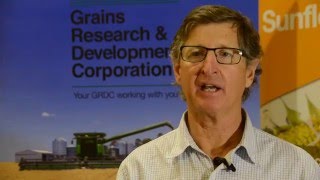
Tony Hamilton, a NSW farmer with 30 years of experience, backs research to tackle herbicide resistance and boost productivity. He's seen no-till transform farming and now pushes for targeted RD&E to solve problems like Group A and glyphosate resistance across his irrigated and dryland crops.
Chapters
My name's Tony Hamilton. I'm a farmer based in central West New South Wales near Forbes. We farm a variety of crops including irrigated and dry land crops. I've been farming for quite a period. I've been farming for over 30 years, initially down near Cootamundra in southern New South Wales and for the last 25 years up at Forbes. I've seen massive changes in farming during that time. The biggest one of course is the adoption of no till. That's been huge and had huge benefits for farmers everywhere. As well as all the positive changes, I've seen problems arising from that, such as herbicide resistance, which is a new issue that GRDC is actively engaged in. We have a range of soil types where we're growing, which also has a range of challenges. So some of the properties that I'm involved with range from light sandy soils with poor water holding capacity right through to heavy clays, larger water holding capacities. There's various issues with those soil types and dealing with them. I'm passionate about the grains industry and evidence based farming. I've always been involved with both a scientific background in agriculture plus as an active farmer. I've really been interested in RD and E and how it can add value to the farming and what they're doing. I get a kick out of growing crops. Also like problem solving and as any farmer knows, there's no end of problems to be solved in agriculture. I've had some experience with the regional cropping solutions networks that GRDC have been running and seen the benefit of being involved with that and it motivated me to join, to apply, to join the Northern panel because I felt that with my experience in agriculture plus having a science background and previously worked as an agriculture consultant, I could be a bit of a conduit between the growers needs and the researchers and help make sure that that is targeted. And so with my experience I thought that there was something that I could offer back to the growers and back to grdc. In the northern zone there are a range of challenges. The overarching one would be herbicide resistance. It's common to all the three zones in Australia. But particularly with the northern zone we've seen a range of herbicide resistance issues creeping up. Initially, certain group A's and things like that with ryegrass. And more recently roundup resistance is becoming an emerging problem. So that will be an ongoing issue and it's a matter of the researchers trying to keep one step ahead of the problem. I think RDE is absolutely fundamental. Australian agriculture, like all around the world is under increasing competition and problems with declining terms in trade. So there's limited scope to improve pricing, there's limited scope to reduce the cost of your inputs. So the best way we can improve our bottom line is through increasing productivity. And increasing productivity really is driven by RD and E, but making sure that is targeted to the farmers, problems, solving their problems, getting answers back to the farmers so that they can improve their productivity and their profit.