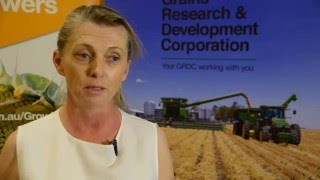
Heuston's hat trick on northern panel

Penny Houston, an agronomist with 20 years in Central West NSW, joined the Northern panel to push research toward farmer needs. She's focused on herbicide resistance, climate change, and water efficiency, and sees hope in a new generation of engaged farmers.
Questions this video answers
Over 20 years.
From Hermidale in the northwest to Gilgandra in the east.
A 100% GRDC-funded research body.
"Grain and Runner Alliance" (as stated in the transcript).
Chapters
My name is Penny Houston, I'm an agronomist based in Central West New South Wales. I've been there for 20 plus years now and I've had numerous roles initially as a reseller agronomist and then moved on become a private agronomist looking after farmers from Hermidale to the northwest in quite a marginal part of the grain grain region of New South Wales to Gilgandra in the east, which is slightly higher rainfall and different farming systems as well. And I've also had a role on Goa which is a 100% GRDC funded research body. Goa stands for grain and Runner Alliance. So it's all about addressing one to three year short term problems and issues grain growers have in the Central west and hopefully coming up with real farmer ready answers that people can implement in the paddock. Straight away, from a personal point of view, I love the challenge of being on the panel. I love the interaction you have with great minds both within the panel and the researchers you get exposed to and the staff at grdc. But probably the main reason that motivated me to get on the panel was the fact that you can help deliver more pharma, can help deliver the direction of research so that it's more farmer friendly, more farmer driven in a timely manner to the region that you're from. However, we're faced with quite a number of challenges. Herbicide resistance probably being the biggest one for Central West New South Wales at the moment. Climate change, how do we manage this climate? So we can't obviously change the amount of rain that falls and if the rainfall does decrease like they're predicting, how do we manage that? So how do we get, how do we get increased water use efficiency with our crop? It's all about the bucket. How big is our bucket? We need to know how big our bucket is, how do we better fill the bucket and can we make the bucket any bigger? So that's a couple of the things that I think are challenging us at the moment. So some of the opportunities I see within the industry is the fact that we have a new generation of passionate, intelligent, well educated farmers coming back to family farms in some occurrences or back to corporate farms in more managerial agronomy type roles. They're bringing a lot of energy and enthusiasm that we can harness to get a lot of new research out there into the paddock. The skill set I think I bring to the Northern panel is that I have been fortunate to have had two teams already on the Northern panel and that makes you become quite an analytical thinker it makes you want to strive for outcomes from research that can be extended in a farmer friendly way into the paddock that deliver to farmers that deliver in a timely way. So I think that's probably the most important role of the pan.
More from Gerri

GRDC National Variety Trials (NVT) Case Study: Helping Oat growers make informed variety decisions

Managing rhizoctonia in wheat and barley: Impact in low and medium rainfall zones 🌾🌾












