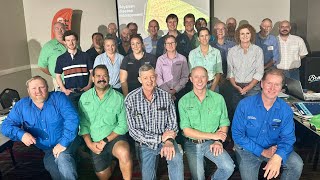
A workshop-style YouTube discussion (Bundaberg) about soybean production in coastal Australia, focusing on an updated online soybean production manual (originally compiled ~2012), market shifts toward edible soy products (tofu, soy milk, baking uses), and the agronomic role of soybeans in coastal sugarcane rotations for soil health. Speakers highlight storage challenges in humid coastal/northern regions and recommend technology like automated aeration controllers; they note ongoing demand in Australia and recent promotion by GRDC and the Queensland government. The manual’s online refresh makes up-to-date guidance accessible to growers and advisers.
Questions this video answers
Bundaberg
About 2012
Chapters
So we're here in Bundaberg today, delving into the depths of the online soybean manual. We're here with agronomists and growers really looking at the whole soybean production cycle. So the online soybean production manual is a really effective tool for both agronomists and growers just looking at all areas of the soybean production system. It does include a lot of updated information to do with most diseases storage every different section of the soybean production process.
The consumption of soybean and the processing of the soybeans in Australia has changed. Back in the 80s, whilst we had a crushing plant that was the main focus. But from the demise of that sort of plant, there was a more focus on the edible type market. The edible market being the Asian influence of tofu and also the introduction of soy milk as a dairy alternative. Those two sort of products have sort of paved the way for additional high end edible sort of qualities. The baking industry is a major sort of consumer of soya beans as flour as an additive in the baking process through improvers. Soybeans in Australia grow from the tropics all the way down through into Victoria. Your main production areas are concentrated in the southeast corner of Queensland where the major manufacturers and processors are situated. There is still plenty of demand in the marketplace in Australia. We are still not producing enough soya beans. That's going to meet all the market demand that we have.
So soybe sugarcanes are a rotation option in our sugarcane farming system. So they really are a key pillar in maintaining soil health in our coastal farming systems. Initially in the early days, we weren't promoting it initially as a grain crop, it was just to get growers familiar with it as a rotation crop in the sugar system. So a lot of guys were just green manuring it. But then it became very obvious that we could grow it for grain. I was humbled at one event where one grower stood up and mentioned that unless he had grown soybeans for grain as per of his farming system, he still wouldn't be a cane farmer today because it got him through tough times.
In my role, we're really looking at how to store the soybeans most effectively and trying to incorporate that extra avenue into farming businesses in the region. Storage in these sorts of regions can be a bit tricky. We often see them in coastal or northern regions and that's where the relative humidity really comes into play. So we often see that the conditions can be a bit challenging for storing soybeans. So we really look to go to a bit more technology in these sorts of regions, looking at automated aeration controllers to really try and overcome some of the issues with manual aerations.
The manual itself came together in about 2012, so it was due for a refresh and now, so it's been reviewed, refreshed, brought up to date and having it online, it's an easy mechanism for growers, advisors or anybody alike just to be able to access that most current up to date information.
It's great that there's been a renewed push from GRDC and the Queensland government to promote soybeans and I think there's a real opportunity there for other farming systems to consider soybeans, not just cane. And it's the kind of crop that people should be thinking about using when they're changing farming systems as a bit of a cleaning up the paddock, so to speak. But the benefit is that you can also earn an income from it. I think it's just a win, win all round. I think it's a great crop. I did access the online manual before I came to the workshop. It sort of helped me decide whether I needed to come or not. And I saw that there was plenty of extra information and more detail that perhaps hadn't been in older publications. So I was really pleased with that and I thought that online manual was quite easy to use. I found the workshop today and yesterday absolutely brilliant. I mean, some of it I sort of knew before or heard before, of course, but a lot of it was a great refresher. Some of those little gems of wisdom that you sometimes forget. But also because the speakers have been given plenty of time to talk, they've gone into quite a lot of detail of their various subjects, which has been brilliant because often when you talk to them it's on the fly or they do a quick presentation at a field day. Whereas this has been a lot more in depth. And then we've of course got their great notes to refer back to.
Globally.
Soybeans are a new crop for me. So it's been awesome to see like the whole picture of soybeans, right from planting all the way to marketing at the end of the season. Yeah, it's been fantastic. The online manual is really good. It's so easy to get through and you can see all the modules really easy, just there, click on them and go through all the information. It's great.