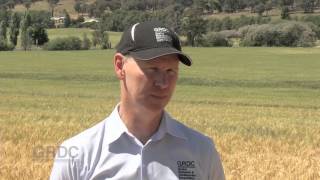
GRDC staff visit a wheat crop in Grenfell, NSW to examine frost damage and a CSIRO trial on frost management. Frost costs the industry $300 million a year, and one grower lost crops to three severe frosts in 12 years. Regional grower groups shape what research gets funded.
Questions this video answers
Grenfell, New South Wales.
Gregory wheat.
CSIRO.
About $300 million a year.
Three severe frosts in the last 12 years.
Chapters
Today we're at Grenfell, New South Wales. Each year we try and get the.
Whole staff from GRDC out of Canberra, out into the paddock, looking at crops, talking to growers and looking at research, so everybody in GRDC understands why what.
We'Re doing is important and how it impacts on growers. So today we saw a crop of Gregory Wheat, beautiful crop of Gregory Wheat. And in the middle of that crop was a trial that's been run by csiro, specifically looking at how we manage frost and how we can develop varieties with better resistance to frost, which is of course a big issue for growers. And right across the whole of Australia.
It costs the industry something like $300 million a year. But probably of more concern is just the way that it impacts individual growers. By the time you get a frost, you've spent all your money, everything's at risk. And it can be devastating for growers.
When they get hit, particularly with that late frost. On the farm we were on this morning, the grower was telling us about the fact that he has experienced on.
His farm three severe frosts in the last 12 years. And it was, I think, quite moving.
For the staff to hear the impact that it has on his business or his family, but then also to hear how he's actually adjusted his farming program and his cropping system to be able to manage that risk and survive that devastation that occurs from time to time. So that culture of engaging with growers is critical to GRDC success and it.
Underpins everything we do.
So if you look at the recent.
Investment plan that we just published and.
Where we go to researchers and ask them to submit their applications, that whole process was driven by firstly, identifying what the grassroots grower priorities are. And we identify those firstly with our regional cropping solution groups, which we have right across each of the regions. And then they are looked at by each of our three regional panels. And from there we have a week long session in Canberra where we have all the regional panels, panel chairs coming into Canberra and working through a process of identifying what is the priorities that are likely to give the best return to Australian farmers. So now when we get back in the office, our staffer will be absolutely flat out looking at those applications, lining them up against the priorities and selecting the investments that we think are going to give the best return to Australian growers.
So that's it from Grenfell.
But if you do have any issues or R and D questions that you want to raise with grdc, please do.
Make a point of tracking down one.
Of our regional panel members or one.
Of our GRDC staff members. Alternatively, you can always send me an email. Bye for now.