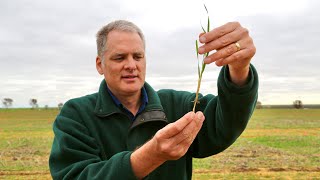
Researchers tested long coleoptile wheat varieties across different soil types and sowing depths to see where the trait helps. At a Geraldton site, Mace18 emerged at 100 plants per square meter when sown deep, compared to 80 for standard Mace, showing the longer root can improve establishment in tough conditions.
Questions this video answers
Dr. Stephen Davies, Department of Primary Industries and Regional Development, Geraldton, Western Australia.
Mace ~80 plants per square metre; Mace18 ~100 plants per square metre.
Chapters
We have the long coleoptile technology available and breeders are integrating it into their programs. But we really want to understand under what scenarios we require that technology. And so that is why we have this nationally coordinated approach to looking at different environments, different water conditions, different soil types to understand the best fit for that genetic technology. The other things that we are thinking about include some of the farming systems, type factors. So if we choose to sow deep with a long coleoptile, how do we then manage herbicides? How do we manage our fertiliser inputs? Where do they go? What are some of the considerations around managing disease?
Rather than focusing on one site with one particular expertise, we're able to bring together all these different groups from right across the country. So the first year was about bringing them all together and building up a commonality of practice so they all have the same understanding around the challenges of sowing deep.
My name's Dr. Stephen Davies and I'm a senior soil scientist with the Department of Primary Industries and Regional Development based in Geraldton, Western Australia. And we're really looking at the role of long color wheats on ameliorated soils. I guess long color wheat is always something that I was quite excited about because I thought, well, you know, they kind of give you that insurance that if they end up a bit deep in the soil or if the furrow fills in with a bit of wind blowing the soil into the furrow, these wheats will have a better ability to still emerge, come through and give us like both a good crop and good ground cover.
There are some considerations we need to make when deep sowing and it's really dependent on the soil type. It is actually an area of the project. Working with engineering team from University of South Australia looking at how we optimise the setup of the seedage so deep. It's looking at what we have now, working out how we change a configuration to make sure we get that seed consistently deeper than conventionally and working out how we're going to place the fertiliser in a different place from normal, deeper than normal, and make sure we manage the separation between the seed and the fertiliser to avoid damage.
So at this particular site we've basically got three what we call soil treatments. So we've got a nill, so a no till treatment. We've got deep ripping, which is a really common practice undertaken on these sand plain type soils. And we've got deep soil mixing, in this case with a rotary spader, which is about incorporating the lime and bearing water repellent soil in this sort of part of the world. And across that we've got sort of four wheat varieties. All the wheat has sort of come through reasonably well. So we still ended up with pretty good plant numbers. But, for example, you know, on average the mace came up from being sown deep at about 80 plants per meter squared in terms of its density, Whereas the mace 18 came up with a density of about 100 plants per meter squared. So what you see is, as you look along the rows, you see with the mace 18 sown deep, you get sort of quite regular establishment, you get sort of solid rows running along. So they've been able to push through and establish quite well with the short coleoptile that really they have got a lot of gaps in the rows. So there's not the density of plants in the row, which then ultimately goes on to affect the density of your heads and the density of the yield potential that you can achieve. It also has other impacts on crop competition. So again, if you've got a less dense crop, you know your weed competition isn't as high.
In three years, two more years, three years in total, we'll have the knowledge, we'll have the confidence. But importantly too, we'll also have a lot of the data. We can then take on into subsequent projects to look at specific aspects around soil temperature, around soil moisture, around soil hardness, and perhaps looking at modeling, building of apps, things to help the growers ensure their confidence, to ensure good germination with deep sowing.