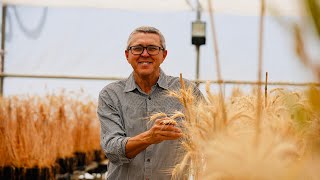
Greg Rubetsky from CSIRO explains long-coleoptile wheat, a variety bred to reach deeper soil moisture when sown deep. Field trials in Condobolin showed it improves emergence in hard soils and hostile conditions where standard wheat struggles.
Chapters
Why is it a game changer? The coleopdyle is the drinking straw that extends from the seed to the soil surface. And when we deep sow, we want that drinking straw as long as we can possibly make it because. Because that straw allows the simple elongation of the shoot from the seed. And if the soil is hard or the soil is hostile, disease or other factors, then you want to make that movement of the shoot as seamless and as gentle as possible. So the long coleoptile is really critical, particularly for chasing moisture at depth. My name is Greg Rubetsky, I'm chief scientist with the csiro, based in Canberra. I'm the project leader of the long coleopodile Wheat Agronomy project. We're hoping to provide growers with packages that when the new long coleoptile genetics commonplace through the farming landscape, there is limited risk or little risk that the adoption is always going to be successful. So we want to make sure that the fertiliser package, the herbicide package, the planting equipment, the impact of soil temperature, all of these factors have been addressed and we provide growers with a range of tools that ensure when we are sowing very deep and there is capacity to sow very, very deep, if we're chasing moisture, that the emergence is going to be risk free. At Condobolin in May 2023, we found that the surface sowing depth had variable moisture, so decreasing moisture. So we were able to sow down to the 10-12 cm for from coleoptile varieties and still able to maintain good plant establishment compared to conventional varieties. Visually in the crop we can see that the long cauleoptile was able to maintain its establishment, so it's got greater plant number per square metre compared to a conventional variety sown at depth. 10 Doberman is where the idea of long coleoptyle wheats actually originated. Back in 1995, I was at a field day and two older gentlemen pulled me aside and said, well, can you do something about our ability for our crops to be planted deep? And I said, well, can't you plant deep? And they said no. Since the dwarfing genes we've struggled to plant deep and it led to a crusade, I guess globally to identify alternative sources of dwarfing. Those genes were brought into Australia from overseas, from all over the world. And then we went through the long and painful progress of testing these genes and we've come up with two or three key genes that are quite unique globally that allow us to breed for reduced height and increased yield, but also give us good seedling vigour. Ra.