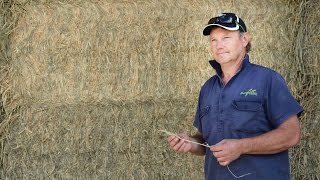
A short YouTube interview (Gerri the NVT Guru) describing how a farm adapted to increased frost incidents after switching to no-till and higher nitrogen in the early 1990s. The speaker explains practical frost-management strategies: increasing crop diversity (adding barley, oats, hay), integrating livestock (sheep), changing rotations (canola, wheat, barley, hay), using a local NRM weather station to monitor frost, assessing paddocks and applying a >50% damage threshold to consider cutting for hay, and performing a cost comparison (noting ~A$100/ha extra cost to cut for hay) before deciding. The piece frames frost as a business/risk management problem integrated with weed management.
Questions this video answers
In the early 1990s.
>50% damage.
About A$100 per hectare.
Chapters
Years ago, we would have classed ourselves as being low frost risk. But in the early 90s, when we changed to no till, stubble retention, good farming practices, increasing our nitrogen applications to maximise our production, we noticed that frost incidents became a lot more prevalent and now we would have some frost damage most years. So ways of dealing with it is to have a broad diversity of crops, varieties. Also the introduction of oat and hay as well. One reason apart from weed management was also frost management. Still, having livestock in our system is important for frost management. We've increased our area of barley because I think most people realise that barley is just a little bit more resilient to frost than wheat. We were running just a canola weight wheat rotation, but we've sort of changed that to canola wheat, barley, canola wheat, hay, and we've also introduced, so sheep feed being a barley, normally vetch mixture, and that's just all to do with managing not only weeds but also frost. We use a local NRM weather station to sort of monitor frost incidents. It's not 100% accurate, but it gives you a guide of when you potentially could have frost damage. So from there, when we identify an event, we'll start monitoring paddocks and assess, try and assess what sort of damage has been caused in those paddocks and what sort of area from there. Once we identify areas that potentially have had greater than 50% damage, that's when we start thinking about putting in some other management practice. And that normally is cutting it for hay. Having your own equipment and not relying on a contractor definitely does make the decision easier. And also being in an area where we have quite a buoyant or reasonable domestic market for hay, that also makes the decision a lot easier. So we'll tend to cut rather than leave a paddock to chance. And I don't think there's been one season where we have cut some wheat or barley, mainly wheat, for hay that we've wished at harvest time that we haven't done it. Normally, if you cut out a percentage of a paddock come harvest time, normally you wish that you'd probably cut it a bit more. So, yeah, so we sit down and work out what sort of percentage is damaged, what sort of loss we've incurred, and then crunching the numbers, comparing taking it to grain or cutting it for hay, cutting for hay is definitely. It increases your expenses up front, expenses probably roughly by $100 a hectare. So you've got to take that into account. And then after doing that financial assessment, we'll make the final decision on whether we'll cut an area for hay or not. It's just business management, business risk management. And frost is part of our risk in our business. And so along with weed management, integrated weed management, frost management is just another part of the business. And it's about managing the risk that frost causes. And most times, there's no way of eliminating frost, but it's all about managing it and managing the impact that it has on your business. So having a diversified business with diversified crops as well as livestock, it's all a way of trying to limit the amount of damage that frost has on our business.