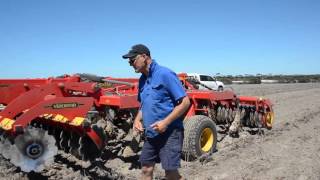
Esperance grain growers Ashley Reichstein and Megan McDowell use a Vadistat deep cultivation system to fix soil compaction and water repellency. A 2015 trial with DAFWA researcher David Hall showed canola germination improved with a 160 kg/ha yield benefit. The machine costs about $60/ha and effects last roughly 8 to 10 years.
Questions this video answers
2015
160 kg/ha (reported, ~7–8%)
310 kg/ha (additional biomass reported)
Treated roots ~180 mm; control roots ~80 mm (first three weeks observation)
Approximately 300 mm
Chapters
Esperance grain growers Ashley Reichstein and Megan McDowell are using a top down deep cultivation system to reset soils affected by compaction, acidity and water repellents right across their farm. As Ashley explains, their interest in this technology was prompted by increasing problems with poor crop germination in recent years due to these soil constraints.
I think it really showed up when I went from a 50 foot bar to a 60 foot bar and all our run lines changed. And once the crop was growing, I was driving past doing crop inspections and I was trying to work out what these waves were in the paddock. And I sat down and thought about it and eventually it occurred to me it was where we'd gone from 100 foot boom spray and a 50 foot seeder and out to an 18 meter cedar and a 36 foot boom spray. It was quite obvious. So addressing it, we're using controlled traffic, trying to work a bit deeper, trying to break up that hard pan with our seating system which we use a dbs. So the deep blade, trying to break it open a bit. And the one I've started really getting into now is the Vadistat top down deep cultivation down to about 300mil trials.
Of the top down machine on the Reichstein property. In 2015, with local researcher David hall from the Department of Agriculture and Food founded Improved canola germination, biomass and yields on a gravel soil type.
We had a 160 kilo yield benefit, so that's working about 7 or 8% biomass. We grew an extra 310 kilos of biomass. And when we started pulling out the plants, looking at the root systems, they were amazing. The canola roots in the first three weeks had sort of grown down to 180mil, where on the control where it hadn't been top down, the roots were probably about only grown down to about 80 mil.
Ashley expects yield benefits from the top down system will be long lasting.
Hopefully we only have to come back maybe every eight to 10 years and run the top downer across it. But once the top downer's been through, we put in our controlled traffic and we enforce that on a pretty strict regime because we've gone through. We've probably spent $60 a hectare and I call it a resetting of the soil. You're making it a lot more friable like it used to be when the.
Trees were cleared in the paddock.
Ashley explains the setup and operation of the top down system.
We've got a set of two way discs here which are independently operated to.
The rest of the machine.
So you can either have just the two way discs in and the tines out, or vice versa. The way we operate it, we have the discs in, we sort of running them about 100 to 150 mil, trying to incorporate the trash into the. Not the subsoil, but mixing in the surface, get it off the surface. So it's getting more of a chance to break down. Then the tines come through and they're running down to 300 mil. And as you can see, they're bringing up a lovely amount of clay that busts it all up. And it's quite moist at the moment. So it's breaking up into good size lumps and getting spread through the soil. The tines are on about a 280mil spacing and we're using a 80mil wide point at the moment. The other little benefit you can actually get is by adding a deep listing point which bolts on the back of the tine here and goes down probably about another 100 mil. So you can actually get to 400 mil depth and disturbance down the bottom. So which is at a benefit which we have used on a couple of paddocks. But it does take a lot more horsepower to pull them. They recommend only put them on the back row of tines because otherwise your tractor will stop. Then after the three rows of tines, we have these little. I call them little star wheels because they actually. The tines actually leave a fairly decent furrow in the paddock. So that just closes in. The furrow does a bit more of the mixing of the surface soil. And once that's been through, we come back with these press wheels or sort of consolidation rollers. It just sort of packs it all down nicely and leaves a good, nice smooth surface. And we can adjust the pressure of those as well.