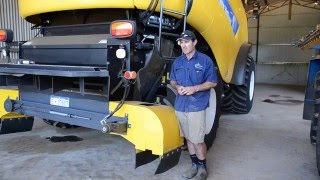
Mark Wandle, a Scadden grower, uses chaff tramlining to manage weeds across 7,000 hectares. A modified conveyor belt on his harvester directs chaff and weed seeds onto a single permanent tramline, reducing spraying needs and delaying herbicide resistance.
Questions this video answers
Around $118 a hectare per year (includes summer spraying).
Approximately 5,300 hectares at Scaddon and 1,700 hectares at Beaumont (northwest of Esperance, WA).
A modified chaff deck on New Holland harvesters with a reversible conveyor (about 550 mm wide) to direct chaff into a single tramline.
Chapters
Tackling weeds during harvest by diverting chaff and weed seeds into permanent tram lines is one of the tools Scadden grower Mark Wandle is using in his controlled traffic farming system. With herbicides, one of his biggest input costs on farm, Mr. Wandle is using a variety of tools to help not only control ryegrass, but prevent herbicide resistance.
Spending around $118 a hectare on total herbicides across the farm per year. That. So that includes all our summer spraying as well. So, yeah, we rotate our herbicides around with newer chemistry, so we're using some of the most expensive, the securas. And we did have a heavier lights on Trefland 10 years ago. We sort of backed that right off as well. Trying to rotate, trying to rotate all our herbicides around now and mix things up to more to a degree.
And while crop and chemical rotations play an important part in weed management, Mr. Wandle is also seeing positive results using a system he calls chaff tramlining. Through a modified chaff deck on his New Holland harvesters, Mr. Wandle can divert chaff and weed seeds into a single compacted tramline rather than both tram lines.
We just pick up all the chaff and it comes down the tray and then we've got about a 550 wide belt that runs 90 degrees and we can change direction of that belt. So we pick up the hydraulic flow off the chaff. Yeah, we've got the belt in there and the belt can drop it either left or right, so we change the direction of our, of our conveyor, so we're always dropping it onto our western side tram lines. So we're just trying to concentrate our weed seeds further.
Mr. Wandle and his wife Hayley are part of a family farming business which comprises 5300 hectares at Scaddon and 1700 hectares at Beaumont, northwest of Esperance in southern Western Australia. Since introducing the chaff tram lining system into their continuous cropping operation, the wandles have reduced the need to spray out tram lines.
It's just another tool in the toolbox for us for weed management. It just gives us the opportunity. We're just trying to touch instead of spreading all our weed seeds out over the paddock again, if they're going through the header, we can catch them and we're just taking them from putting them on our productive part of our paddocks and just trying to direct them into our least productive parts of the paddock in the tram line. And then from there they're in a very hostile environment where it's compacted. It gets wet, dries out quick, and then we drive back over them again. In crop. We know exactly where they are. So we can come back and use other controlled methods.