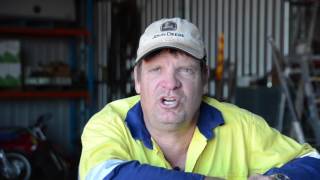
Darren Lee uses soil moisture probes and weather stations on his 6,500-hectare farm near Mingenew to make smarter fertiliser decisions. The technology helped him skip a $100,000 urea application one year, showing how digital tools can cut costs and manage the wild swings in his grain yields.
Questions this video answers
6,500 hectares (mixed cropping and sheep enterprise).
Approximately $100,000.
Seven moisture probes with corresponding weather stations.
150 tonnes.
About 60 kilometres.
Chapters
Dry years and an analytical business brain was all the encouragement Western Australia grower Darren Lee needed to investigate the advantages of digital technology in agriculture. Mr. Lee, who farms a 6,500 hectare mixed cropping and sheep enterprise near Minanu, has reaped the benefits of installing soil moisture probes recently, saving him $100,000 in urea costs. We were in two minds whether to put out any nitrogen and we could extrapolate the data that we had of moisture in the profile and we basically, it was too late from a phenology perspective. And the moisture probe, we had enough moisture to finish. It was like a fuel gauge pretty much to see how much moisture we had left. And basically we kept 150 tonne in the shed. We didn't apply one kilo of actual nitrogen in urea out. So from that perspective, our investments already returned us what we've outlaid, plus the fact that you get 150 tonnes still in the shed that we'll utilise this year. The seven moisture probes with corresponding weather stations were installed by Mr. Lee in an effort to better monitor conditions in a drying climate. So we're only 60 kilometres from the coast and in big production years we'll grow 16,000 tonne of grain. That's our biggest year ever. But on a real dry year, we've delivered 800 tonne and not actually delivered any wheat. So for me it's trying to manage those peaks and troughs and try and get a bit of stability within the production system, maximise on the years that are good and try and minimise on your costs and the years that aren't. So that's where we've sort of fallen into that digital agriculture space, I guess. Here, Mr. Lee explains how the moisture probe technology works. It basically does everything, so every second of the day it measures everything that happens. Where your wind's coming from, your humidity, wind speed, and out in the paddock, that's where our moisture probe is. And whilst I'm a big believer in technology, it's always nice to have the old functional rain gauge. And I think we said 20.2 mils came the other week and we're right on 20 mils here. On the old scale, all this information comes back to our main mainframe computer and all the artificial intelligence with crop manager and all that sort of paper links in so we can get yield estimates. We know where the moisture is in the ground. With a background as an agribusiness banker, Mr. Lee relishes the opportunity to crunch numbers and decipher cost effective solutions for his farm. This has a further flow on effect to his role on the Grains Research and Development Corporation Western Regional panel where he's responsible for determining how to distribute levy payer funds, being partly responsible for how that money spent. I take great effort and pride to be involved in that and trying to get that stuff land on the ground with actual applications that have real bottom line effect for growers on the longer.