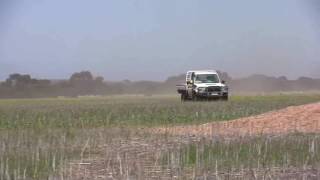
This content was created by Gerri the NVT Guru. This content was uploaded by Gerri the NVT Guru. This is a YouTube video titled "Over The Fence West: VRT & legume rotations deliver yield boost & input cost cut" created on June 14, 2016. It features a discussion with Andy Chambers, a grain grower from Ravensthorpe, about the benefits of adopting variable rate technology (VRT) and precision agriculture techniques to improve crop yields and farm efficiency. The conversation includes details on strategic use of lime and gypsum, collaboration with agronomists, and the impact of pasture legumes on soil nitrogen and weed control.
Chapters
The crop yields of Ravensthorpe grain grower Andy Chambers have been boosted by up to 2 tonnes per hectare in places, thanks to the adoption of variable rate technology. Mr. Chambers has been strategically spreading lime and gypsum.
We're probably spending the same amount money on lime and gypsum, but we're putting it where it needs to go. So instead of wasting it on country where it's not needed, the yield increase in the stuff where it's most effective, the grey clays, can be up to the 1.52 tonne.
The grains research and Development Corporation is encouraging growers to adopt VRT and precision agriculture techniques as a means of improving on farm efficiency. Andy first started implementing variable rate technology in 2007 and has since been trialling and testing rate controllers on both his spreader and seeder.
We've just been working with the agronomists to look at yield maps and biomass maps and then using the EM and gamma maps to kind of a little bit ground truth of what we see on the yield maps. Hope to see in the future the more accurate PH testing that can be done so we can get a proper map of our soils to where to apply. So we may even be able to go out to higher rates and lower rates in the spots where we don't need it.
Mr. Chambers runs a mixed farm, cropping a rotation of pasture wheat, barley, canola, oats, peas and lupins and running wethers and crossbred lambs.
After they're grazed, every chaff pile is burnt with pasture or crop will still burn them if you leave them. You'll get a spot of rye grass in the paddock.
The inclusion of the pasture legumes by Zarula and Cerridella in the rotation have also contributed to input savings by boosting soil nitrogen and assisting with weed control.
On normal cereal crops, we're applying two lots of 50 kilos of Flexi N. When you drop one or two of those applications off with a good nitrogen base. With the bijoril off the pasture, we found we've been able to go out two weeks in a in a barley and make moulting specs no problem at all. We're changing our practices to get as much grain off as possible and the best crops first.