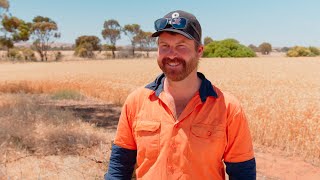
Andrew Sargent has used precision ag tools for twenty years at his South Australian farm. He describes decades of compatibility headaches between manufacturers, especially importing maps for variable-rate seeding, and a 2019 Nuffield scholarship studying open-source solutions. Both see farmer-controlled data platforms and open ecosystems as the fix.
Chapters
Harvest time at Crystal Brook in South Australia's mid North. The headers on Autosteer. The yield monitor is recording yield, grain, moisture and position data, the essentials necessary to produce yield maps. Precision AG at work While Malcolm Sargent sits at the controls, son Andrew sits in the UTE doing battle with a tablet. Trying to show me yesterday's yield map.
But if I zoom in it's like stuck to the picture. This is my life. So we've been involved with precision AG probably for just over 20 years now I'd say so. Dad was one of the guys that started Small SPA or Southern Precision Ag association. That was started I guess out of frustrations with compatibility between different manufacturers in the early days of precision ag.
SPAR now stands for the Society of Precision Agriculture Australia and is a national umbrella group supporting the use of precision AG in different industries. The Sargents were early adopters, I think.
99, 98, 99 was when we got into yield monitoring with an Aguleta yield monitor and we got autosteer 2 centimeter autosteer in about 2001 and then we had a Topcon rate controller, variable rate controller for an air seeder back then as well. So we were trying to get those sort of three systems to all play together.
Getting them to play together took some time. And Andrew Sargent says while there've been some great advances in technology allowing growers to make better informed judgments at harvesting, seeding and fertilising, it doesn't work as seamlessly as he'd like.
You want it to just work when you need it to work and yeah, quite often that's not the case.
He says auto steering headers and seeders have been a standout in terms of farmer take up and making the job easier, although there are often compatibility issues between equipment and across brands. But it's variable rate seeders that he's had the most trouble with.
I guess our biggest issue was with variable rate was getting maps out of the software into a format that the controller on the seeder would read, getting the controller to reliably run those maps.
In 2019, Andrew set off overseas on a nuffield scholarship to see if other places were working through the compatibility gremlins in the precision AG technology. He was particularly interested in the use of open source tech. Most ag tech is proprietary, so it's closed source.
I was just sort of interested in looking at other industries sort of IT robotics where they've developed more of an open ecosystem which has helped them move forward faster and how we could bring some of that into WAG and maybe make our lives a bit easier.
Andrew admits to doing a lot of thinking when he's sitting at the Chaser Bin and feels open source is definitely part of the solution. Where the programs for the various bits of equipment are freely available, anyone can modify it.
I guess with the open source stuff no one really owns it. So then on the flip side, I guess everyone owns it. So you need to get that critical mass. You need to get enough of a community following it that it's not just one guy trying to trying to keep it running. They have forums that are supported just by community members, just other farmers that have made contributions to the project and are happy to answer questions.
And he says timely access to your data is essential.
If you've got a question, you want to answer that now so you can action something about it. Now. You don't want to go back and sit down and reprocess your yield data in three months time because that doesn't help you now make a decision.
Andrew Sargent feels there are real opportunities for grower groups to to jump on board and help with data collection, such as spray records. And they could also supply an open source platform that farmers can use to put the data in, which gives flexibility to change service providers without having to go through the hassle of adapting to a whole new tech ecosystem.
Farmers themselves are really good at working together, and as an industry I think that's helped drive us forward a lot faster than what it would have had we all done our own thing. And I think the same thing can apply to ag tech as well. If we sort of collaborate more and we're not all doing our own thing, we're not all reinventing the wheel, we might actually get to some useful solutions for farmers sooner, which would be great.