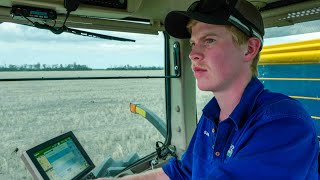
Sam Hodgson and Christian Cap show how Boardman Agriculture in NSW uses EM38 electromagnetic mapping to spot soil differences from black cracking clay to sandy clay loam, then runs variable-rate fertilizer trials across 250-meter strips to cut costs and improve soil health.
Chapters
We've been using precision ag for a long time on this property. I suppose years ago precision ag technology was very expensive, hard to obtain and not user friendly at all. So in the recent years, with the rising costs of inputs and the increase in availability of precision ag technology, we've been able to adopt more technology in each part of the farm and now we're able to use technology like EM mapping to better assess our paddocks. Hi, I'm Sam Hodgson, 2 IC here at Boardman Ag. So we're a broad acre cropping enterprise located in far north New South Wales between Taloona and Cropper Creek. We grow wheat, barley and chickpeas in the wintertime and in the summertime we grow dryland cotton. So our trials we've undertaken is looking at different soil types in the paddock. So our soil types are predominantly a black cracking clay, self mulching soil and they move through to a sandy clay loam. Looking at these different soil types, we've been able to find variations in the paddock in nitrogen and phosphorus and then use these soil tests to apply different rates of fertiliser when it comes to planting and in crop application. Christian Cap's my name. I live in Gundiwindi, I'm a precision Ag consultant. I, I have my own business called Grow Ag. So Shane and Sam are very much into adopting precision Ag. We did a soil map using an EM38. We mapped the variability of that soil and then did some targeted soil testing with our agronomist Jack. He's got those results back and we've verberated our urea prior to planting and then at planting our starter and our seed across that pad. We did three trial strips of 250 metres wide to look at different rates of urea and seed across the paddock so that we could see what the combination did to our yield. Whether it's just variable rate urea to save a few dollars or make those dollars work a bit harder for you, or you can get into more agronomic traits as well, like seeding rates and starter fertiliser rates. So yeah, that's one of the challenges is you just got to know where you want to end up with it all. And ultimately it's dollars in the farmer's pocket that matters. It just gives us more accurate data on the field. Yeah, so this will improve the soil quality, I suppose. In terms of precision ag, getting started is my best tip. As soon as you're able to adopt new technology, work with people who are like minded in the field. You're able to streamline data from tractors to consultants and then make more educated decisions on the farm. Sam.