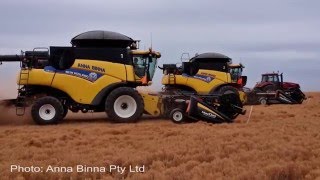
A farmer with ~20 years lentil experience explains practical steps they use to reduce harvester-fire risk during lentil harvest. They describe paddock preparation (firebreaks, harvested buffer laps, harvesting into the wind), machine modifications (fiber frax insulation, added ducting to increase airflow, ‘fire exit bombs’), onboard and support firefighting equipment (extinguishers, 1,000 L fire units on chaser bins, ex-CFS trucks), and organized crew procedures (pre-harvest briefings, defined pickup-bin roles, monitoring frequency for blowing headers). The speaker stresses working with local dealers and being proactive to manage risk.
Chapters
We've been growing lentils for about 20 years. They've been a really important part of our system. They're very profitable. So, yeah, there's something we've sort of learned to get pretty well. We've learned to learn to manage them pretty well. We've had issues sort of 15 years ago with a couple of the headers we owned and I suppose we learnt to recognise the conditions when the headers were building dust. And then over time we've just sort of learnt to a, to set up our headers the best we can and modify them, but also to set up the paddock. So if we have any sort of incident, the paddock's well set up so we can sort of deal with it ourselves. In setting up the paddock, it's really simple. We have a fire break around every paddock that we farm, so that's sort of a couple of metres strip and normally we just aim to blow off the headers before we go into the paddock so they're clean. And then we just harvest three laps around the paddock, which sort of gives us a 50 metre area around the paddock that's got a very low fuel, so it'll really hardly carry a fire. From there we just look really to harvest across the wind so that the dust these sort of predominantly blowing off the machines and then we harvest into the wind. So if we happen to have any sort of smoulder, the wind's always blowing towards land that's harvested. We run a couple of chaser bins so we've put thousand litre fire units on them. They're all set up so the operator can just start the pump and just drive around. If we had a small smoulder or a fire, they can just drive around it. We make sure that they're operating in an area so they've got a good view of the whole paddock. Where the headers are, where the trucks are, where the trucks are loading. Beyond that we've got a couple of ex CFS fire trucks of our own, so we've certainly got plenty of fire power in the paddock. On the harvesters themselves, we put on a couple of extra water extinguishers, so we've got two powder and two water extinguishers, so we're pretty well set up. I suppose the first thing to do is just work out anywhere in the headers that's hot and perhaps anywhere that could be a potential ignition source. And it's obviously dust causes these issues, so look to limit the dust getting on the engine. So what we've done is we've fitted a material called fiber frax to all the turbo, the manifold and the exhaust. And that basically insulates it and lowers the temperature down to about 100 degrees where it's a lot less likely to ignite. Beyond that, we've got ducting all over the engines. We just try and establish anywhere that there's. There's a bit of a low pressure zone on the engine. So we've got ducting and we've probably increased the airflow over that manifold area by about three times. So, yeah, just to try and identify those areas and then modify it so it's as good as it can be. We have these fire exit bombs on the headers and we've got about half a dozen just placed strategically throughout the sort of engine bay. So anywhere that we've heard or perhaps get chaff collect that we think could be an issue. We've got these bombs and basically if we had a fire, the fuse ignites and they put powder and extinguish the fire. We have a bit of a get together pre harvest, especially with our new employees, and just run through a bit of a strategy, particularly around lentils, just so the pickup bin drivers know what they've got to do. If we had an incident, basically one pickup bins to deal with whatever is going on in the paddock and the other pickup bins to sort of come and watch the header and assist the driver. And generally our truck drivers then would go and get one of the fry units. So we just have a strategy and we pretty much stick to it. In crops with a high canopy, sometimes the headers will start to build dust and these are the conditions that we recognize. So in those conditions, depending on how bad it is, we'll blow the headers off. That can be as often as every hour or as little as every six hours. I think it's very important to work with your local dealer, have a look at your machines, talk to other growers, and then really work out what you're going to do with your machines and work with the local dealer to get it done early. So you just make your machines the best they can be. Look, lentils are a very important part of our rotation and there's something that we must just learn to manage this risk or perhaps if we don't, we're at risk of being legislated to manage it. So, yeah, just be proactive and get it done and enjoy growing lentils.