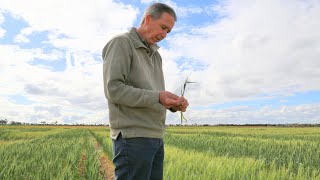
Spot form net blotch affects roughly 90% of barley crops in Western Australia's low rainfall zones. A four-year GRDC trial tested fungicide effectiveness and variety resistance, comparing cultivars like Maximus and Spartacus to guide growers on when fungicide pays off and which varieties to plant.
Questions this video answers
Approximately 90% of crops in WA.
2024.
Chapters
We've probably seen more spotful net blotch in the low rainfall environment over, say, the last 10 years because of the increased area of barley and the use of more susceptible varieties in these areas. Most barley crops have a small amount of spot form net blotch. Pretty much 90% of crops in WA have spot form netbloch to some degree.
While that may sound like an alarming statistic, the prevalence of spot born net blotch in WA is nothing new and growers are pretty good at keeping it under control. However, incidences of the disease in WA's low rainfall zone have been increasing. So with GRDC investment, researchers from the Department of Primary Industries and Regional Development are helping growers with the best management options.
So growers are going to learn a bit more about the epidemiology of the disease, how it actually acts in the low rainfall environment, the impact of the disease, and particularly the impact of the disease. With some new varieties that are emerging, they're also going to hopefully gain some confidence in decision making and particularly around when not to apply fungicide. The benefits there are obviously reduced inputs to crops, reducing the pressure on fungicides in terms of fungicide resistance and generally, I think make managing barley crops easier.
2024 will be the fourth and final year of the project which has featured trial activity across WA's low rainfall zone. A range of barley varieties have been grown on barley stubble using a plus and minus fungicide approach to determine what the yield loss might be and provide information on disease carryover as well as the impact of different resistance levels of those varieties. Information on rainfall, temperature and humidity has also been recorded and a spore trap has been capturing the level of disease present in the paddock.
What I can suggest to growers is to avoid barley on barley rotation, where possible to choose a variety that has resistance to spot form net blotch, which will reduce the disease severity in crop and also the carryover in disease in following seasons. So with varieties like Maximus that have a moderate increase in disease resistance compared to Spartacus, we've seen that that translates to quite a reduction in disease severity in crop. There are several varieties now that actually have improved resistance to spot form. Nep Lodge.
There you go.
This is Spartacus untreated, the SVS variety. You can see it's.
Yeah, look at that. Some nice lesions down low and they're coming up the canopy. Yeah, I reckon. Might get a fungicide response on that one.
Alrighty. This is combat untreated and as you can see, wow, pretty clean.
Not much disease in that one. So that move from svs to mrms is certainly making a difference in the level of disease, isn't it?
You wouldn't need to spray this, no.
Ultimately, the project hopes to quantify the yield impact of spotfall netbloch in low rainfall environments, as well as provide critical data on the response to fungicide applications and if one is even needed at all.
In the final year of the project, we will be analysing the results of historical data, all the trials that we've run within the project, and doing economic analysis to understand the the impact of the disease, the response to fungicide control, and providing some guidance to growers in these lower rainfall environments as to the possible return on investment or the need for fungicide when they're faced with spot form net blotch.