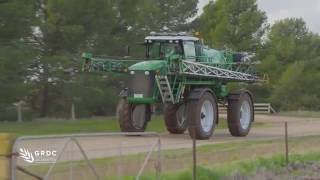
Interview with grower David Gooden (Lockhard) about choosing a new spray rig. Key priorities: future-proofing (ground clearance), flexible application (high water rates, range of speeds and droplet sizes), reliable service/backup, and fuel-efficient operation. Specifics mentioned: 3Ts rapid-fire with recirculation, 25 cm nozzle spacing, two-wheel-drive direct-drive automatic machine, 41 m boom (matched to 13.5 m traffic lanes), and an expected ownership of ~6 years or 3–4,000 hours.
Questions this video answers
3Ts rapid fire and recirculation.
25 centimetre spacing.
Two-wheel drive, direct drive, automatic.
41 metre boom.
About six years, roughly 3,000–4,000 hours.
Chapters
I'm here with David Gooden, a grower from Lockhard. We're just going to have a quick chat about some of the decisions he went through when he purchased a new spray rig. So, Dave, with this machine, what were some of the things you considered when you were buying it, some of the most important factors for you?
Well, the key decision was trying to buy something for the future. We wanted something with a bit of ground clearance so we could be doing something later in crop. We wanted something that would give us the ability to apply high water rates at different rates, over a range of speeds, over a range of droplet sizes. And finally, with a good service and back up, we wanted to make sure we had someone who was able to do that.
So the spray system that you went with on this machine, what's it fitted with?
It's fitted with 3Ts, rapid fire and recirculation. We spaced our nozzles at 25 centimeter spacings to allow better coverage. And the important thing with rapid fire and recirculation, so it allows us to apply chemicals over a large speed range and with different water rates and also allows us to recirculate our chemical before we get to the field. So we're not having to charge up the lines before we start an opera, before we start a paddock.
Any other functions on it or features? You sort of, when you're weighing up your decisions, you thought, well, that's a good idea. I like that.
A few. Use was a consideration, overall fuel use. So the machine we've got is a two wheel drive, direct drive machine, automatic. So fuel use is quite low, fuel consumption is low. We want a good service and good backup. So we want to deal with someone who knows about the whole system and can fix the problems when they occur.
When you purchased this machine, how wide did you end up going with the boom?
It's a 41 metre boom. It matches with our control traffic system, so in multiples of 13.5 metres. So we have a little bit of overlap.
You think that's an important thing for other people to consider when they're buying machines, how that sort of fits into the farming system and all your other equipment?
Absolutely. When going to control traffic, matching the sprayer is an important part of matching your machinery.
So with this machine, how long do you reckon you'll keep it before you change it?
Maybe six years, say three or 4,000 hours, roughly.
So it seems to me that you spent a lot of time doing research and doing a bit of homework before you actually bought this machine. David.
That's right, yeah. We put a lot of work into trying to come up with a system that suited our operation and our needs and requirements to make it more efficient and effective when we go out and spray.
I think that's the take home message for all growers is that to do your homework and a bit of research about what sort of machine is going to suit your farming system, to think about the factors, some of the things that David talked about, obviously service, speed, range, volume, how it fits into the future, into the farming system, they're all really important. So it means that the machine that suits David may not be the same machine that's suitable for your farm.