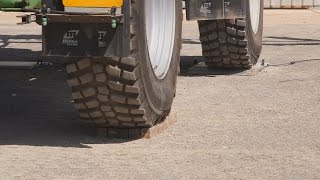
This is a short interview transcript from a Gerri the NVT Guru GrowNotes video about matching tyre pressure to wheel load on a Millers sprayer. Ash explains his original tyres lasted about two years before sidewall bubbling, cracking and failures. After fitting higher-rated tyres he noticed less soil compaction and better load carrying, but some tyres developed bulges. He purchased scales to measure axle and individual tyre weights and fitted a TyreDog tyre-pressure monitoring system; measurements showed two-to-three tonne side-to-side weight discrepancies and tyres’ running pressure rose ~2–3 psi from cold. To visually match tyre shape he adjusted pressures, in one case creating a ~30 psi difference between two tyres to suit differing loads.
Questions this video answers
Approximately two years.
About 40 kilometres an hour.
They increase about 2–3 psi.
Up to two to three tonnes.
About a 30 psi difference between two tyres.
Chapters
Ash, with the purchase of Millers sprayer a few years ago, how long did your first lot of tyres last for?
Yeah, approximately two years.
Sorry, and what, what, why don't they last two years?
Sidewalls kept bubbling up and, yeah, just failing, cracking and eventually blowing.
So what process did you go through to replace the tyres?
We started looking at the tyre ratings and the numbers on the side of the tyres. So we found that the tyres that were on there were only barely spec'd to do what we wanted to do. So we started looking out in the industry to see what sort of tyres that we could find. They had a better load rating and better quality.
With the tyres that you put on, what did you notice?
Firstly, because we went for a tyre that has more tread on the ground, we were finding less compaction and less cutting up of the soil, that was one thing. And also, obviously, because we went for a better quality and better rated tyre, they were carrying their weight better.
You had damage on one of the new tyres. What do you think caused that?
Yeah, one of the new tyres had a bubble in the sidewall. We don't know what caused that, but yeah, we had to replace that for fear of blowing it. When you're going down the road at 40 kilometres an hour, you don't want a tyre blow.
To select the correct tyre, we need to be able to weigh the sprayer. What have you done to accommodate that?
Not only to weigh the sprayer, but a few years ago I bought a set of scales for weighing grain. So we've got a set of scales now that we can put the sprayer on and weigh front axle, back axle or individual tyres, whichever one we can. So we know the exact weights of the actual machine front to rear. But not only that, we also know each individual tyre, what weights on each of those.
What did you notice physically about the new tyres?
One in particular, after we put the new tyres on, had a big bulge in it. I actually got the tyre wrapped back to have a look at it and he checked the tyre pressures and yeah, said it was fine. But yeah, we had at least one that was really bulgy, another one was bulgy and the other two weren't too bad.
So, yeah, now we've adjusted the pressures in the tyres and with the boom fold and tank full, what have you noticed with the shape of the tyres?
Now, two of them looked as though they were pumped up nicely and normally, but the other two seemed as though they were flat, although they had the same tyre pressure.
Ash, you put the tyre dog system on your sprayer tyres that has the sensor at the valve stem and the screen in the cab to tell you what the tyre pressure is. What have you noticed?
They just show the accurate pressure of what's in the actual tyre. The only thing you do notice, they do gain a little bit of pressure and that's just normal tyres, cold pressure to running pressure. They actually increase 2 or 3 psi.
That's not uncommon. What did you do? How did you find out what the issue was with that shape of the tyre being a little bit bulgy for the two tyres and standing up better the other two? What did you find there?
Just by chance, we weighed the front and the back on the dual pads and then we decided we would weigh them individually and found there was a huge discrepancy in the weight between side by side tyres, front and rear, anything up to two to three tonne.
Right. That's a damn lot.
Yeah, it's a lot of pressure.
So what are you going to do about pressure now?
What we've done is we've pumped them up so that they actually look the same. And, yeah, we've got 30 psi difference between two tyres just to get them to where they actually should be for the load that they're carrying.
And does the shape of the tyres look a lot better now?
Four tires now look as though they're pumped to the same pressure, although they are. Two of them are 30 psi difference.