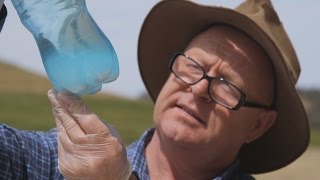
Learn to conduct a jar test that mimics spray-tank mixing at field scale. Divide per-hectare rates by 100 to get jar volumes, then mix water, ammonium sulfate, 2,4-D, and glyphosate in sequence. The video shows how insufficient water or agitation causes precipitate that clogs filters.
Questions this video answers
Divide the per-hectare rate by 100 (use 1/100 of each volume).
700 milliliters.
10 milliliters of glyphosate.
Approximately 400 milliliters of water (about 60% of the jar).
14 milliliters of liquid ammonium sulfate; derived from a field rate of 2 L per 100 L (equals 20 mL per L), so 20 mL × 0.7 L = 14 mL.
Chapters
Today I'm going to show you how to conduct the jar test. We need only some very simple material like a pet bottle marked up and the syringe you can easily get in the pharmacy. That's basically all we need. The only thing, what needs to be precise is actually the measurements because we really want to mimic what's happened when we mix our chemicals in the tank. And I would suggest the easiest is to work on a per hectare base and divide everything by 100. So for example, you use 70 liters per hectare. In our jar test, we will be using 700 milliliter. 70 liters divided by 100. If you use a liter of glyphosate per hectare, we will be using 10 milliliter. Okay, so let's go through one. And I have three chemicals here. I have liquid ammonium sulfate, I have 2.4D and then I have glyphosate. So very common standard scenario. So we start off with probably 400 milliliters of water in our bottle. Because when you start mixing, you probably have only 60% of your water weight in the tank. And from 700 milliliters, just a bit more than the half is 400. So that's what mimics our tank. Ammonium sulfate is measured in pair hundred liters rather than per hectare, but it's 2 liter per 100 liters. So per liter would be 20 milliliter. But because we're only working on 700 milliliter here, I have 14 milliliters of ammonium sulfate in here, which I put in because it's already pre mixed. We don't have to worry about anything. Ready to go. The next one is our 2.4D and we're working on a liter. So there are 10 milliliters in here. Agitation by hand, very easy to mimic. And last, not least, we putting our glyphosate in again at the liter per hectare. So we're looking at 10 milliliter. So a little bit of a shake. And in real life, you would be filling up our tank to 100%. That's what we're doing here as well. So basically the 700 milliliter I was talking about earlier, that's what we want to achieve now. And here is our full tank. And we have mimicked exactly what we would do in our mixing procedure. Now, in this case, everything worked perfectly. Earlier on, I did this one here. This is exactly the same mixture, but I tried to cut corners and took less time. I used less water, and as a result we have precipitate on the bottom and the mixture failed. So if you have clogged up of your filters, the precipitate on the bottom there, that's actually what will do it. So simple as it.