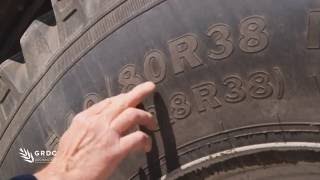
Gerri the NVT Guru walks through tyre sidewall markings: size, load index, speed symbol, and RCI. Run tyres at about 75% of max inflation (20-25 psi) to reduce paddock damage, improve boom stability, and help autosteer work better.
Questions this video answers
The width of the tread (540).
The 80% is the aspect ratio (depth) relative to the 540 tread width.
R indicates a radial construction.
38 is the rim diameter (inches as per the example).
Load rating 172; speed symbol A8 (given at 40 km/h in the example).
Chapters
The next part of this process is to understand all the information on the tyre. And when you're buying, purchasing a tyre, the information you need to look for obviously brand, that's pretty common sense. This one's very important. That's the model of the tyre. Obviously we're all familiar with this. 540 is the width of the tread. 80% of the 540 is the depth of the tyre. R it's a radial. 38 inch is the rim. And this one just happens to be an industrial tyre. And this is the old Imperial figures, which now is the new metric. 540 80s R38. But that's only about 25% of a tyre. 75% as tyre is this information the load rating and speed? The 172 is the load rating and the A8 is the speed symbol. That equals certain amount of kgs and that's at 40 kilometers an hour. If you want to go faster, it's a lower load capacity and a bit higher speed. The D stands for 50km per hour. I've graffitied the tyre, but this information should be on there also. It's very, very important. RCI stands for Rolling Circumference Index 48. And that 48 is a group number to tell you how the rolling circumference of the tyre. Very important. This 2.5, that's the beading pressure, has nothing to do with the operating pressure. So it's saying don't go over 2.5 bars when you're beating the tyre. Very important to find out what the maximum inflation pressure is. A lot of tyres will have maximum pressure at maximum kilograms the tyre can carry. They're only maximums. You don't need to operate the tyre there. And we don't like to operate tyres at that pressure. We like to operate down at about 75% of the maximum. It's not on this tyre, this industrial tyre, but has a tread pattern very similar to an R3. What that means is we got 70% contact and 30% void, where the other R1 tyres will have 70% void and 30% contact. Why we're going for this type tyre is it cuts up the paddock a lot less. Okdoke to summarise all of what we've learned, we've learned about all the numbers on the tyres. We also need the weight information and these numbers when we go into our tyre dealer, including the rim number. When you have a look in the tyre manufacturer's catalogue to see what tyre is matched up to what rim that's very important. The reason we're doing all this is we've got a lot of weight above us there, a big tank capacity, and the big issue is we're damaging our paddocks because we aren't getting this right. We're having to put far too much pressure on these tyres. We need to get that tyre pressure down to about 20, 25 psi. But also tyres and the tyre pressure has very big impact on the stability of the boom and obviously the comfort of the operator. And also your auto steer, if you don't get all this right, your auto steer could not work properly.