Australian farmers use camera surveillance and parasitoid flies to manage snail pests that cost operations six figures in crop damage and harvest contamination. Cameras record every minute to catch snails emerging so farmers can time baiting, while parasitoid flies released in Albany, Esperance, and Yorke Peninsula offer longer-term control.
Chapters
Snails are one of the main pest management challenges facing Australian farmers. They can damage young crops at establishment, but the main issue is that they climb crop plants in the spring and can end up becoming contaminants of the grain harvest.
The snail problem is not only affecting us at seeding, but also the back end of the year at harvest time. We're having contamination issues with our bulk antler that, you know, we're working really hard, hard to rectify. So, yeah, it's a very pressing issue throughout the whole growing season, really. It'd be pushing six figures quite comfortably by the time you take into account buying a roller at harvest time, cleaning grain, buying bait, supplying bait.
Research into snails over the past decade has largely focused on baiting. And while a lot has been learned, baiting is only one part of an effective integrated management strategy for snails. That's why a new GIDC investment led by the University of Adelaide and the South Australian Research and Development Institute, or sardi, is combining technology development with biological research to inform control management.
Monitoring is a major challenge for farmers. Not many people have any time to do it. The idea here with the cameras is that they will automatically detect when snails start to move at the end of their summer dormancy. And if we know when they're moving, then we know when the best time is to put out some snail bait.
Having the cameras on the farm is definitely going to help us when they get bad, especially on dry starts where we're struggling for crop establishment. Snails can take hold of our crop really quickly, so we're always out in the paddock looking. But another tool to help manage the snail damage or feeding, I guess, is something else we can rely on as well.
For biocontrol, a parasitoid fly was released at two sites in Albany and one in Esperance in collaboration with the Department of Primary Industries and Regional Development, along with Stirlings to Coast farmers and cepwa, the South East Premium Wheat Growers Association.
It's been established around the York peninsula region for 20 years. And now for the first time, we're releasing it in Western Australia to try and help get on top of small pointed snails.
Research has been conducted over in South Australia for almost 20 years. So it was really important that we could show WA farmers that we could bring the research across to WA and it could help them with the snail types that they're trying to target in their baiting programs and through management practices.
The female flies attack conical snails by laying a live grub on the outside of a shell of a resting snail and this happens throughout spring and summer when the flies are active. The grub crawls into the snail and consumes it and then eventually develops into an adult fly which then emerges to attack more snails.
Releasing flies is an interesting one. It could be a great tool or it could do nothing. But I guess if you don't try, you don't know. Then I guess we've got a bit of a responsibility as growers to make sure we're doing everything we can to make sure the end product of grain is world class.
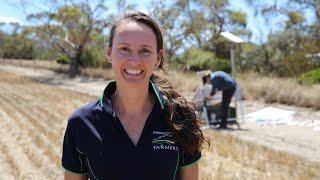
We're really lucky to have some awesome engaged farmers as part of the Stirlings to Coast Farmers group. It's really great that farmers in their region are happy to put their hands up and be part of the project and volunteer parts of their paddocks as well.
I think being part of grower groups is great, incredibly important. If no one puts their hand up, a lot of research isn't done and everyone benefits from the research. And farming is in an industry where you don't necessarily have to do it better than your neighbour, collaboration actually makes everyone more money at the end of the day.
The cameras have been collecting footage at one minute intervals since installed with grower groups already able to access the footage and see where the snails are moving to. However, biocontrol is more of a long term prospect.
Once the fly has a local breeding population, then it will start to passively spread itself around the landscape over time and hopefully start to attack more snails across farming land. Look, we could be talking five, 10 years plus before we start to know what the likely benefit's going to be. And that's just how biocontrol works. Biocontrol itself is not a silver bullet. These flies are not going to wipe out snails, but they will help to suppress the snail population as part of a larger integrated control package.