The stories behind the figures, why it is important to have a high margin business - Simon Fritsch
Simon Fritsch shows how top grain farms in NSW achieve twice the return on assets of average farms by focusing on high gross margins and measuring performance with ROAM. The best 20% hit 8% returns versus 4% for the rest, driven by crop choice, water efficiency, low operating costs, and multi-year planning rather than scale alone.
Chapters
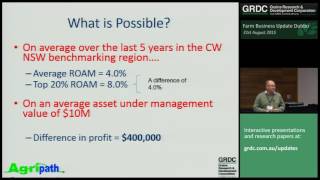
Where we've been and start to talk about what are some of the key things that you need to think about when you're running a farming business, a grain growing business in this environment? What are the things that you need to think about? And more importantly, how do you build a business that is resilient, sustainable and produces year on year profits for your businesses going forward? From my perspective, Agripath is all about helping people understand their businesses. What we do is collect farm performance information and your financial information on an annual basis and put that into a set of numbers that you can actually sit down and make some good management decisions. As we're just hearing about some of the issues in terms of that you face. Trying to read from a P and L based tax accounting point of view. Our business is really about trying to look at the physical financial stuff that happens in the production year and make some good management decisions going forward. I want to talk to you today about a data set, a universe of clients that's situated mainly in the north and west of Dubbo. Here agripath has benchmarking groups in lots of what we call agro ecological zones that are similar rainfalls, similar soil types, similar climate. So I'll be focusing on the Coonamble, Warren, Galagan, Bone, Tranghi type environment. How many people from that region in the room? Beauty, how many people from the south and the east in the room? Okay. Hopefully some of the concepts that we talk about today, you'll be able to see that they're very transferable to your own farm businesses. And I really want to challenge you today to think about what are the things we're trying, what are we trying to do with this business? What are the things we want this business to do for us in terms of profitability and making the business perform better? One of the key things I think is important when we step back from it and we've heard speakers talk about the attributes of good farm management and I'm not going to spend another half an hour or so talking about those things. I'm really going to look at the farm, the engine, the thing that actually drives the profitability in the business, the things that you actually have to get right. And one of the things that I think is most important and probably the key message for all of you is that regardless of what you do, top performers focus on building high margin businesses. In other words, they produce high gross margin this year, next year and the year after. And that is the thing that supports the profitability of the business, underpins it and allows them to increase their wealth, provide for the succession, get the families schooled, and also deal with things like holidays and things that are necessary parts of meeting your lifestyle goals and environment. So high margin businesses are really important and we'll look about what that actually means. The other thing is that top performers in doing that actually understand their environment. They understand what it takes to generate margin and they do things that are specific to their business that is a reflection of the environment they're in. In other words, they are making specific management decisions that reflect things that actually happen in their environment. The other thing I want you to remember is that activity does not always mean profitability. And we'll talk about some examples on what that actually looks like. But often in farming we are guilty of making decisions. And because that's what we do each year, and when the fundamentals aren't right, they often mean that we don't make any profit. And not only does it mean that we don't make any profitability, it can often deny us a more profitable opportunity in the years that follow over that environment. The other thing that I think is common misconception is that scale is irrelevant. Small businesses are able to make good profits. So if you're sitting here thinking, well, I can't compete with the big boys, that's simply not true. And we'll look at some of that data and ultimately, as we've already heard from a lot of the speakers, strategic thinking and management is essential to drive good margins in your business. So I want you to focus on how do I get my business to become a high margin business? How do we understand that? Well, one of the ways that we at Agripath do that is by measuring what we call our universal measure of profit, which is called a return on assets managed. And it's simply, as we've already heard with the prior speakers, a way of understanding how well are we managing our assets to get a return for our business? It's calculated by taking the gross income. And in this case we're not using the P and L income that you provide your tax accountant. We're actually accounting for crops that are crop income that is associated with that production year and disregarding crop income that might be carried over from a prior production year that's been sold for tax purposes in your environment. So we're really starting to understand and line up the financial implications of the management decisions we've made to achieve a crop outcome in that environment. From that, we deduct what we call the direct costs. And they are simply those costs that you incur to generate income. They are things like fertiliser, chemical fuel, and in our case, because we're dealing with diverse cropping systems, labour machinery costs such as depreciation and R and M to own it, which we'll talk about a little bit more further on, that equals what we call gross margin, which enables us then to understand how well we're performing in each of our different enterprises over that period of time. And from that we're deducting what we call the overhead costs. Overhead costs are simply those things that your business incur that don't generate you any income. They are things like your bank fees, your rates, your general insurance, the cost of running your utes and vehicles. Those things that you have to pay regardless of whether you grow one hectare of crop or you grow 10,000 hectares of crop or run one cow or 500 cows. They are costs that your business incurs each year, regardless of what you do on that enterprise. And as managers, what we have to do is take those things and understand how do I generate this thing into a high profit business and where should I be focusing? Most and foremost, we deduct from the income, the direct cost and the overhead. We get what we call your operating profit. That operating profit is then put over the assets that are managed in the business. So in this case, it's the land or water, livestock and machinery that your business is actually utilising to generate an income over that period of time. One important distinction here is that it's important to realise that this operating profit is actually calculated before interest drawings and tax and capital improvement. Now, they are all very important things through your business, and ultimately that operating profit needs to be sufficient to cover those things. Otherwise you are, in what Mike was talking about, a cash flow deficit point of view, and you're also eroding wealth if it's not. But from a point of view of comparing businesses in a universe and trying to understand how well is my engine performing before it meets these discretionary things. We use operating profit or roam, percentage of the return on assets, manages. Our key measure, and we do that because it gets simple, is that things like debt and how much you draw, mindful that we've got an imputed labour cost up here for owner managers. But how much you draw and spend on school fees and holidays and those sorts of things, and how much you spend on capital improvement on your property and your tax position are actually all discretionary items. They are driven by how much profit your business generates. But when we're trying to understand farm Performance and look between one farm and another and try and understand what is it that's making this engine drive a lot better than another. We need to avoid those discretionary items so we don't get into discussions to say, well, it's okay for Joe down the road. He doesn't have five kids at boarding school like I have and the debt I've got. So our key measure is this thing called return on assets managed, which is simply the operating profit before those discretionary items are taken into account. Importantly, the story behind it numbers. What are the issues in terms of what it is? Well, I think first and foremost, as we've already heard from a couple of speakers, it's important to know what is possible. And two big measures for me are return on assets managed, which I've just talked about. And the other one is water use efficiency. In terms of how well are we converting the moisture available to us to grain yield as a key measure for our business going forward? They are probably the two biggest things. The other part is that the types of decisions we make are really important. Crop choice, plant available water, and how we integrate our cropping systems in terms of rotations and crop sequences can have a huge impact on your businesses in this environment in terms of getting an engine that is actually very profitable and generates the surpluses we need to pay the, pay the interest drawings and tax and holidays and school fees. The other part of it is the risk management side of it. What we do know is good performing businesses have really resilient systems. They are designed to make money in the environment that they are working in, regardless of what happens environmentally over time. And the other thing that top performers tend to do very well compared to their peers is that they have really good harvest management systems. They get the grain off, they get it into storage, they get it dried down, they get it blended, they do the things they've got to do to deliver a quality product as much as possible. They also are good at agronomy. They have the attention to detail, they trial things, they don't implement large scale things. They trial things, then implement them and they plan. Most importantly, they're looking at last year's results and looking at what the implications of what they've learned from that might be for their businesses going forward. They're obviously good people. Most top performing farmers are really good at logistics, they're good at handling people and they're precise in the way that they get things done. They don't leave things half right. They do it right time and time out again and Actually, as we talk about business growth, often one of the biggest challenges for managers is going from a one to two man operation to a point where they're getting to five or six. And staff management issues become a real important part of whether they can continue to replicate the engine that was working so well for them when they had a good locus of control over all the staff. Once the staff get too high, that locus of control starts to get a little bit narrower and they can't control things as well as they used to. So it's a real issue in terms of recognising your own skill development. Am I a good people manager? Do I need to get more skills or a few more systems in place to enable me to manage those sorts of people? The other part is what naturally comes from that is top performing farms generally have a low cost businesses. They have machinery and overheads that are low in cost compared to their peers and they know what their costs actually are. And they've built businesses, as I said, that are of high margin that allows them to capture some of that profitability. So what do those returns look like in this part of the world? On average, in the last five years in the Central West, New South Wales, in our data set, the average Rome return on assets managed has been 4%. In other words, if you've got a $10 million asset this, they've generated about $400,000 worth of operating profit, which has then been used by those businesses to cover their interest over their interest tax and capital improvement component of the business and their drawings. The top 20% have achieved 8% over the same period of time and that's a difference of 4% return on asset year in year out over that period of time. That being that the top 20% are those businesses that each year have actually generated the highest returns on an average asset. That means the difference in operating profit between a top performing farm and an average, and we're not talking about the bottom 20% is $400,000 in any one given year over five years, that's $2 million. That goes a long way towards buying the next door neighbours, paying the debt off, providing the succession that businesses are so urgently wanting to try and achieve in their businesses. So a focus on a high margin engine that enables us to produce high operating profit is quite possible in this environment. What does it look like? This is a suite of farms, or the universe of farms that Agripath has benchmarked in that Warren Canamble region. And each one of these red columns here represents a farm's performance over that period of time. On the left axis here we've got return on assets ranging from -5 through to over 20% return on asset. And the black dot represents what the average farm in that data set for each what each farm's achieved on average over the last five years. The red lines represent the range of returns that it's actually encountered in that period of time to get that average. Does that make sense? So the average is the black dot. That's what. So this farm here has achieved an average return of just over 9% and it's at as high as 21 and as low as minus 3 over that period of time. And as we can see, there's a fair range of return. Top performing farms achieving 8%, the average a bit over 4, and quite a few farms struggling to make break even type returns in that environment. That said, most of those farms are probably north of Coonamble where it's been particularly tough challenges seasonally for those farms over that period of time. When you sit here and look at that data set and look at it, the first thing that strikes you is that there are some farms producing really good profits, but between them they have massive variances. So our top performing farm, huge variance in terms of its profitability. And there are other farms that are doing pretty well with a lot less variants. So part of the things that we're interested in, nagrapathies, what are the things that those farms are doing to take that variance out? How are they responding to their environment and what sort of engine is it or how does that business look in terms of how it generates that income and what can we learn about that going forward? Okay, let's start dispelling some myths. Scale, scale, is it relevant? Is it required to be profitable? This is the same data set. So these same farms lined up in terms of their scale and ranging from 0 to 14,000 hectares, return on assets ranging from 0 through to just over 8%. This is for those farms that are predominantly dry land farming in that environment. So I've taken out some that have got some irrigation and those sorts of things in it. And I hope you can see here that when we're looking at scale being area farmed, including fallow and the return on assets that the farms have been able to achieve over that period of time, that the top performing farms are still achieving returns up around 8%. And there are plenty of farms here at 2,000 and less hectares that are getting returns in the 7 to 8% return. But equally there are a few farms with low scale that are getting returns of around 2% from their businesses. So farms of small scale potentially quite possible to be able to achieve high returns, have an engine that really works for them, performs well for their business going forward. And equally with large scale, there are some farms that are doing quite well and some farms that are only just performing on average. So the key message here for you is if you've got a small farm, it's about getting an engine that is effective for your business, that produces high margin to enable you to expand your wealth over that period of time. And overall, while scale helps in terms of generating plenty of cash, it's not the be all and end all in terms of high performance. One of the things I think is really important is that when you line this data set up and start to look at how well they convert crop income into margin, this measure here is long term crop gross margin. So this is their average crop gross margin they've generated from their farms over five years. So it includes all the crops grown within one year plus any fallow ground that they had as part of that, as part of that margin. And each year that is averaged. And what we've got Here is the 5 year average results which is represented by each of these black dots. And you can see here, and that's linked up with return on assets managed on the left hand column and long term gross margin per hectare on the right hand column, that the top performing farms that are achieving 7 to 8% returns are getting margins, average margin across their entire cropping land up over $300 a hectare. And for the poorer performing farms that are getting low returns, average margin is down to $150 a hectare. So one of the keys is the R squared says it's predicting about 60 to 70% of the, sorry, 57% of the variation there. So the question becomes, is when we talk to these people, they say, well, how can it be so different? I'm getting the same sort of yields and the same sorts of prices as my peers. Why is there such big differences in profitability? And some of the issues with some of these farms is that it's not just margin that's dealing with their issues, it's also other things like their overhead, cost structure and things that is explaining some of this variance as well, which they need to understand. And for some it might be that they're generating the income, but it's actually costing them a lot to do that. And that's coming about by the decisions they've made in terms of plant ownership and what that actually costs them to get a result in their individual businesses over a period of time. So from a business point of view, margin is the most important thing for you to focus on. Your key role is to focus on building a high margin business. That's not just about throwing inputs at the business to try and get higher crop yields. It's about stepping back from the environment that you work in to and looking at it and say, what do I need to do to deal with the issues that I have that are facing my farming system to get the best result possible out of them? We've talked about key drivers of profit. We know that one of the key things is income and income less. Cost gives us our profitability. When we're thinking about high margin, we need to be thinking about these things. Where does my business sit in terms of how well am I performing in yield, how well am I performing in price? And we've heard a lot about those this morning. What about my scale in terms of hectares and what does that mean in terms of how I get gear up, my kit and those sorts of things? What is appropriate for the scale that I'm actually running at, how arable I am, am I managing farming as much as I should can be. And more importantly, what my enterprise choice, and as a result of my enterprise choices, what level of crop intensity I have when we're trying to improve income, they're the things we need to be analysing and understanding for your business going forward. From a cost point of view, it's about trying to understand the direct costs that your business is incurring and they are broken up into area yield and TPML costs, or total plant, machinery and labour costs, which I'll talk about a little bit later on. And of course, your farm overhead costs. Do you have a business or an engine that has a high overhead costs in its business compared to your peers? Are there things fundamentally structurally wrong with your business causing your overhead costs to be higher than they should be in comparison? And the only way you can really understand those things is by measuring them. And that's probably one of the strengths of benchmarking, is you get to measure the things confidentially against your peers so you understand where your business sits in the universe in terms of what it's going to do. What is crop choice? How important is it? This is the crop data for the long term, five year averages again for each crop, with the blue columns representing what the average farm has achieved and the red representing what the top performers have achieved for the crops. And over on the left here is the difference in the overall crop margin over that period of time. This is for farms north of Coonamble. What it's telling you is experimentation in general is not generating high levels of profitability. Has been a key focus in this part of the world on wheat and chickpeas as the major crop choices. And the other ones, the ones that have been grown by other people actually haven't been able to get in the top 20% over that period of time. It also says that top performers are achieving about $140 a hectare compared to their peers that are in the $90 per hectare. You start looking at that over a 4,000 hectare farming property, $100 a hectare. There's your $400,000 all in margin as you come further south towards Trangi, Gilgandra Warren, where the season's been a little bit better. Soil types not as heavy and a little bit more forgiving. Then some of these other crops are starting to focus as key crops in that environment. And again top performing farms generating average crop gross margin of 300 and 280 odd dollars a hectare compared to just under $200 a hectare for the average farm in that environment. So huge potential to pick up profitability. And as managers, one of the challenges we have is to say, well, what the hell do we do with this information and how do we package that into something that actually makes some sense and makes my business a high margin business, a high margin engine that can help me cut, pay the interest bills, provide the succession and the school fees. What you need to do is understand your environment. And I think this is key for all businesses. Whether you're south or north, east or west of Dubbo. You need to understand your environment. We've already heard that yields and those things are a very important part of generating profitability and key areas that we as managers can actually focus on. We can't do much about exchange rate, we can't do much about price, but we can do a hell of a lot about yield in terms of the way we manage our farming systems going forward. And yield's really driven by plant available water and how well you convert that water, which we call water use efficiency. Plant available water is really about growing season rainfall. Can't do a lot about that in this part of the world. But stored soil water, we can, we can do a hell of a lot about stored water in our environment as well. And those things we control, how we till it, stubble management are all things that actually impact on our stored soil Water. And one of the things I don't think we know or focus on well enough is just how much moisture are we actually starting with each year and what impact that might have on it. If you look at the long term records for Coonamble it generates between October and April there's a. Sorry, November and April it should read, there's 277 millimeters of fallow rainfall. If we convert that at 27.5%, which is about the long term average conversion or fallow efficiency from rainfall goes up and down a little bit. But year in, year out, 27.5%, it means that we start with 84 millimetres of starting water on average in the Coonamble environment. Now to me that has a huge impact on you as farmers in terms of how do I make good decisions based on that fact. I know some years it's going to be full, some years it's going to be a lot less than that. In fact, in the last couple of years it's been down as low as 20 and 30 mils of starting moisture. And yet so often I go out and farmers say, oh, I've got a full stick, got a full stick. I'm a 6 foot 8 rugby Ford and I can push it all the way down so it's full. The reality is you are farming in an environment where on average you're going to store 84 mils and you're going to store it in a profile that can hold 150 to 210 mils in that environment. So that actually starts to say strategically, how should we use that information to make better decisions going forward? Should we be looking to try and fill this totally or should we be having a more frequent cropping sequence in our system where we're farming the 84 mils and hoping on plant available water to get us through that environment. And I think the further north and the further west you go, the more this becomes applicable. For you guys that are south and east of Dubbo, it's probably about saying what farming sequences do I put in place that will actually manage disease and the yield dragging issues which I'll talk about a little bit more. But the further north we go, the more we need to think about moisture and what that means from a management point of view. To fallow or not to fallow, that is the question. It's a famous old line, but in essence if you look at data from Coonamble based on Coonamble and average water use efficiency type data, we're starting with plant available waters, including Aldi 4 mils, plus our in crop rainfall averaging about 270 mils on average in that environment over growing season. That's going to convert yields around that sort of level. Given that often a few little things go wrong. 2.4 to 1.4 tonne of chickpeas prices, you know, they vary as we go. Giving us income and direct costs of 320 and 335 give us these gross margins of 256 and $309 for chickpeas on short fallow compared to 561 for wheat that's grown on long fallow. In other words, we decide not to grow wheat here and chickpeas there, we fallow it right through and grow wheat in the corresponding year. Is the chickpea as the chickpea crop in that environment. The average farm in that environment has overhead and interest costs of $111. So therefore, if we're long fallowing a crop, we need to double those up. So we've got $222 and we end up with an environment here where the short fallow and the short fallow chickpeas got a combined gross margin of $343 compared to a long fallow wheat crop of 339. So you'll probably go, wow, wheat and chickpeas. That's much better outcome than that. We've made a few more dollars. But interestingly, if you step back and say, well, what's it actually cost us to grow that $343 hectare gross margin? It's actually cost US$320 plus $335 compared to $375 on a long fallow. Right. So we've got to get the same margin. We've put up the same risk capital, double the risk capital, get the same margin over a two year period of time. So the question becomes, the further north, the more unreliable your in crop rainfall, the more we need to be thinking about fallow in our system. As we come further south and we start looking at crops like wheat, chickpeas and lupins and Faber beans, we can see there that those sorts of break crops are having huge impact on the ability of farmers to generate higher gross margins. So we should be incorporating wheat and chickpeas and fava beans and canola into our cropping sequences more regularly than we should. Because in this environment they're performing, at least a couple of them are performing just as well as wheaties in that environment. So their ability to deal with some of the Disease and weed issues that we've been looking at that are becoming more and more problems for our businesses going forward. Relevant and should be utilized in the cropping sequence. Alright. The other thing key message is really important is not to confuse activity with profitability. All right? What generally happens is that people go, I've got a high debt, I've got heaps of pressure on from the bank, I need to go and plant the farm fence to fence and I'll respond to that and hope the hell it works. Well, this is some data from again our average farms north of Coonamble last year. Over the last two years where the seasons have been really appallingly bad and we saw the resultant returns on asset that they've achieved in that environment in a bloody tough time in that environment. What we're seeing here is decisions to plant wheat in 2013 in response to I've got to do something led to a gross margin, yields of almost non existent yields and gross margins of about minus $140 a hectare for the businesses. That country was then turned around and backed up with chickpeas in the next year to get the same negative sorts of results. And yet when we looked at the data and started looking at farmers that set aside wheat here because the starting moisture was too low and and went to left out, left the weed out in this year and then went to chickpeas actually started with instead of 236mils of short fallow moisture, their starting moisture on the long fallow was 297. An extra 60 mils of moisture has taken the profit from minus $97 a hectare through to $403 a hectare in an environment where it was very hard to make anything happen. So when we're in positions where moisture is really low, we need to step back and say what are the implications for this decision in terms of this crop but also the next crop? Because that result there meant that this crop wasn't in a profitable planting position either. But by storing the extra moisture we've been able to generate a profitability well above what we would expect in an environment that was pretty tough in that environment. One of the key things there is the decisions you make this year will actually impact on next year, the year after and the year after. And probably no better example of that is probably the chickpeas in 2010 where we had people planting large areas of chickpeas because the wheat price was bad at planting. Rather than sticking to the sequences, they chased chickpeas. And we all know what happened in 2010, in terms of most of the chickpea crops failed and wheat at harvest time was very profitable crop to grow. So not only was there an issue with that crop in that particular year, what we saw the next year when we started looking at farm performance in the Northwest, was that the people that had grown a lot of chickpeas suddenly had to put a lot of wheat in, in that environment and the year after that. Then there's a need to grow wheat on wheat to get the sequences back into place so that you can get back to a more normal type of rotation to deal with some of the weed and disease issues that have been experienced in those production systems. So the implications of one decision back in 2010 is still being felt in 2012, 2011, 2012 and 2013 as they try and get their systems back in place. So the decisions that you make on one crop and in one environment can have a big implication on it. And one of the things that top performers do is they make their decisions not just for this year, but for the next year and the year after and the year after that. They understand the implications of going heavy on chickpeas. They understand the implications of going heavy on wheat means that we're going to have wheat and wheat, wheat on wheat the next year, which is a no go zone when we're in a high crown rot environment and a high nematode environment. So those sorts of decisions can have a huge impact on profitability and how effective this engine is at driving high gross margin for your businesses going forward. When we talk about plant available water, so we've talked about plant available water and the need to understand it, particularly north and west of here and to be really sure. And there's some tools now out there, we're starting to see EM type probes and stuff that are enabling us to understand plant available water. But there are other tools like climate that actually allow us to get a good estimate on what our plant available should be and then go out and actually test it and realise that it's got to be sopping wet to be really full in that environment. So one of your key things is to really understand your starting moisture going forward. But water use efficiency then is about how well do we go about managing some of those implications. What sort of crop sequences do we have in the environment that we are, that are going to help us deal with things like nutrition? One of the great things about fallow is we have this thing called mineralization. We can mineralize 40 and 50 kilos of nitrogen over a fallow period, which is free in from the air that we don't actually have to put out in a bag. So that's an extra plus to the business. If we use legumes like faba, beans can generate up to 80 and 100 kilos of N per hectare, again saving us up to $80 worth of input costs. So how we pull those things into a farming sequence is what the top performers do really well and really simple things like variety. Okay, are we making sure that we're keeping up to date with varieties and are we planting the right variety in the right window? And when we're outside of that window, are we changing that variety? The amount of times we look at farms and look at the yield and start working through the issues with them and they've sown an early sown variety late because they had the seed. The impact on that is quite dramatic in terms of profitability. So it's about getting those little things right. The times of operations, the type of planters they use, how well they're effectively going about getting a plant stand, and how they're dealing with things like disease and more importantly, weed issues. And again, things like fallow in a farming system, in an environment that you're dealing with, are great ways of using different chemistry to control difficult to kill weeds, particularly where you're in a winter cropping, ailing environment. Then there's a few things. We can't deal much about heat and frost and rain at harvest time, but we can with harvest management systems and those sorts of things, and even thinking about where we plant crops in terms of frost management. So some of these issues that we deal with, we can actually manage those things if we think it through in terms of a strategy that's synonymous with our environment. So if we're in a high frost risk zone, how do we manage the sequence of crops and what we grow to get better outcomes? What's the effect if we don't manage those things? This is what happens. So this is 2014 Central West Bread wheat on short fallow. So this is from a short fallow from the prior crop. Top performers average 3.6 tonnes. Average was 2.3. Focus down here. Costs were 432 compared to 369. So it cost them a little bit more. Gross margin 571 to 274. So two or three things can drag profits back by. Can usually yield drops 30% but profit drops 50%. So we're going from $274 to up to 571. And all we've done is gone up a little bit over a tonne of the hectare in yield. So you've got to manage those profit dragons. And what we know is good performing farms have cropping sequences that deal with the issues in their businesses. It deals with nematodes, it deals with the crown rot, it deals with the difficult to kill weeds through the types of sequences that they actually run in that environment over the period of time. Yet when you look at the plant available water, 30 extra mils, well, that would have contributed some of that extra yield. But a lot of it's in terms of how they dealt with and their systems are set up to deal with these, what we call these profit draggers that can really hurt you in terms of getting farm performance out of the yield. The other component of what top performers do is they run what we call a really low cost business. And probably one of the greatest ones that you can have an impact on, and the one that we very rarely recognize or understand is the cost of our operations. And that's really called total plant, machinery and labour costs. So if you think about it, if you either use contractors or you own your own kit, if you own your own kit, you have to have labour to drive it, you have to have the RNM to manage it, and you have to have your pay depreciation on the machinery, or you can use contractors. And this is just a sum of TPML for a wheat crop for wheat in the Northwest, lined up from highest gross margin to lowest gross margin. And you can see here, each one of these represents a farm's cost of doing business or total plant, machinery and labour cost. And what we're seeing here is that some farms, it's costing them over $250 a hectare to do their operations, and some farms it's costing less than $70 a hectare to do their operations. It's not about what's the highest or the lowest. In fact, this farm here and these farms here might actually not have enough kit to get things done in a timely manner. These guys have got far too much kit to get things done and they're still not getting a high result. The point is that these costs represent about 40% of your direct costs. If we go back to the gross margin, we've got TPML costs here, total cost of $432, top performers $170, total cost of $369, total cost of 170. 40 to 50% of the direct costs are related in the costs of doing business in those particular businesses. So it's actually something you can influence about. So if you've got a low profit business and yet you've got high yields, high prices as your peers, but you're still not converting that into margin, then it's TPML and growing costs that are your issue that you need to start to address in your business going forward. And again, the only way you can understand what those costs look like is by measuring them. All right, in summary, I hope you understand that scale is not necessary for profitability. What is necessary is to have a high margin business that reflects the environment that you're actually operating in. Gross margins are key and as managers you need systems that help you deal with the profit draggers. Resilient high margin businesses are understand their environment that they work in and they've gone from a discussion to say well we farm and this stuff happens to us to we farm in this environment because we know that one in five years we have very low starting moisture because we're in dry and low growing season rainfall and we do these things because of that fat. Our farming system is designed around that fat. Or it might be that we operate in a high rainfall environment. We do these things because of that fact. Different conversation from that happened to us. That's why we are where we are. Activity does not always mean profitability. Remember that. Make sure you understand your starting moisture and implications on profit and plan for a low cost business. And finally, I just want to acknowledge a couple of projects that we're working with with the grdc. The economics closing the yield gap for the northern region and the integration of technical data and profit drivers for more informed decisions. Thank you.
More from Gerri







GRDC National Variety Trials (NVT) Case Study: Helping Oat growers make informed variety decisions



Managing rhizoctonia in wheat and barley: Impact in low and medium rainfall zones 🌾🌾
