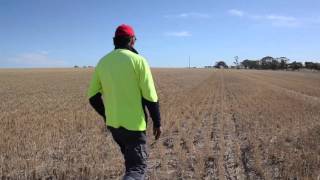
Western Australian grower Shane Hill lost up to 25% of yields to frost in 2012. GRDC invested $13.5M since 1999 on the problem. The 2014 National Frost Initiative tackles it three ways: genetics, management, and environment.
Questions this video answers
Up to 25%.
About 0.8 tonnes per hectare per year.
Total 5,500 ha: 3,500 ha wheat; 1,000 ha canola; 400 ha lupins; 400 ha feed barley.
About $13.5 million.
Introduced in 2014; prongs are genetics, management and environment.
Chapters
Frost has emerged as the biggest risk to yieldering grower Shane Hill's cropping business in the past 10 years, with Frost damage causing wheat yield losses of up to 25% in 2012, Mr. Hill said he calculated that frost was costing his cropping operation about 0.8 tonnes per hectare per year across their long term yield.
Average after a couple of reasonable years probably dropped back to half a tonne or something that we're losing. So it's 25 to 30% of our yield on average. Prior to 2013 we were probably down to about 1.7 tonne for a five year average which should have been closer to 2.4 probably if we didn't have any frost.
Mr. Hill, brother Dean and wives Kerry and Karen farmed 5500 hectares in the WA WH wheat belt, cropping 3500 hectares of wheat, 1000 hectares of canola, 400 hectares of lupins and 400 hectares of feed barley. They have trialled several different management strategies to help mitigate frost risk through research undertaken by the Grains Research and Development Corporation.
It seems that every frost's different and every year is different. There's. I don't think there's any management tool that's 100% effective. Even delaying sowing to miss the flowering frost is probably just as fraught with heat stress and moisture stress, drought stress at the end of the year as missing the flowering frost. The flowering frost is not the one that costs our business heaps of money. It's more a grain filled frost later on. Quite often it's the later sown crops that get hit smashed more with frost than the early sown. This year our worst affected farm is the farm we seeded last 2012. That was the case as well.
Mr. Hill said research into frost mitigation tactics was vital but conceded no silver bullet would address this issue and various measures were needed to reduce risk.
Some of the management tools maybe that we tried, we've probably altered rotations a bit in that it's definitely more barley onto some of the frost prone areas. Variety ranking of frost susceptibility is potentially valuable tool. The stubble management and stuff is definitely interesting and worth investigating more whether there is ongoing issues there.
GRDC has long acknowledged the severe implications of frost on crop production and and since 1999 has invested about $13.5 million in more than 60 frost related projects nationally. In 2014, GRDC introduced the National Frost Initiative, a three pronged approach addressing genetics, management and environment. National Frost Initiative Chair Peter Roberts said growers in wa, particularly were sowing later to try to avoid the impacts of a September frost.
Work being done by CSIRO and other researchers has shown that the season, longer the season, the variety, the potential yield, farmers don't take advantage of that because they're worried about getting hit by frost. So we lose. Every year we lose by sowing later. And so the guys that don't do that, the guys that sow earlier in less frosty risk areas, they're actually able to capture more profit.
Mr. Roberts said gains were already being made through genetics research being carried out by the National Frost Initiative.
Should we be able to define genetic variation in certain cultivars, particularly wheat or barley? Then the next question is, can we exploit that certainly from a variety or a genetic point of view? We're not yet at any stage where we can say that a grower should grow one variety over and above another, and you will be avoiding frost totally. We're not at that stage. The project has allowed us to rank varieties in terms of frost tolerance. These are minuscule differences, but every quarter of a degree is helpful when you're out there. Having a farming system that delivers profit each year is the aim of the game, rather than trying to hit the highs and take out the lows, and it's about trying to manage that risk.