Webinar 2: Ecology, resistance update and management of sowthistle.
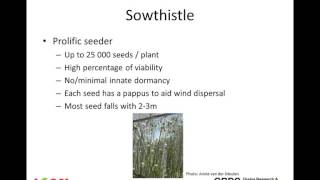
Michael Wittereck and Annie Vondermullen discuss common sowthistle ecology and resistance. Seeds need moisture to germinate and emerge only from the soil surface or top 2 cm. A regional survey found glyphosate resistance in about 20% of samples, with some resistant populations surviving at label rates. Management requires cultivation, crop choice like barley, and preventing seed set.
Chapters
Good morning and welcome to those that are online for this next webinar in our series of what's new in weed control. Today we want to talk about the ecology and management of common sowhistle. And we're going to be joined in a minute by Michael Wittereck from QDAF and Annie Vondermullen, also up there in Toowoomba with Michael. This webinar is being recorded and will go up on the GRDC YouTube site in a couple of weeks time. So you will have an opportunity to go back to it. Or for those that have missed it and haven't been able to dial in this morning, they'll get an opportunity to hear the presentation as well. As I mentioned, what we want to talk about today is ecology and management of South Thistle. Most people probably on the call know Michael Widderich. Michael's been up in Toowoomba Daff for a number of years and leading the weeds extension and research team up there. Annie may not be as familiar to everybody on the call. Annie's joined the DAF team over a year or so ago now and has been doing a lot of work on South Thistle, in particular with regard to resistance management. So we'll hear from both Michael and Andy as we go through this presentation. So at this stage I might pass over to Michael and we can get into the presentation proper and I'll come back later with the questions. Thank you, Michael. Okay, thank you very much for that, Mark. As Mark mentioned, there's two of us giving this presentation this morning, so myself and Annie Vandermeulen. So we're both sitting here in the office in Toowoomba and we're going to do a bit of a tag team presentation. So we'll be passing the handset backwards and forwards to each other. So Annie's going to be talking primarily today about the ecology of Southhistle, so characteristics of the weed that have resulted in it becoming a major weed of zero till systems. She'll also be talking then about some of the resistance testing that she's been doing and then I'll be talking predominantly about the management strategies. So I'll hand it over to Annie and we look forward to giving this presentation and then answering any questions that you may have at the end.
All right, so we're all now looking at that slide on the southhistle germination profile. So this was a study done in growth cabinets with rain simulated using the spray cabinet. So that meant it was applied very precisely and evenly. The temperatures were controlled. The growth cabinets are set at either 30, 20 or 25, 15 and emergence was assessed over time. So from looking at that chart, you can see that at least 30 millimeters of rainfall was really needed in either a single or in consecutive events to result in significant germination. So the message there is that a reasonable level of soil moisture is needed for germination to occur. You'll also see that although there was a preference for the cooler temperature regimen, germination did occur at both temperature regimes. So the take home message there is that provided the soil is moist, seeds will germinate at a wide range of temperatures. So we can go to the next slide now. Okay, so in this slide we're looking at the results of a study where pots were buried in the field and then seed was buried at various depths. So you can see that after eight months, about 30% of the surface sown seed had emerged. And the result was similar for seeds sown at 1cm depth. Less than 5% of the seeds germinated from 2cm depth. And no seeds emerged from depths greater than this. The main point here is that the seed is adapted to emerge from, at or near the soil surface, meaning that the species is favoured by low or minimum tillage systems. Now, for the next two slides, I'm just going to hand back over to Michael. He's going to discuss some research he was involved with on cultivation and seed burial.
Thank you, Annie. So, recognising that sow thistle is a weed that is favoured under zero till systems, we have been looking at introducing cultivation strategically back into the system. So what we've done is we've done four trials over a series of four years investigating single pass and double path applications of different cultivation types. And the idea behind this was really to compare the impact of cultivation versus zero till system on the emergence of common southhistle. So I'll be going through this one trial at a time because we did get different results across the trials. So the first one we're looking at, trial one, you can see the blue bars there. All of them are below the 100%. That 100% represents the emergence that we found in zero till plots. So in trial one, we found a reduction in sowhistinal emergence as a result of all the different tillage types. So, Erica, if we go to the second year now, this is trial two, straight away there you can see that under both the harrow and chisel plough, remembering these are single pass treatments, we had an increase in the emergence of south thistle compared to zero till systems. But still in the offset and one way we had reduced emergence. And I'll go on to explain that once I've got all of the years of data up. So next one, Erica. Okay, so similar to trial two, trial three, we had a very similar result in that the chisel plough treatment, we had an increase in emergence haro, not so much this time, but still had dramatically reduced emergence in the offset disc and the one way disc treatments and the last one, now this one is very similar to trial one. So in trial four, each of the different tillage treatments resulted in a reduction in an emergence of sowhistle compared to Xerotill treatments. Before I go and talk about the second disturbance path in that trial, I'll explain to you what we believe is happening here. So in Xerotil we have most of the sowhistle seed is remaining on the surface or in the surface one centimetre of the soil. As Annie already talked about, that's the emergence zone that favours sowhistle emergence. When you come in and do cultivation of any sort, you get incorporation of the seed deeper into the soil profile. And so in trials one and trial four, where we've had that incorporation to the deeper profiles, we've had reduction in emergence. So it's reflecting again on the graph that Annie talked to previously. Now, trials one and trial four, what happened in those years is, I should go back and say what we did in this trial is we put seed on the soil surface and then we put the cultivation over the top. So in trials one and trial four, what happened is soon after we put the cultivation on, we had quite good rainfall and that continued throughout the season. So in the zero till situation, the viability of the seed was still high when that rainfall occurred. Therefore we got a large amount of emergence for the seed that was buried. It was too deep to emerge, therefore we got a reduction in emergence. In contrast, in trials two and trials three, we had very hot dry conditions after we put the cultivation on. So that meant that seed that was lying on the soil surface in the zero till treatment did not retain its viability, but seed that was buried did. Therefore, when the favourable conditions came, so when we got rainfall, there was not as much viable seed on the soil surface and we got lower emergence in zero till compared to those treatments that buried a portion of seed, but still at a depth where there was able to be emergence once the conditions were favourable. That's why we've had increased emergence under harrow and chisel plough. So using this sort of strategic Cultivation to manipulate the seed bank and therefore to manipulate emergence. The result of that will really depend on the season that follows after the cultivation is put on. If it's a wet season you will get some benefits. If it's a drier season, you will not get the benefits so much. In trial four there you can see that we put on a second pass that was put on I think about three months after the first pass. And the idea behind it was to see if we put on a second pass, does that increase emergence by bringing some of that buried seed back to the source cell surface. We only did that for the very two top treatments there, which was the offset disc followed by the chisel plough and the one way disc followed by the chisel plough. And we did find coming back with the chisel plough after the one way disc did result in a secondary flush of emergence. And that's purely because some of that buried seed had been brought back towards the soil surface where the environment is favourable for emergence. So we might move to the next slide please, Erica. Okay. Something to be aware of in regards to perhaps bringing cultivation back into the system is that when you bury the seed of Southhistle, you also affect the persistence of that seed. The seed of Southhistle is very short lived on the soil surface there. The you can see in the table that when it's buried at a 0 to 2 centimeter depth, the persistence is generally for 8 to 12 months. So that's the period of time that you'll have viable seed present. However, when you bury the seed that increases the dormancy. So we've done this work in pot trials and at 5 to 10 centimeter burial depth, even after two to three years of burial, 10% of that seed is still viable. So in terms of cultivation and its use in the system, you really have to weigh up the pros and cons of that practice. I believe in a zero till system if you're going to have favourable environment and a large flush of emergence, if you're able to control that emergence. So treating seedlings, robust rates of herbicide and so on, you can actually drive down the seed bank quite quickly. So I'll hand it back over to Annie now and she's going to be talking about her. Oh, she's going to first be talking about crop competition and then she'll talk about her resistance testing.
Okay, so here we're looking at the slide entitled Competition. This was a field trial that was conducted at Condamine and it tells a very clear story. This paddock was clean at the time of planting and no residuals or in crop herbicides were used. So immediately you'll notice that barley is a superior competitor to wheat where south thistle is concerned. Row spacing and crop density had no real impact in barley. But where wheat is concerned, the story is quite different. The narrower row spacing was considerably better for suppressing southhistle relative to the wide row spacing. To a lesser extent than row spacing. Crop density also played a role in suppressing sowhistle with higher density of wheat planting suppressing sowhistle more effectively. So the take home message here is if you have paddocks where southhistle is a persistent problem, you might consider planting barley instead of wheat as your winter crop rotation. But if planting wheat, consider narrow row spacing. Okay, so we can go to the next slide now. Now here we're looking at southhistle seed production. So Southhistle is a prolific seed producer and most seeds are viable and ready to germinate immediately following seed shedding. Sowhistle is predominantly self pollinated. In a study that was done of ALS inhibiting herbicide, it was shown that there was very little outcrossing in this species with less than 4% movement of the resistance gene. This means that if resistant plant, this means that resistant plants will almost certainly produce resistant offspring. So again, the take home message, don't let yourselfhistle go to seed. If possible, control early during the rosette stage. So we can flick to the next slide now, which is the update of the resistance testing. While I'm not aware of any benchmarking study, anecdotally, we hear that group B resistance is widespread in this species. The map in this slide shows the results to date for the survey of glyphosate resistance in common southhistle across the northern region. So in this process, for those who aren't aware of it, we requested agronomists and farmers to send in samples from their paddocks. We weren't requesting specifically samples from paddocks where there had been a spray failure. We wanted this to be a non targeted survey. So to give a good picture of the real situation in terms of whether or not glyphosate resistant, you know, is a widespread problem. So as a result of this and our own collections, we've got 148 samples for resistance testing. Now, of the viable samples tested, approximately 20% have shown resistance to glyphosate. So far our screening has identified 19 resistant populations and the levels of resistance are between 20% and 93%. So that's, that's the numbers of survivors to application of glyphosate at field rates based on the label recommendations. And approximately half of the resistant populations identified have greater than 50% survival to glyphosate applied at label rates. Now so far the mechanism of glyphosate resistance in Southhistle is unknown. This isn't a focus of our survey work.
In terms of winter cereals, there are many, many herbicide options here and really this phase of the crop rotation there's no reason why you shouldn't be able to come out of this crop clean in combination with crop competition. As Annie has already mentioned, there are plenty of in crop post emergent herbicide options. So we've got them listed down there under the last point. Bramoxinil however, will only be effective on small weeds. You've got other options there such as precept and velocity and then all your group eyes which do provide effective control of Sowhistle. Also as was previously mentioned, you've got turbine as an option which is now registered for pre emergent control in your winter cereals. So as I mentioned, plenty of herbicide options in your winter cereals. Combine that with crop competition also perhaps starting with a clean seeding bed. So that may include a delayed planting and hitting that first flush of emergence. I don't see any reason why we shouldn't be able to come through our winter cereals quite clean. Next one please. Now in contrast is chickpeas. Now chickpeas are certainly the weakness in the rotation. It's where you can expect there to be blowouts. That's for several reasons. Firstly, poor crop competition. So your chickpea crop isn't going to provide much competition against Sowhistle. There's really no post emergent options for use in Chickpea. And the last one there is a regular rainfall. Now that's referring to balance. So that's a pre emergent herbicide option that can be used in chickpea. But there seems to be quite a bit of variability in the control being achieved by that herbicide and we suspect that that's due to irregular rainfall patterns and the need for that herbicide to be reactivated by rain. The other issue with chickpeas too is you've got your triazine, so your group C herbicides there that really don't provide very long term residual control of your sowhistle. So you might have control there for the first part of the crop but later in the crop those residuals do not persist. So you've got sowhistle coming through towards the end of the crop. So, again, in terms of thinking about this strategically, if you know you're going to have an issue in a paddock with sow thistle, avoid going in with chickpea if you can, because there's limited herbicide options or effective herbicide options in that crop. Next one, please. Okay, now, fallow options. So there's many, many registrations for use in fallows for common sowhistle. An important thing in terms of targeting sowhistle in fallow is to target it when it's at the rosette size. As with many weed species, once the weed starts to get larger in size, a lot of these knockdown treatments reduce in their efficacy. So definitely important to spray when small. So you might question then, if we've got all these options in fallow, why do we see so much sowhistle in fallow? Again, I'm just looking here anecdotally at practices that are common in the northern region. In particular. We all know that flame is being relied on quite heavily for the control of summer grasses. Now, while flame may partially control southeastern, it's really not doing a very good job. I think that's part of the issue. And maybe after that, not coming back and applying a second treatment. So what happens is you then have sowhistle that's present, they're larger in size and then more difficult to control. The other thing to also consider, we've already talked about the different resistances that are present in sowhistle. So Annie's already said that of the samples that have been sent in, 20% of those have been identified as glyphosate resistant. And we do know, even though the testing hasn't been done, that there is group B herbicide resistance out there as well. So as a result of our herbicide application approaches, that's why I believe we do have quite a large problem with sowhistle in our fallows. And also goes back to seed set. If we're not stopping seed set, we're really just perpetuating the problem and allowing it to spread. Next one, please. Okay, now, in regards to other approaches with our knockdowns in fallow, as I mentioned, when your weeds do get bigger, it is harder or more difficult to control them. However, there are some options. Double knock is one that I'd really like to push. We've been doing quite a bit of work on double knock across a lot of our key species, and we're looking at it. Now on common sowhistle, as a result of the resistance that we're finding, a double knock of your group eyes followed by paraquat is quite effective. More effective on smaller weeds, less effective on large weeds, but still on large weeds can provide you with upwards of 95% control. So it's an important tactic to stop seed should you have escapes of your knockdown treatments. But I also wanted to mention here, with the double knock, really try to use it as often as you can. When you do have escapes in the paddock, you really don't know by looking at them whether they're resistant or whether they've been missed in the herbicide application. The only way to guarantee that that particular potential resistance gene is not spreading is to stop seed set. So I would advocate using the double knock as often as you can to stop seed set. The other thing there is avoid your two 4D or MET sulfur on mixtures with glyphosate. And that's because of antagonism, which is commonly known. The other thing to mention here is that there's now recommendations with the products you can see in the table there, and that's registrations through detect sprayers. So you can see those there. And in addition to that, there's a minor use permit. The number for that permit is 1,163 and it's a permit for use of products that are applied with optical spray spray technology. So in addition to those products, you can see the only one really that's additional is spray seed. So that can be used through detect spraying. So again, detect spraying is an option that can be used effectively to apply different modes of actions, higher rates, and can also be used to apply that double knock tactic. The next one, please. Okay, I won't go too much into this slide. We've already talked briefly about turbine and balance and some of the limitations there with balance in particular. What you can see though is a chart or a graph there. Now this is data which is being supplied by the Northern Grower alliance and it's looking at data across two sites and the efficacy of residual herbicides on common Sowhistle. Site one, which is the blue bar, was at Malayali. And I just wanted to mention there that three days after the application of residual herbicides there was 14 mil of rain received, so enough to incorporate that herbicide. The density of plants at that site was quite low. So in the untreated plots it was only 0.4 plants per square meter. The other site was at North Star two days after the application of herbicide they had 35 mil of rain. So again good incorporating rain for these herbicides. And the density of South Thistle at that site was much higher. So in the untreated it was eight plants per square metre. Looking at those charts you can see that we're looking at the percentage reduction of Southhistle compared to the untreated was quite high across those three herbicide treatments. At Malay you're looking there at 83 days after application so you've got quite long term residual control. And at North Star you're looking at 62 days after treatment. The little star that you can see on the turbine extreme red bar is just to show that that is a significantly reduced efficacy in that that site. Also just in regards to the atrazine label, I might just mention here that Southhistle is not specifically mentioned under the fallow claim of the label but it is mentioned under the maize and sorghum parts of the label as having pre emergent efficacy on Southhistle. So we do have fallow residual options there that can be used and can be effective in Southhistle control. Next one please. So we're doing pretty well for time. This is actually our last slide. There are some key things to remember in developing a South thistle best management plan. So Erica, what I'll get you to do is just Click up there's 8 dot points and I might get you just to click them all up there straight away. Okay. So the first thing that you really need to do is be aware of your population of South ISL and what will and won't work. The only way to do this is through resistance testing. Now you might have done testing in the past for species like barnyard grass. So the same premise applies. If you want to make best use of your herbicide options that are available, you need to know what's working. We are still doing testing on glyphosate and Sowhistle. We are also part of a new project that will be looking at other resistances across other species. But within Sowhistle we're also going to be looking at group B resistance and benchmarking that farm hygiene is also important. Common sow thistle is a wind dispersed seed. While most of that falls fairly closely to the parent plant, some of that can go further distances. So keeping those non crop areas free of Southhistle is also important. That includes roads and channels. Point three is aim for 100% elimination of seed set for two to three years. That goes back to the point of the persistence of seed if you're able to stop seed set for that period of time, your seed bank will be dramatically reduced. Now, if you've got a massive seed bank with millions and millions of seeds, a small percentage of that seed bank may persist for longer, and a small percentage of a very, very large number may still be a reasonable amount of seed. But stopping seed production is one of the key components, not only for sowhistle, but for a lot of the weed species, or all of the weed species that we indeed are trying to manage. Point four is maximise crop competition in your winter cereals. So when you can, perhaps if you've got the opportunity to grow barley, do so. And if you're able to grow wheat on narrower row spacings, that's certainly a beneficial approach. Point five is about avoiding chickpea. That's the crop where you're going to have potential blowouts. So if you know you've got sowhistle issues, avoid growing chickpea. Number six, if you're relying on knockdown herbicides, certainly treat small weeds, or alternatively use the weed seeker and apply higher rates and make sure that you're using different modes of actions and not relying just on the same ones or all the time. And as I already mentioned, plan to use your double knock more times than not. If you've got a really, really small density of sow thistle that you haven't been able to control, if there are options to go out and physically remove those plants, so maybe hand pulling them or chipping them out, that's also worth the time and input. Point seven, apply your residuals early in fallow. So that's about getting residual control across the fallow and to complement your knockdown herbicide options there. And as mentioned, flame is effective on a lot of our summer grass species, but not so much on sowhistle. Therefore, you're really going to have to have a partner in there with flame. And the last one there is about cultivation and as was mentioned, it prolongs a seed's life in in the soil. So you really need to weigh up whether or not cultivation may play a role in your system. I know it's been brought in for some other weed species as a bit of a salvage operation. What you need to be aware of there is, even if it's being used in a salvage operation, it's going to impact on your seed bank and then subsequent emergences.
More from Gerri







GRDC National Variety Trials (NVT) Case Study: Helping Oat growers make informed variety decisions



Managing rhizoctonia in wheat and barley: Impact in low and medium rainfall zones 🌾🌾
