Webinar: Maximising the performance of paraquat based herbicides in northern fallow
Transcribed webinar (Mark and Sean Hood, Syngenta) on maximising performance of paraquat/diquat (bipyridyl, Group L) herbicides in northern fallow spraying. Covers available formulations, mode of action (Photosystem I; fast contact activity), use patterns (glyphosate alternative, double-knock, night vs day, moisture-stressed weeds), application factors (rate vs weed size, water volume/quality, droplet spectrum, optical sprayers) and tank-mixing and safety considerations.
Chapters
Welcome to this next series in our advances in weed webinars, Weed management webinars. Today we've been joined by Sean Hood who's the solutions development leader for Syngenta based in Toowoomba. And what we're going to focus on today is maximising the performance of parapot in our northern fallows spraying systems. So welcome to Shaun and thanks for participating in this webinar. The agenda for today, what we want to cover off on are the bipyridal herbicides, so the group L herbicides or the parapot based herbicides. So we're going to have a bit of an introduction to those herbicides. We're going to talk about how paraquot works. We then want to move into different strategies to use paraquat in northern fallows and then we want to talk about maximising the performance of these contact herbicides and we'll talk about things such as rate versus weed size, water volumes and droplet spectrum, day versus night application and tank mixing. And then we want to follow up, finish up with a little bit of a quick cover off on the safe use of parapot herbicides. So that's the agenda, we want to cover through the next 30 minutes and then we'll open up for some questions at the end of the presentation. So looking at the bipyridyl or the group L herbicides, these are the herbicides which are largely based around paraquat or diquat molecules. So we've got a number of different formulations which are available. So the most common formulation is the 250gram per liter paraquat formulation such as Gramoxone or one of the other variants of that formulation. We also have paraquat diquat formulations such as Spray seed and its variations. There's also a straight 200 gram per litre diquat formulation or regloam brand which is predominantly used in the defoliation space. And then there's also a couple of other newer formulations of paraquat mixed with Amitrol at different concentrations there there as alliance or products like Paraglide. And these formulations again are probably going to broaden out the broadleaf spectrum of paraquat and add a different mode of action because the amytols group G group Q herbicide and that will give us an alternative mode of action for resistance management. So with the paraquat formulations, while I've got Sean on the line, I'll ask Sean to talk about the difference in the new Paraquat. New Gramoxane 360 Pro formulation and maybe some comments around spray seed and where he sees the fit for those herbicides. Sean, do you want to take over?
Thanks, Mark. As Mark's already suggested, we've got a new formulation in syngentering, gramoxylene 360Pro, and as the name suggests, it contains quite high loading at 360 grams per litre of paraquat. It is, however, formulated without adjuvant. What this does is it gives agronomists and growers the flexibility to select an adjuvant based on the weeds they're targeting, the water rate and the environmental conditions they've got in the paddock. It is important, though, to remember that to maximise performance, an adjuvant like a non ionic surfactant is still required. But from an efficacy perspective, Gumoxone360 is equivalent to the 250 gram formulations of Caragua. Another advantage of the Gramoxone 360 Pro is that it's currently only available in the 100 and 1000 litre pack size. These containers are safer, I guess, because they have a closed loop system and therefore there's less chance of spill. Having said that, Syngenta is currently working on registration for the 20 litre pack size. As Mark suggested, there is the other formulation in spray seed, which contains both paraquat and diquat. Diquat in the formulation gives the product a little bit more of a strength on the broadleaf weeds and it's particularly good for controlling volunteer bottling. Thanks, Mike.
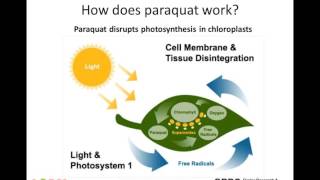
So it's just a very quick introduction. Next thing I think we need to focus on is actually understanding how paraquot works, because that largely drives a lot of the considerations that we need to have as far as application. So paraquat as a herbicide, it's highly soluble and very easily penetrates through the leaf and it does that very rapidly once the spray hits the leaf. The important things are, as I think most people know, is coverage is really important. It's contact herbicide. It grape doesn't move very well within the plant, so we have to cover all of the green material on the plant. So that's a really critical thing to make the herbicide work. Humidity helps get that penetration, so if we're in more humid conditions, we get better penetration into the leaf and quicker penetration before the spray droplet evaporates off the leaf surface. And as Shaun was just alluding to before, a non ionic surfactant is very important for paraquite herbicides. To get maximum leaf coverage and break that surface tension, spread the droplet across the leaf surface to give us that penetration into the leaf. So in most of the common 250 gram per litre paraqut formulations, there's plenty of surfactant in most situations built into the formulation, unless you're going to use very low concentrations and very high water rates. But if you're getting into some of those high load formulations, we just need to, we may need to tank mix the non ionic surfactant in that situation. Once in the leaf, paraquat gets to the chloroplasts where photosynthesis is occurring and it interrupts the Photosystem1 pathway within the plant. That Photosystem1 pathway is what produces the free electrons which drive photosynthesis paraquat. When it gets in there, it binds with those free electrons, creates free radicals and then they react with oxygen to produce superoxides. The superoxides then attack the fatty acids within the cell walls. They cause the cell walls to rupture, they leak water from the cell walls and that all happens very fast and it becomes a self, just keeps going throughout the plant and keeps destroying all of those cell wall structures. What that does, as I mentioned, it causes water leakage out of the cells, but it also very fastly disrupts the flow of moisture throughout the plant. So particularly in conditions of high light intensity, we need light to kick that reaction off. But when we've got high light intensity and we've got warm conditions, we've got plants that are moving a lot of water around, particularly in the xylem. As those cells start to rupture, we see wilting of those plants come through very fast and often within hours of the application of a parap based herbicide. We're starting to see that characteristic wilting coming through as the cell structure is starting to be destroyed. So we're putting it out in cool conditions, in low light conditions, that takes much longer for that symptoms to be observed. So that's really important to understand and that gives us, I guess the flow on from that is as these cells get destroyed, the not being able to translocate the herbicide around the plant. So we call these paraquot based herbicides, contact herbicides. They're not really systemic within the plant generally because they're destroying the pathway that we can move herbicide around the plant, it's getting destroyed very quickly, often within hours of application. So the obvious implication of that is we need very good coverage because we're not going to get the herbicide translocating around throughout the plant. So what we do want to spend a bit of time on, particularly in the second half of this presentation, is talking about how we're going to maximise coverage onto the leaf surface and the importance of water rate and herbicide rate in that situation. Just before we get onto the application side of things, I wanted to spend a little bit of time talking about some of the potential use patterns for Paraquot. And there's a number of different places where people are using Paraquot now, and there's probably a few other places where we could be using Paraquat. I guess in my belief, there's probably three or four key places for the use of paraquat. The first one, as I see, is an alternative knockdown to basically glyphosate in our northern fallows situations. I think most people are aware that we are dealing with some pretty extensive glyphosate resistance now across a number of different weed species in our northern fallows. And we really need to preserve glyphosate utility for as long as we possibly can. And one way to do that is to reduce the amount of glyphosate we're using. And so there's an option there to basically replace some glyphosate with an alternative product. And Paraquot's probably the most commonly considered product to fit into that situation. But as we just sort of alluded to, it's contact herbicide. So we're going to have to target small weeds, we're going to have to use relatively high water rates to make that work. And we also will come to talking about application rate of herbicides as well. But as a general introduction, as weeds get bigger, we need to put out more parapot herbicide to do the job when it's just used as a standalone option. We now have the ability to use some very high rates of parapot via optical spray registrations, such as Weed Seeker or Weed it. And I'll come to that in a couple of slides time where we can spend a little bit of time talking about that. But this is just basically as a replacement for a glyphosate application over summer. It does have some utility in that space. Probably the more common strategy where Paraquote is getting used at the moment in most of our farming systems is more as a double knock application. And I'll split double knocky up here into option one and option two and they're slightly different. So in some situations, what I call strategy one here is we're needing paraquat in conjunction with another herbicide up front, just to be able to give us satisfactory levels of weed control. And this is important for weeds like fleabane, feathertop, rhodes grass, possibly southhistle. In that situation, a single application just isn't giving us good enough control. And we need that double knock. We need that second hit of paraquat to be able to deliver that. The second strategy is slightly different where we're using the double knock technique really to delay resistance development. And in that situation, we're putting out the first treatment, the first hit of the double knock. And we're expecting to get very close to 100% control with that alone. And then we're coming back with the para pot with a different mode of action to control maybe just the one or two weeds per paddock that happen to be resistant to the initial application. So it's again a different strategy to the double knot just to give us efficacy in the first place. So we need to be thinking about those two different options as strategies to delay resistance. We also may use paraquat just to buy some time. So we have the option of putting paraquat out at night. And it tends to the night conditions work very well for paraquat. Day conditions work very well for glyphosate. So in the situation where you need to be spraying 24, seven, you know, that could be a good option to use both of those herbicides in that program. We may want to use paraquat just to burn off weeds before we're introducing another tactic. So if we're trying to cultivate, we're trying to double knock, we're running in time constraints. Paraquot can be a good way to hold everything until we have a chance to get back to it. The fourth situation I've put up here, which is one that we're facing more and more, is becoming more and more of an issue for us. The example I've used here is managing moisture stressed weeds. And barnyard grass is a classic example that we're dealing with at the moment. The example I'm thinking of here is we've got early tillering barnyard grass, probably the ideal growth stage and a lot of it out there at the moment. The ideal growth stage to be sprayed in our fallows. But we're hitting these runs of 35 and 40 degree daytime temperatures. And we're seeing those plants going to some sort of moisture stress because of the high temperatures that are out there, and then overlaying that. We're seeing high levels of glyphosate resistance in some of our populations. So the question to the Growers or the agronomists that are managing that is what do we do in that situation? In the past we've had the ability before glyphosate resistance in the barnyard grass, we've had the ability to basically sit and wait for an extra rainfall event until the temperature comes down. And even if those weeds had moved on from early tillering and started getting late tillering or maybe even into seed head production, the glyphosate was still robust enough to control them. But with the lack of glyphosate, if we've got glyphosate resistance, we just don't have that as an option anymore to leave those weeds go and expect that we can control them with glyphosate. If they're too moisture stressed for glyphosate, they're going to be certainly way too far moisture stressed for any of the group A herbicides. So that option is really removed from us. So what are we going to do in that situation, apart from ploughing the paddocks? I think we've got an option there for paraquat in probably a multiple application type timing to be able to control some of those weeds. Backed up by this trial data, which quickly present here, which was some work done by New South Wales DPI down at Balata a couple of years ago now. So looking at Big 10 to 20 tiller glyphosate resistant barnyard grass in that situation. So the first application of glyphosate hasn't done much upfront application of Paraquot again has only given us 50% control in this situation. So obviously unsatisfactory as we would expect with those weeds. We come along and put the second application of paraquat over the top of it. So the glyphosate followed by the paraquat on big glyphosate resistant weeds, it certainly improved it, as you can see by these first bars, but still hasn't given us acceptable control in the long run. And in this trial the paraquot followed by second application of Paraquot has done a very good job on these larger and particular potentially moisture stress glyphosate resistant barnyard grass. So that's probably best case scenario. But it is something that hopefully we will be able to utilise in some situations and as opposed to just letting those weeds get even bigger and just coming back with a late para pot really isn't an option that we'd want to consider in that situation. So that was a little bit a quick introduction to where we can potentially use paraquite in these situations. Now I want to move a little bit into how we're going to maximize the performance of these paraquat herbicides. Talking about rate for weed size, we'll talk about water volumes, we'll talk about droplet size day versus night and spend a bit of time on tank mixing as well. So as we move into weed size, Shaun, I'm going to flick over and stop talking and leave this to you to talk to the weed size requirements for parapot based herbicides on the various weed spectrums.
Thanks, Mark. We're looking here on this particular slide at the rates for spray seed. You can see as we go from the two leaf to pre tillering stage, the rate is lower around the 1.2 to 1.6 litres per hectare. Obviously as the weeds get larger to the early tillering stage, the rate jumps and that applies to the broadleaf weeds as well. At the smaller weed stage you can go with the lower rates, but certainly as the weeds get higher you have to go for the higher rates. Now the label rates are validated by dose response trials across a whole range of soil types and environmental conditions. And what we're looking at there is it's a robust rate, will give a good solid result. As a general rule though, paraquat is water volume sensitive. In other words, the bigger the weeds, the higher water volumes are going to be required. And Mark's going to talk about that shortly.
Thanks, Shaun. And I guess just backing up Shaun's comment there on application rate, we can go to some very high rates to start controlling some of the big weeds. And particularly it comes uneconomical obviously as a boom spray. But if we've got the option of optical or camera sprayers, so weed, it's weed seeker type things, we can now go up to some larger rates. So I've just put in there the newquat 250 gram per litre nufarm registration of paraquat now is able to be used up to nine litres per hundred litres at 100 litres a hectare, so equivalent to nine litres a hectare of paraquat chasing this range of weeds as I've got listed across there. And then the alliance product also can go up to 10 litres a hectare on the current labels that are out there. So it does give us the option of some registrations to go to some really big weeds obviously in situations where they're only scattered and we can economically justify to do that. There is also still a permit in place for use by the weed Seeker for some other products and in particular relevance here is the spray seed type formulations. Paraquot dipots up to four litres. A hectic there under that permit situation. So we have got those options available to us as well to control larger weeds. Weed size is also important in doublenocks and I just wanted to introduce this slide and talk to this slide a little bit. So this is a summary of a number of trials done in central Queensland looking at Feathertop road grass control when we were developing the permit for use against Feathertop, the group A herbicides, or the verdict in particular against the group A herbicides prior to planting mung beans, which has been in place for a couple of years. What was interesting from this data, when you looked at the control by weed sizes, you can see the data that's up here on the slide is the 150mL of verdict alone targeted against small seedlings. And we're getting useful levels of control in say the 75 to 95% range across the trials. As you're moving into mid tiller, the best jobs are still doing that same low 90% controls, but in the poorer situations the controls dropped off substantially. So much more variability in the results you're getting as we're moving into bigger weeds based on the climatic conditions that they're experiencing. And then when you get into mature weeds, a standalone application of Verdict is given quite poor results. We follow that up with a double knock of paraplot in this situation was 2.4 litres of gramoxone.250. And you can see the small weeds have got, you know, up has even tightened up the data. We're up in the 90 to 100% control, more variability as we're moving into mid tiller and the bottom end is probably unsuccessful as far as a commercially acceptable job. And then as we're getting into larger weeds, we're never getting 100% control and we're getting again increased variability across the weeds that are there. So again, weed size is really important, not just with Parapot but with all herbicides. But this helps to back up that story. So that was the first part of the story was rate water volume. Sean, do you want to talk about water volume?
Thanks, Mark. We've done some recent trial work with agronomists and our local team looking at the effect of water volume, particularly in the hard to control weeds. The bigger the weeds get, the higher water volumes required for the spray seed. And both the Gramoxone label recommendations, water volumes vary from down around the 50 to 100 litre mark for the smaller plants, two to five leaf stage. But as they get up to the grasses at the five to early tillering stage, water volumes up around the 100 litre mark are definitely going to give us a better result. Now, in the broad acre scenario and the summer cropping scenario, 100 litres is where we're probably aiming. In the horticulture environments where we've done some recent work, they'll put on upwards of 300 litres to control a similar spectrum of weeds. But obviously they've got smaller paddocks. But in the Broadacre area, where we've got the larger paddocks, 100 litres will certainly give the result that we expect both with the grasses and broadleaf weeds.
What about while you're on talking water shaun, what about water quality?
Well, I guess the thing that you need to remember about water quality is that paraquat is really tightly bound to the soil and it's quickly deactivated once it hits the soil surface. So it stands to reason that that water quality is obviously important. If you have a high level of organic matter, then you're likely to run into problems. This on the screen there, you're looking at a simple bucket test. If you drop a coin into the bucket of spray water, if you can see the coin in the bottom of the bucket, then the water is generally good to use. If it's filled with organic matter and soil, it's going to be cloudy and you're unlikely to see the the coin, then you're likely to run into problems with paraquat. That is also the case with products like glyphosate. But unlike other herbicides, paraquat is generally not affected by water hardness or the ph, so that's generally not a problem.
Thanks, Sean. One of the issues we come across a lot in the particular in the northern fallow spraying market is night versus day application. And should we be putting out paraquat at night? I guess. You know, Sean and I have been running a series of workshops and talking to a lot of growers and there's certainly a lot of opinions out there as to night versus day application. I think what we can agree on is that the night application, particularly under our northern fallow spraying situations, we're more likely to have conditions where we've got lower humidity at night and potentially better Delta T, which is certainly going to, in most situations, allow us to get better spray deposition onto the leaf than say a 35, 40 degree day time application and potentially better penetration into the leaf. So I think that's a Given, So that's going to certainly work in our favour for a night application. However, on the flip side of that, certainly there's more opportunity for having inversions which won't get the spray to the target at all. And they're obviously a big major concern for us from a drift point of view. So that needs to be balanced into the fact that in a lot of situations the night spraying conditions will be better as far as the actual para cot performance once it's got onto the crop. Obviously, paraquat requires light to kick off that reaction process that I talked about earlier. So when you look at through the literature, there's evidence there to say that if we apply paraquat early evening, we may get some translocation before we get that rapid cell destruction out there. So that can occur in some situations. When we look at it across the trials, often when you try to demonstrate that you struggle to be able to generate any large benefit to that night application, particularly if you're targeting small weeds and particularly if you're using robust rates. So in that situation of targeting small weeds with a robust rate and a good application, it's often very hard to show that a night application actually gives you better results than a day application. But in some situations it can be shown. This is an interesting trial again from New South Wales dpi, which was conducted in March this year, of looking at day versus night application across a range of rates, getting up into the weed seeker type rates of paraquat up to the nine litres a hectare. And as you can see here, while there's not huge differences along there in the day versus night at the lower rates, and we're talking very large barnyard grass and very heavy populations over 10 per square metre. So a really challenging situation. Obviously not what we would normally be targeting for a paraquat application, but in trial work trying to generate and show different responses, that was what was the target in this situation. So the 2 litre rate, yes, you can see there's a small advantage there to night application. Again, similar coming through at the 3 litre rate. As we're getting up into these higher rates, where you're getting high levels of control, the application rate is starting to mask any potential difference between day and night applications. So I guess in my point of view, as I see it, the key take home message is let's get our targeting right and get small weeds with robust rates and therefore the likelihood of day versus night is probably pretty low. But if growers particularly want to spray at night, as long as they're managing Inversions, then there's no real, they're never going to be any worse off by a night application. So tank mixing, I guess that's the other question that comes up is to we want to mix potentially products. What can and can't we mix with parapot based herbicides? So again, if we're targeting small weeds or we're using a double knock application in a lot of situations, there's probably no need to be. Tank mixing products with paraquat doesn't necessarily mean you can't do it. It's just really, you know, what are we actually trying to achieve by the mixture? In some situations where we would be mixing one would be adding residual herbicides, particularly in a double knock to the second paraquat application. Paraquat is very well suited to those. It's basically physically compatible with just about every residual herbicide that we're likely to be using as long as we keep the agitation going. So that's easy to do. I guess the area of concern comes from tank mixing herbicides which require by their mode of action to be systemically moved around the plant. And if the parapot is starting to destroy the cell structure rapidly, then we're potentially not getting these systemic herbicides to translocate to their target site. So that's obviously a key area that we want to focus on avoiding those sort of situations. And I guess the other question that comes up quite a lot is paraquats. Are Photosystem 1 active herbicide or group L? The other herbicide that also targets the photosystem is the Photosystem 2 herbicides. And that's our Group Cs or our triazines, our diorons, our ureas and those type of herbicides. There is some interaction between, if you read the literature, there's some interaction between Photosystem 1 and Photosystem 2 herbicides. And potentially tank mixing group C herbicides with parapods slows down the speed of activity of parapot slightly, which may end up slowing down your speed of brownout slightly and potentially in some situations may give you a slight increase in long term weed control. But again, it's a bit like the day versus night story. In most situations there's relatively minimal advantage to doing that. And if you're using robust rates you're probably not going to see any difference anyway. So the last point we wanted to sort of COVID off on and try to keep on time is the importance of the safe use of paraquat. I noticed the big stewardship area for Syngenta, so Certainly. I'll invite Sean back to talk to the safe use of paraquat.
Yeah, thanks, Mark. You know, there's no doubt that the Paraquat products are dangerous and they're a Schedule VII poison for that reason. Syngenta, as Mark said, does take product stewardship seriously when it comes to the Paraquat product range. And we're continuously educating the agronomists and the growers to help raise operator safety. The active ingredient, paraquat, is actually non volatile and it doesn't have an odour. So manufactures add a stench agent to the formulation and that's what you'll smell if you're not wearing a respirator. The formulation also contains an emetic which will induce vomiting if the product is accidentally swallowed. And there's no doubt that Paraquart is potentially fatal if it's swallowed. The formulation is also corrosive and it's classified as a dangerous good. So eye protection is essential for this reason. And if you wanted to avoid inhaling the spray mist, you should wear a respirator. When mixing the product, the label obviously contains advice regarding the required ppe and growers should follow the instructions to help keep themselves safe.
More from Gerri







GRDC National Variety Trials (NVT) Case Study: Helping Oat growers make informed variety decisions



Managing rhizoctonia in wheat and barley: Impact in low and medium rainfall zones 🌾🌾
