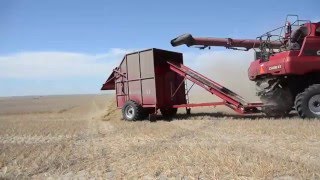
WA grower Dean Levitt and Professor Stephen Powles discuss integrated weed management on Australian grain farms. Levitt's 5,000 ha operation uses sheep grazing, mouldboarding, and seed cleaning to cut weeds, gaining 500-800 kg/ha in wheat yields. Australia spends roughly $1 billion yearly on herbicides, making diverse control methods essential to preserve their effectiveness.
Questions this video answers
About $25/ha yield loss and up to $85/ha spent annually on weed control.
Approximately 5,000 hectares (near Mingenew).
Close to 4,000 lambs annually.
Between 500 kg/ha and 800 kg/ha.
Close to $1 billion a year.
Chapters
Developing integrated weed management strategies, while ensuring herbicides don't lose their efficacy is one of the biggest challenges facing the Australian grain sector. GRDC research compiled by the CSIRO has found WA growers incur yield losses of about $25 per hectare due to weeds and spend up to $85 per hectare annually on weed control. These figures ring true for WA grower Dean Levitt, who crops 5,000 hectares in the wheat belt near Minganew. Our biggest wheat issues are, well, the two Rs, radish and ryegrass to start with. And kerch grass is starting to become another problem. But they're all on country that we've bought in into the enterprise and it's all adjoining this property. So our biggest problem at the moment is just trying to get that weed bank down to start with and then you can tackle it with your things like mouldboarding, your double knocks and chaff carts and all that. Mr. Levitt grows wheat, canola and lupins and he also runs dorper sheep, turning off close to 4,000 lambs a year. The sheep are a key part of Mr. Levitt's non chemical integrated weed management strategy, which also includes using a chaff cart, mouldboarding and seed cleaning before planting. Anything that can reduce your numbers is the first thing that you apply to it. That's why we still run stock. Stock are very good at cleaning up country out of crop. What goes through a sheep's gut is equivalent to a chaff gut being over the place anyhow. So while you can get a return that's non chemical, we grab it. Just started the last three years with mouldboarding. That's where the country's got that dirty and I want to keep it in crop. I've mouldboarded it to get it back to square one, whereby I've not only got rid of my weed seeds, but also me non wetting sands as well. And that strategy has been huge to us. We're in the process of also going to tram lining on that sort of country as well, going back to say a 40 foot tram line set up as well. That's all to keep the lengthening out the time and the effect of the mouldboarding. Mr. Leavitt is now seeing the benefits of mouldboarding efforts with wheat yield increases of between 500kg and 800kg per hectare. RE Director Professor Stephen Powles said with Australian farmers spending close to $1 billion a year on herbicides, ongoing investment into weed management strategies was critical. Farmers know that herbicides are simply the best way to control weeds. And it's almost impossible to imagine modern farming without herbicides. And yet that is the threat we face. And collectively, through the research we're doing and the practice of farmers, we can keep these herbicides working for future harvests and future farmers. And it's quite a challenge, but we can do it. And it's through diversity and it's through integrated farming systems. It's through not relying on the same tool all the time. So when on a good thing, not sticking to it. And if we practice all these integrated, sensible, diverse strategies, we will keep our herbicides working and have more crop with less weeds. And that is the objective.