What farmers should know about the economy in 2015 - Saul Eslake
Saul Eslake's talk surveys the global and Australian economic outlook relevant to farmers. He argues the advanced economies are recovering unevenly from the 2007–09 global financial crisis (US stronger; Europe and Japan weaker), with low inflation and deflation risks shaping prolonged low interest rates and unconventional monetary policy. China is slowing structurally (demographics, wages, services growth), with recent financial-market volatility but a low likelihood of a hard landing. Australia’s resources boom is fading, unemployment has risen, housing and construction are absorbing demand, and the Australian dollar is likely to fall (Eslake forecasts mid-60s USD cents) which will help exporters. Interest rates are at historic lows in Australia but expected to remain until unemployment falls, with gradual rises possibly in the second half of the following year. For agriculture he highlights long-run demand growth from a 3+ billion Asian middle class, land and water constraints in Asia, and large investment needs (~A$600 billion over 25–30 years) plus productivity gains and openness to foreign capital to seize export opportunities.
Chapters
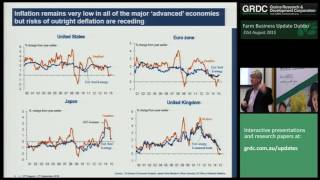
Foreign. For the introduction and good morning everybody. It's very nice for me to be back in rural areas of the country in my post investment banking world that I'm now starting up. For the last three years when I worked for bank of America Merrill lynch, which is one of the world's biggest, biggest investment banks, most of the people I spoke to were sitting in city offices focusing on global financial markets. But sometime before then, when I had 14 years, which I think is more than 10,000 hours with ANZ, I used to do quite a lot of presentations to farm groups or small businesses in rural areas. And one of the things that I was always conscious of in coming to farming groups was how little control farmers have over the things that matter to them, whether it's rainfall or temperatures or prices of products or any of those kind of environmental things that you do. What you do in the face of things over which you have very little control and how well you do, I suppose depends on a very small range of things compared with big businesses in the cities who often have the capacity to set the price of what they sell or to change the market into which they sell. And you don't have any control over most of those things. What I'm going to talk to you about this morning are things over which you have very little control either, but many of which do influence the environment in which you are ultimately going to sell your products. I'm going to talk a little bit about the state of the world economy and financial markets, a little bit about the Australian economy and interest rates and the currency which do matter to you a great deal. And if time permits, and I don't prattle on too much about the first two of those things, I want to talk a little bit about the longer term opportunities for Australian agriculture that I can see and some of the challenges that Australian agriculture faces in meeting those opportunities. And I'm going to try and do that using non technical language. But if I happen to say something that you don't understand doesn't make sense, feel free to interrupt and say what the does that mean? I'm not offended by that. Or hopefully there'll be time for some questions at the end of this session. Again, as long as I don't prattle on too much. So let me begin by talking about the global economy and although there's been a lot of focus on China in the last week, and China is Australia's most important trading partner, so I am going to talk about that in a minute. I want to begin actually by looking at the so called major advanced economies. That's essentially the U.S. europe and Japan, because we're still, in many ways in the world economy. Dealing with the aftermath of the global financial crisis in 2007 through 2009, that was, as the name suggests, a banking and real estate crisis. And it resulted in the most severe recessions that most of the world's big economies have experienced since the Great depression of the 1930s. Most other recessions that the U.S. europe and Japan have experienced have in the past been the result of a period of interest rates being too high. And the solution to recessions caused by interest rates being too high is usually cut interest rates to to a sufficiently low level that people and businesses will then go out and borrow money at lower interest rates and the economy will restart again. But recessions caused by financial crises and real estate busts are different from that history. Going back now, as economists have looked almost 800 years, says that recessions caused by banking crises or real estate crises take a lot longer to recover from. In part, of course, because those crises, banking and real estate busts, are usually caused by people having borrowed too much money beforehand and hence as a result are very reluctant to borrow more money, even at very low interest rates after the bust has happened. And while that's an oversimplification, it does contain a lot of truth about the situation that the major economies in the advanced world have been confronting over the last few years. Now we are starting to see some better news emerging in the us, Europe to some extent, and even in Japan, in the US and the UK in particular, as you can see from the left hand chart, the level of real gdp gross domestic product, the broadest measure of economic activity there is, is now well in excess of where it was on the eve of the crisis before the advanced world fell in a hole. In Europe and Japan, by contrast, they still haven't regained the level of economic activity they had on the eve of the financial crisis. And it's likely to be some time before they do. In the US and the UK where the recovery is further along, as you can see, the unemployment rate is now down to what are by historical standards in those countries, close to full employment. Whereas in Europe, although it has begun to come down, it's still very high. And in some European countries like Greece and Spain, it's well over 20%. In Japan, the unemployment rate looks low, even though economic activity is still only just past its previous peak. But that's partly because Japan has a declining population and for cultural reasons, people who lose their jobs in Japan are less likely to own up to being unemployed when surveys go around asking that. But in these countries at least, we are seeing unemployment fall to very low levels. And that's certainly a sign of progress compared with where we were in the US and the uk. A considerable amount of progress has been made in unwinding some of the imbalances that were the underlying causes of the crisis. In particular, excessively high levels of debt in the household sector and in the business sector. That's less true of Japan and in parts of the euro area where debt hasn't come down as much relative to incomes. But at least in the US and the UK and in the business sector, across the advanced world, the progress that's been made in getting levels of debt down does mean that there's more likelihood that people and businesses will be willing to borrow at low interest rates in order to restart economic activity. But it's taken a long time to get there. The banking systems are now beginning to function more normally in most advanced economies. One of the things that made the recovery from those very severe recessions of the immediate aftermath of the financial crisis so long to take hold was that bank lending was going backwards. That was partly because banks were in no position to lend with all of the bad debts and losses that they'd incurred during the financial crisis, and partly because households and businesses didn't want to borrow. And history shows that, whether you like banks or not, if banks aren't functioning in the way that they're meant to by lending money to viable households and businesses, it's very difficult to have a sustainable recovery in economic activity. And although it was unpopular with many people for governments to put money into banks to recapitalize them after the financial crisis, if governments hadn't done that, then the aftermath of the most recent financial crisis would have been much more like the 1930s than it turned out to be. And at least in the US case, where it was very unpopular for governments to use taxpayers money to bail out banks who were partly responsible for the financial crisis in the first place, the taxpayers have actually made a profit on the investments that they made. And as well as enabling the banking system in America to start returning to something like its more normal function. So again, something to be positive about is that across most of the advanced world, the banking system is again starting to do what banks are meant to do, One of the other consequences of the global financial crisis was that inflation has fallen to very low levels in most advanced economies. And something that has been really scary has been the possibility that the world could fall into outright deflation, that is consistently falling prices, which has been Japan's experience for most of the last 20 years. And while most of us don't like inflation, that is rapidly rising prices and governments and central banks pride themselves on keeping inflation low, deflation is something much more scary altogether. Some of you, as farmers, will have experienced long periods of falls in the prices of the products that you sell. And you know how difficult that is for economies or countries as a whole to experience. That tends to have two very severe consequences. One is that if people believe that prices are going to be lower for almost everything in a year or two's time than they are now, they will put off buying them in the expectation that they will get cheaper. And that just makes it harder to dig yourself out of recession. The second problem is that since it's very hard, although not totally impossible, to have interest rates below zero, if inflation is negative, then even with very low interest rates, real interest rates will be positive. And that makes it harder for low interest rates to work as they're meant to, in promoting an economic recovery. And that's been a big part of Japan's story over the last 20 years. That even though they've had very low interest rates for much longer than America or Europe or Australia for that matter, they found it very difficult to get low interest rates to work in the way that the textbooks say they should because they have had negative inflation in the last year or so. The very substantial decline in crude oil prices from over $100 a barrel to around $42 a barrel has pulled down headline inflation even further. That's probably a one off decline that will work its way through the system. And most central banks and governments focus on so called core inflation exclusive, including food and energy prices, which do fluctuate a lot over time. Even those however, are reasonably low. And no central bank wants to see its economy falling into the same experience as Japan has had. And that's another reason why around the world interest rates have been kept at very low levels. But in the US the Federal Reserve, that's their central bank, is becoming increasingly confident that the the risks of falling into Japanese style deflation are receding. And that's why the US is likely to be the first central bank in the advanced world to move away from zero interest rates. The U.S. and other central banks in the advanced world have since the onset of the financial crisis, been engaged in a whole lot of unorthodox monetary policies that central banks usually don't do. The one you may have heard about is so called printing money or quantitative easing, which despite what some people said at the time, has not led to runaway inflation in the way that printing money literally did in the 1920s in Germany or has done in Latin America on different occasions or in the former Soviet Union in the aftermath of the collapse of communism. Rather, what the so called printing money has done, and they haven't literally been printing banknotes, rather what they've been doing is buying government bonds and other long term securities, mortgage backed securities or corporate bonds has been to try and pull down long term interest rates over which central banks have no control compared with short term interest rates, in an attempt to encourage more borrowing by companies at long term interest rates to promote a recovery in economic activity or in some cases particularly Japan and Europe, to weaken their currencies which had risen very strongly in the lead up to and after the onset of the financial crisis. Because in the US they are now back, as I showed you before, to close to 4 full employment, and because they are now much less worried about falling into Japanese style deflation. The US is sometime between now and the end of the year, possibly next month, if not then before Christmas, likely to start returning interest rates to more normal levels. It will be gradual steps. American interest rates aren't going to shoot up suddenly, but it will be a significant change in the global financial environment. The US central bank hasn't lifted interest rates since 2006. By contrast, I showed you Europe and Japan are in many ways still dealing with the aftermaths of the financial crisis and are a lot further away from being on the road to a sustainable recovery than the US is. They're likely to keep zero interest rates for three, four more years. And what this contrast that's opening up between interest rates in the US and in Japan and Europe is going to do is drive the US dollar higher against currencies such as the euro and the yen and for that matter the Australian dollar. But I'll come back to that in a few moments. Markets are always looking forward, trying to figure out what will happen at some time in the future. So they have been pushing the US dollar up against other currencies for some time, and that is almost certainly likely to continue. That the US dollar will become stronger against other currencies and the euro and the yen will tend to weaken against the US dollar, which will probably help those countries to some extent at a time when the US doesn't need as much support from depreciating its currency as it might have done before. Let me talk about China, because That is the world's second biggest economy. It's Australia's most important trading partner. It sets the prices for many of the commodities that we sell to other countries, besides Japan itself, besides China itself. And it's been a lot in the news lately. China's economy is clearly slowing. There's no argument about that. People do wonder whether the figures published by the Chinese statistical authorities, real GDP and the like, actually represent what's going on in the Chinese economy. The Chinese publish their economic growth figures within about 15 days of the end of each quarter, which does make you wonder how they get those numbers quite so quickly when, for example, Australia's June quarter numbers won't be out until this Wednesday. That's almost three months after the end of the quarter. The Chinese put their figures out after about 15 days. That's one of the reasons why economists spend a lot of time looking at other indicators of the Chinese economy to see whether what's actually happening differs from what the government authorities actually say. One of the things that people watch closely is a survey of purchasing managers, that. That is, people who place orders for things in manufacturing firms and in services businesses. These are known as the PMIs, or purchasing managers indices. And because they come out early each month and are not subject to government control, they're often regarded as a bit more reliable. And some of the turmoil in the Chinese share market of late has been prompted by this decline in the purchasing managers index for manufacturing activity, which you can see there. On the other hand, manufacturing isn't all that the Chinese economy consists of these days. And the services sector, which, as I'll show you in a moment, actually is a bigger proportion of the Chinese economy than the manufacturing one is these days, seems to be holding up fairly well. One of the things that has bothered people in the last few years is whether China's health, housing market will have a hard landing, whether you'll see a big decline in property prices of the sort that you saw in the United States and some European countries that precipitated the financial crisis in 2007 and 2009. Well, house prices have been declining in China over the last year or so, but in the last few months there are signs that that's been leveling out. More recently, a lot of attention has focused on the Chinese share market, which is down almost 50% from its peak in April of this year. What sometimes doesn't get reported is that the Chinese market had risen by more than 100% over the previous 18 months or so. There's no doubt that the Chinese share market was a bubble and it's burst. One of the things that people have focused on in the last two or three weeks in particular is the failure of attempts the Chinese authorities had been making to put a floor under the share market by extraordinary measures that you would never find in a Western country, such as banning companies from raising new capital or forcing brokers to stop taking sell orders, as well as putting very large amounts of the Chinese government's own money into the share market in an attempt, attempt to buy it. They did that last Friday, for example, because they don't want the market to be falling ahead of this week's 70th anniversary of the end of the Second World War. Military parades and that sort of thing. Now in a communist dictatorship, governments do that sort of thing. What the failure of the authorities to stabilize the stock market has done as far as Western observers is concerned is undermine some of the confidence that, that they have perhaps naively shown in the past that the Chinese authorities can manage their economy through government policy measures much more effectively than Western governments have been able to do. When the government owned everything, when everything was a state owned enterprise, maybe that was possible, although the overall results in terms of Chinese people's living standards weren't all that impressive during that era. But it certainly undermined investors confidence in the Chinese government's ability to ensure that growth. Is whatever they have said at the beginning of the year it was going to be, my take on the Chinese economy is that it's slowing. And it's slowing for a combination of structural and demographic reasons more than anything else. As an echo effect of the one child policy that's been pursued since the late 1970s, China's working age population is going to be declining outright over the next 15 to 20 years. And even if, as they're now doing, relaxing the one child policy, it's obviously going to be about 20 years before the impact of that starts to show up in the working age groups. In the meantime, China's experiencing a population profile that looks much more like that of a rich country such as Japan than of a developing country, which in most respects China still is. China is no longer a cheap labor workshop in the way that it has been for most of the last 25 years. Wages have been rising quite rapidly in China now and many manufacturers find that places such as Mexico or Vietnam are cheaper to locate manufacturing activities than the coastal provinces of China. China. And they're also less likely to have their intellectual property stolen, as many Western countries. Western companies have found when they've been working in China, as I mentioned before, the manufacturing sector. Sorry, I didn't mean to jump ahead that far. The manufacturing sector doesn't account for as big a share of the Chinese economy as it. Geez, I really did jump ahead then as it did before. And services sector almost always grows at a slight pace than the manufacturing sector. And China isn't as dependent on exports as it used to be, partly because with its currency having risen and with wages having grown quite rapidly, as I mentioned before, it's not as competitive a location. These are all long term things that will continue to work to slow China's economic growth. China isn't really seeking to devalue its currency as many people had been arguing over the last couple. Couple of weeks. Yes, three weeks ago. Three weeks ago today, the People's bank of China, their central bank, did announce a change in the way they fix the daily trading range for their currency. But that wasn't a big devaluation of their currency compared with how much it has risen over the last two or three years. Rather, I think what the Chinese were attempting to do was to prevent their currency from being dragged up against others in Asia and elsewhere in the world by the peg to the US dollar. You can see here that although the Chinese currency has been fairly steady against the US dollar over the last two years, because the US dollar has been rising against other currencies, the Chinese currency has been dragged upwards against the yen and other Asian currencies through the peg to the dollar, ahead of the likely first increase in U.S. interest rates later this year. The Chinese don't want their currency to continue to be dragged upwards by the US dollar against third currencies. And so they've been seeking to give themselves a bit more wriggle room to prevent that pattern of the last couple of years from continuing. If the Chinese really wanted to boost growth in their economy by devaluing their currency, they would have done it a lot more than the 3 or 4% by which their currency has fallen over the last two or three weeks. They'd have done something like 20 or 25% as the Japanese have done over the last two or three years. And that doesn't seem to be on the offing at all. It's important to remember that China's companies have a lot of US dollar denominated debt and that means that they're unlikely to want to see their currency fall a lot, since that would cause all sorts of financial problems for Chinese companies who have debts borrowed in US dollars if the value of their own currency falls. One last thing to remember about China is that because it's had so much growth over the last 10 years, 6% growth in the Chinese economy of today adds a lot more US dollars to the world economy than 12% growth in the Chinese economy of say 10 years ago did. And putting it a different way, if China's economy continued to grow at 10% per annum for the next 20 years, then because it's so big now, in 20 years time it would account for something like 40% of the world economy. And that doesn't make sense. Even though China has 25% of the world's population, it's just not possible for it to continue growing at those sorts of rates over the next 20 years. So China is in a sense starting to become a more normal economy at which growth rates are closer to the ones that people in Western countries, including Australia have come to expect. So not say that the ride in China is going to be easy. Of course they're going to have ups and downs like they've had. But the likelihood that China will have the sort of hard landing sort of experience that Western countries have had six or seven years ago is I think still relatively small. Let me turn to what's happening in Australia. And in some ways Australia's economy is still doing relatively well compared with the other Western economies that I've been talking about. We didn't have a recession as usually defined during the financial crisis and we still haven't had any quarters of negative GDP growth. So the chart on the left hand side says that over the last 15 years we have done relatively well. But most of the gap between Australia and the other countries I've shown on the left hand chart came from this period here when other countries experience experience deep recessions and we didn't. Since then we've continued to grow at about 2 and a half, 2 and 3 quarters percent. But so have other countries like New Zealand, Canada, the US and the uk and we've had faster population growth. So a different way of looking at Australia's performance compared with others is to note that while our unemployment rate is still lower than many other countries, we're one of the few in the Western world where unemployment has actually been going up rather than down. And Australia today has a higher unemployment rate than New Zealand, the United states or the UK, which hasn't really been true since the early 1990s. One of the things that accounted for Australia's inability to withstand the recessions that other current countries experienced after the financial crisis was of course the resources boom, the huge increase in the demand for Australian resources, commodities, and the investment required to boost our capacity to supply those, which was largely driven by the urbanization and industrialization of China. We were also helped by population growth that was much greater here in Australia than in most other Western countries. Those things are beginning to recede into history now. While resources exports are still rising quite strongly as projects that have been under construction in the last few years come on stream, the rest of the economy is actually really only growing at an average rate of about one and a quarter percent, compared with the close to 3% we'd experienced prior to the onset of the financial crisis. Now, as I said, population growth is slowing as migration falls away. Why is migration falling away? Well, because prospective migrants coming to Australia can see that the unemployment rate has been drifting up and it's therefore less likely that if they come here they'll get a job. Whereas particularly in New Zealand, which is traditionally a major source of migrants to Australia, they've had a much stronger economy. Unemployment has been coming down. Not nearly as many Kiwis coming to Australia as there had been for most of the last 20 years. As I said, we've been through the biggest commodities boom in our history. Not since the Victorian gold rushes had the prices of Australia's exports and the amount of economic activity in the resources sector been as high as they were over the last two or three years. But that's now receding into history. Resources investments declining. The prices of Australia's resource commodity exports have fallen by more than half since 2011. Employment in the mining sector is now beginning to decline. And what we're experiencing is a struggle finding new sources of economic growth to take over the role that the mining sector has been playing for most of the last six or seven years. The Reserve bank always knew that a peak in the mining boom would come. And partly with a view to nurturing alternative sources of economic growth, they have reduced their official cash rate to the lowest it's been since the 1950s. Not as low as the zero rates in the U.S. europe and Japan, but by Australian standards and bearing in mind, we haven't had a financial crisis or a recession. Pretty low interest rates in Australia. Lower interest rates have worked to boost the demand for housing. Borrowing for housing by Australians is at the highest level it has ever been. Much of the increase in borrowing by Australians for the purchase of housing has been by investors as opposed to owner occupiers. They now account for a bigger share of borrowing than people looking to buy homes for themselves do. And since over 90% of investors buy an established dwelling rather than a new one, the main effect of that significant increase in borrowing by investors to buy housing has been to push up prices, particularly in Sydney and Melbourne, much less so in other parts of the country. And although this is often not a popular thing to say, I'm not convinced that certainly simply pushing up the price of existing housing does anyone any good. In the first place, people aren't as willing to borrow against increases in the value of their own houses to fund other spending as they were 15 years ago. And second, particularly in Sydney and Melbourne, rising property prices are making home ownership much more difficult to achieve for today's 20 and 30 year olds than it was when today's 50 and 60 year olds were in their 20s and 30s. Nonetheless, and partly aided by a significant increase in the volume of foreign investment into Australian housing, we are now getting a building boom. And the number of dwellings under construction in Australia and likely to be completed this financial year will be over 200,000 for the first time. One of the things that kept house prices high in Australia has been a shortage of housing relative to the number of people looking to live in them. Again, particularly in Sydney and Melbourne, if we get two or three years of more than 200,000 dwellings being built and completed, we will have made some significant inroads into the amount of housing that there actually is. I said before that people aren't as willing to borrow against increases in the value of their houses as they once were. So that is partly because people don't have the same income growth as they used to. Wages are growing at a very low rate relative to prices, people aren't making the same amount of income from interest as they once did, and people are saving a much higher proportion of their income than they once did, partly in order to rebuild superannuation balances that were severely impacted by the financial crisis, partly because some people simply want to reduce the amount of debt that they they have. Either way, it does mean that consumer spending, which is 60% of the Australian economy, is much weaker than it has been on previous occasions when interest rates have been relatively low, and partly because consumer spending is soft and businesses know that governments are wanting to reduce their budget deficits. Businesses outside of the mining sector have been reluctant to step up their investment, despite the fact that interest rates have been very low. So, as I say, we're struggling to find alternative sources of growth. One of the things that is helping and will provide more assistance to the Australian economy over the next two or three years Is that somewhat belatedly, the Australian dollar is beginning to fall. Now, some of the fall in the Australian dollar is simply a mirror image of the fact that the US Dollar has been going up against other currencies for the reasons that I mentioned before. The US economy doing much better than other advanced economies, it being more likely that the US will raise its own interest rates well in advance of central banks in other economies. And since the US Dollar is itself going to rise further, as I've been saying, for that reason alone, the Australian dollar is likely to fall further, but it will probably be reinforced by further declines in the prices of commodities like iron ore and coal as China's economy slows and as the supply of those commodities continues to increase. And if the US does start lifting its interest rates, then the gap between US interest rates and Australian rates will begin to narrow. There'll be less foreign investment flows coming into Australia to arbitrage that difference. That will also put downward pressure on the value of the Australian dollar. So in my view, the Australian dollar is probably going to fall to some somewhere in the mid-60s, during 2016. And at that level, many more Australian industries, including farmers, will be much more competitive internationally than they were when the currency was $0.80 or higher, as it has been for much of the last seven or eight years. So that's good news. And in some sectors of the economy, such as tourism, we're already seeing the impact of, of a lower exchange rate in providing some kind of stimulus. For a while there, when the currency was close to or even over US$1, Australia was running a deficit on our tourism transactions. Now we're starting to see the tourism trade balance record a surplus as fewer Australians take overseas holidays and more foreigners come to Australia. We could do more to boost tourism, including by reducing the complexity of our visa procedures. But at least the currency is helping to work in that regard, and it will ultimately have a positive impact on other sectors such as higher education and agriculture, as well as providing a bit of a buffer for the mining sector against falling commodity prices. What we are seeing is a pickup in employment growth in some of the more labor intensive sectors of the Australian economy. Dwelling construction is one. Tourism, which is spread over accommodation and food services, arts and recreation, and transport is another. We're also seeing quite a pickup in various categories of household services employment. The reason places that employ many more people than the mining sector did. And that's one reason why, even though overall employment growth is fair, overall economic growth is fairly slow. Employment growth has been picking up and the unemployment Rate seems to have levelled out and because population growth is slowing, that is, there will be fewer people coming into the labour force looking for work. The chances are that we've now seen the peak in the unemployment rate and unemployment will be gradually coming down. I won't say any more about government spending. The point I want to make here about interest rates is that the peak in unemployment is very important for the way that the Reserve bank thinks about interest rates. In the past, going back more than 20 years, since the Reserve bank began announcing changes in its interest rate policy, there's never been a period, other than in the late 1990s of more than about 12 months between when unemployment has peaked and interest rates have started to turn around and be begin to go up. I don't think the Reserve bank is in any hurry to raise interest rates. But if the unemployment rate really is coming down, then there will not be any further reductions in interest rates and the next movement in interest rates will be upwards. In my view, that's going to come sometime around the middle or end of next year when the currency will be in the mid-60s. That will result in higher import prices, but it will also mean that there's less need for interest rates to be at record lows in order to provide support for the economy. So you win some, you lose some, you will get a lower exchange rate, but you won't get any further cuts in interest rates. And at some point, probably in the second half of next year, interest rates will start going up, but only very gradually. And the chances that we'll get interest rates up to where they were before the financial crisis, for example, hit Australia is, I think, very, very small indeed. Let me just say a few things briefly about what I see as the opportunities for Australian agriculture. Many of this you will have heard before, but I think it's interesting to bring it all together in a way that tells a compelling story. Even though China's economy is slowing, given where the average Chinese income is now, and given the growth that's likely to be experienced over the next 10 to 15 years in countries like India, Vietnam, Indonesia and the Philippines, there will be a dramatic increase in the number of middle class consumers in the region immediately to our north over the next 10 to 15 years. Already there are about 800 million. Sorry, not 800 million. There are about 400 million people who can be regarded as Middle Eastern income consumers in China. In Asia as a whole, by the end of the 2000 and twenties, the number of middle class consumers will be over 3 billion. It's a very large proportion of humanity and their spending, which is currently running at around 5 to 8 trillion US dollars per annum, is likely to be in the prices of today in excess of $30 trillion. They don't need to grow at 10% per annum in order to achieve those absolute numbers anymore because the starting point is relatively larger than it was a decade ago. And that in turn is likely to mean, as their incomes rise and their tastes change, significant increases in their consumption of a variety of food products. One way of thinking about that is to look at where Japan and Korea, which are relatively rich Asian countries are today. There's not going to be a lot of growth coming out of either of those two economies. But to say, well, that's where China, Southeast Asia and with a lag India are likely to be heading, that's a good template for thinking about it. So the potential for growth in consumption of a variety of agricultural commodities and processed foods as the number of middle class consumers increases towards 3 and over $3 billion over the next 15 years is enormous. But Asia is going to have very great difficulty meeting that demand from its own resources because of the declining supply of arable land relative to the demand and the increasing difficulties that Asian countries are having securing enough water for agricultural purposes. Climate change is having a very significant impact in some parts of Asia, particular particularly the northern half of China and in some parts of India, as rainfall patterns change dramatically. Australia of course has enormous amounts of arable land relative to the number of people we have to feed in our own country. And although we're always thinking of ourselves as a dry country which in terms of inches of rainfall per hectare, we are in terms of rainfall per number of people that live in this country country, we actually have quite a lot of it. We just don't store and manage it and price it particularly well. But the capacity based on those two things, water supply and arable land to meet some of the demand from Asia is quite significant. Because of the difficulties accessing sufficient land and water, among other things, and the decline in their agricultural workforces, East Asian and South Asian agricultural production EAS is likely to decline over the next 15 to 20 years, which in turn means that in order to meet those requirements associated with growing incomes, Asian imports of food products are likely to rise quite significantly. Some of that's already in train of course, but there's definitely further to run. The free trade agreements that the government has completed this year do open doors for for Australian exporters to take advantage of these opportunities. Now I know that some of the free trade agreements that Australia signed in the past, particularly the ones with the United States and Thailand, haven't really done much for Australian exporters, particularly in the agricultural space. But if you look at the detail of the three that have been signed by the present government, the Japanese and Korean ones are already entered into force. The Chinese one is meant to enter into force once it's passed the Australian Parliament. If it does, there's some opposition to that, as you know, and obviously in China passing Parliament is not an issue do genuinely open up opportunities for Australian agricultural exporters that other countries, with the exception of New Zealand, don't have. And although it may well be the case that the US and Europe eventually reach free trade deals with China at some point in the future, that's at least 10 years away. And in the meantime, the opportunity is there for Australian agricultural producers and service providers to get a leg up over their competitors from other relatively rich countries. New Zealand has shown that this is possible. There's no reason why Australia can't do exactly the same thing. But in order to capitalize on those opportunities, two things have to happen. One, the productivity of Australian agriculture has to improve. Gavin referred to essentially the same thing in his introductory remarks earlier. And in order for productivity to improve, a great deal more capital investment is going to have to be brought into agriculture. Port Jackson partners were hired by Anz. I think Angus Taylor, who's the member for Hume south of here, was associated with the writing of this report. Pulled out some of these figures indicates the likely capital requirement of Australian agriculture over the next 40 years, both to ensure intergenerational transfer of farms and to meet some of the other requirements that will be necessary in order to boost production. Production in order to take advantage of the opportunities that exist and that you can identify some through increases in borrowing, some through internally generated capital, but there's still likely to be a requirement of some 600 billion Australian dollars of increased investment in the agricultural sector over the next 25 or 30 years to meet those opportunities. A lot of that could come from superannuation funds, but inevitably a good deal of it's going to come from foreign investors as well. We have to manage that carefully. But if we're not willing to accept increased levels of foreign investment, then the opportunities that do exist in front of Australian producers will probably be captured by producers from other parts of the world. There's more I could say here, but I'm actually going to flick quite quickly through to the summary of what I'm saying there. The recovery from the global Financial crisis in Western countries has been slow and uneven, but particularly in the United States, it's now more clearly underway. That's going to see the US beginning to raise interest rates before the end of the year, which will see the US dollar rising further against other currencies, including the Australian dollar, meaning that the Australian dollar has further default. China's economy is undoubtedly slowing, but the rate at which it's slowing is exaggerated by the turmoil you've seen reported in China's financial markets. A hard landing for China is I think, a fairly remote possibility. But a gradual slowing as its demography and economic structure change is something that you can see certainly bet on here in Australia. The resources boom is fading away. That's another reason why the Australian currency is going to fall. But we are struggling to identify strong sources of alternative economic growth in Australia. The currency will help a bit. The housing building boom that's now underway will help a bit. It will be helpful if governments were willing to spend more building infrastructure around the country. But for essentially political reasons they're not. A lower currency into the 60s will probably help that. Don't expect the Reserve bank to cut interest rates anymore. Rather probably in the second half of next year. Look for the beginning of a gradual rise in Australian interest rates. And from a longer term perspective there are enormous opportunities for Australian agriculture to be part of the medium to longer term Australian growth opportunities. But. And the free trade agreements will help us get there in major markets. But there's a need for substantial improvements in productivity and that in turn will require significant amounts of new investment for the most to be made of all of those opportunities. I hope I've left a little bit of time for questions even though I've rushed through some of the things I wanted to say. Can I thank you for paying attention to all of those things and if there is time for questions, I do my best to answer.
More from Gerri







GRDC National Variety Trials (NVT) Case Study: Helping Oat growers make informed variety decisions



Managing rhizoctonia in wheat and barley: Impact in low and medium rainfall zones 🌾🌾
